
Gold Prices on the Verge of $4,700: With Tensions in the Strait of Hormuz and Inflation Pressure, the US Dollar Makes a Strong Comeback—Can Gold Bulls Defend the Final Line of Support?

FX168 Finance, April 23—— After the Asian trading session on Thursday, renewed selling pressure appeared in the market, causing gold's attempts to move higher to be repeatedly frustrated. At the same time, the US Dollar Index gained upside momentum for a third consecutive trading day, showing clearly strong characteristics. The core factors driving the strength of the US dollar come from two fronts: first, ongoing signs of friction between the US and Iran in the geopolitical sphere; second, the market's expectations of the Federal Reserve's future rate-cutting pace have been recalibrated due to inflationary pressure. This twin dynamic continues to support the US dollar, while simultaneously exerting significant pressure on gold, a non-interest-bearing asset.
Recently, the international gold market has been under pressure. Spot gold prices (XAU/USD) have hovered near $4,700 per ounce, failing to effectively extend the slight gains from the previous trading day. On Thursday (April 23) during the Asian session, renewed selling pressure repeatedly thwarted moves to the upside in gold. Meanwhile, the US Dollar Index has posted gains for three consecutive trading days, displaying obvious strength. The main forces driving the dollar’s rise are: first, persistent geopolitical friction between the US and Iran; second, recalibrated expectations around the pace of future Fed rate cuts amid inflationary pressures. These two factors together support the dollar and put clear pressure on gold, which does not provide interest income.
Geopolitical Risk Escalates——US-Iran Maritime Standoff and Strait of Hormuz Deadlock
The US Navy's naval blockade measures on Iranian ports have complicated the US-Iran relationship, keeping tensions elevated. Although US President Trump announced on Tuesday a temporary extension of the soon-to-expire ceasefire agreement with Iran, market participants remain broadly skeptical that either side can achieve lasting de-escalation. The core reason lies in the lack of substantive progress in peace negotiations, while the confrontational posture around the Strait of Hormuz continues to escalate.
Trump has made it clear that the US Navy's blockade of Iranian ports will continue; in response, Iran has listed the lifting of the US naval blockade as a strict precondition for resuming negotiations.
More seriously, on Wednesday, the Islamic Revolutionary Guard Corps announced the seizure of two container ships—marking the first such move since clashes with the US and Israel in February this year. This incident has significantly increased the risk of further escalation and keeps geopolitical uncertainty looming over the market.
Against this backdrop, the US dollar's status as a reserve currency is further consolidated, and funds seek the safety of dollar-denominated assets, creating a crowding-out effect on gold.
Inflationary Pressure Transmission——Energy Supply Disruptions Boost Oil Prices, Raising the Fed's Rate Cut Threshold
The Strait of Hormuz is a key global energy transport corridor, and ongoing risks of supply disruption have strongly supported crude oil prices. Higher oil prices have in turn directly pushed global inflation levels significantly upward. This inflationary environment has prompted a reassessment of the monetary policy path among major central banks—with Fed policy shifts particularly in the spotlight.
Although Federal Reserve officials had previously anticipated the possibility of a rate cut by the end of this year, recently persistent inflation data and ongoing resilience in economic activity have lifted the bar for lowering borrowing costs.
The market now expects the Fed will likely be forced to take a wait-and-see approach and temporarily maintain a tightening bias. Speculation about this “more hawkish” turn in Fed policy has become another key factor supporting the US dollar. Since gold itself does not generate interest income, the opportunity cost of holding gold rises when rates stay high or rate cut expectations weaken, causing funds to continue flowing out of the gold market and further exacerbating downside pressure on gold prices.
Technical Pressure——Gold Prices Hover Near Lower Bound of Uptrend Channel, Key Support Level Tested
From a technical perspective, gold is now trading near the lower boundary of a rising parallel channel, and the short-term trend shows an overall neutral-to-weak structure. The Relative Strength Index is hovering around 39, near the lower end of its range, indicating that previous bullish momentum is gradually fading but the market has not yet entered oversold territory.
Meanwhile, the Moving Average Convergence Divergence (MACD) indicator remains in negative territory, further reinforcing this view: Unless there is a substantive improvement in market momentum, any attempt at gains may struggle to sustain.
Specifically, if gold prices clearly break below the lower boundary support of the channel at around $4,691 per ounce, the next key test would be the previous structural bottom near $4,568. Once selling pressure is released more rapidly, it could open up space for a deeper decline.
Conversely, to the upside, bulls need to break through resistance at the upper channel boundary near $4,926 per ounce and hold above this level to restart a broader uptrend and pave the way for a new round of gains.
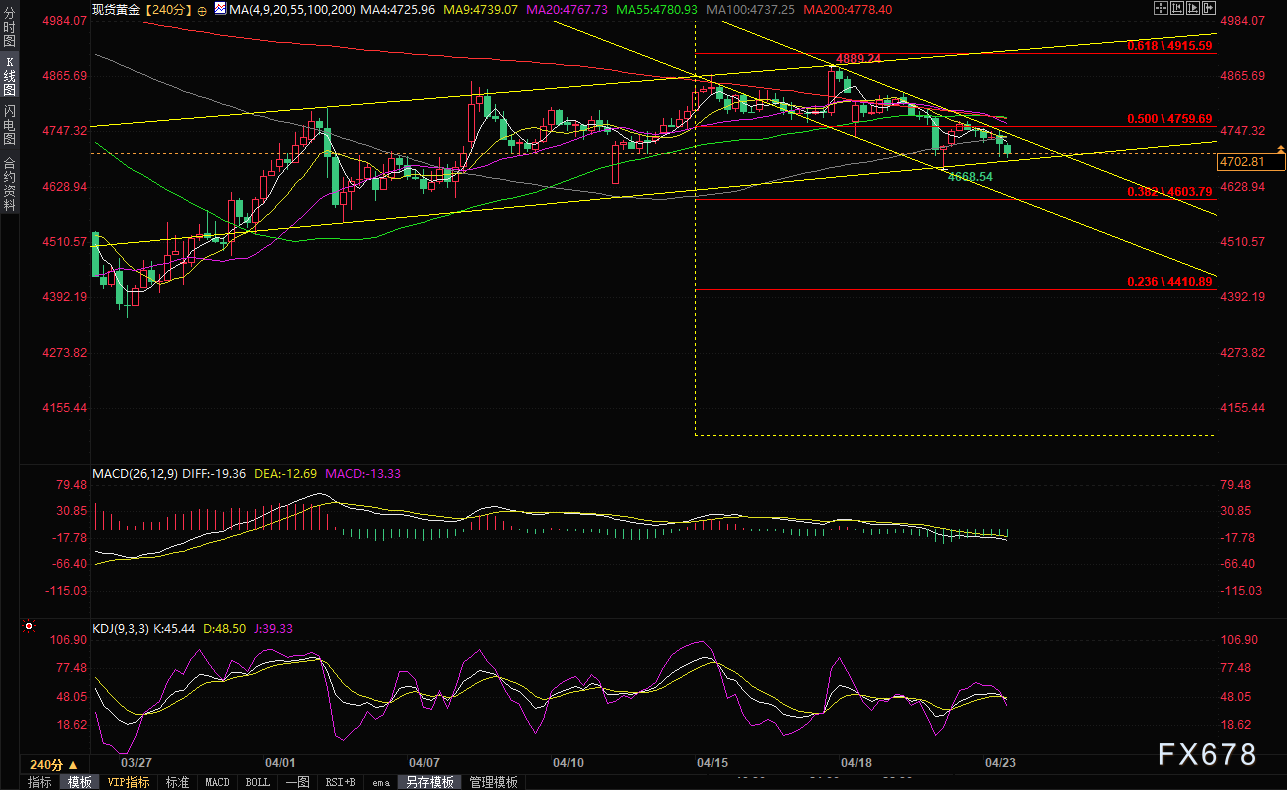
(Spot gold 4-hour chart; source: EasyMarkets)
Critical Juncture in Bull-Bear Battle: Dollar Strength and Geopolitical Risk Shape Gold’s Path
In summary, the gold market currently sits at a critical juncture in the bull-bear battle. On one hand, the geopolitical risk in the Strait of Hormuz and the continued escalation of the US-Iran confrontation should, in theory, trigger safe-haven demand and potentially support gold. On the other hand, this geopolitical backdrop is pushing up energy prices and aggravating global inflation, indirectly strengthening the rationale for the Federal Reserve to maintain its tightening stance—hence boosting the dollar and suppressing gold prices further.
Currently, the dollar enjoys a dual boost from geopolitical risk aversion and monetary policy expectations, while gold—disadvantaged as a non-yielding asset—continues to see capital outflows. Technically, support around the $4,700 mark and the channel support near $4,691 per ounce has become the bulls’ final defensive line. If this area is conclusively breached, gold could begin a new round of declines; conversely, if there is a sudden easing of geopolitical tensions or a clear dovish signal from the Fed, gold could have the opportunity to rebound based on the channel support. Investors are closely watching these developments to determine the next clear trading direction.
Beijing Time 13:42, spot gold is now trading at $4,704.92 per ounce.
Disclaimer: The content of this article solely reflects the author's opinion and does not represent the platform in any capacity. This article is not intended to serve as a reference for making investment decisions.
You may also like
Today's Bullish Patterns & Technical Sentiment | Published on 04/23: CERT, ATAT, WST and More
Oil: Security shock and Hormuz blockade – BNY
UMXM (Manadia) surges 15,350% in 24 hours: Driven by Kraken and Bitget listing announcements
Trending news
MoreCrypto prices
More





