
USD: Seeking a Bottom from a Technical Perspective, No Substitute Has Emerged Yet

Since late March, the US Dollar Index has experienced sharp fluctuations, surging to highs before falling back and then breaking through consolidation ranges. The ebb and flow of geopolitical premiums and fluctuating expectations of Federal Reserve policies have significantly increased market disagreements regarding the short-term direction of the dollar. This article reviews the recent characteristics of the dollar's movement from technical and capital flow perspectives and offers a short-term outlook.
I. Technical Analysis: Key Levels After Losing the Psychological 100 Mark
In early April, the US Dollar Index briefly hit a stage high of 100.64, but then weakened consecutively, closing at 98.10 on April 20, down 0.74% compared to 30 days prior, with a range volatility of 3.08%. The psychological support at the 100 mark has been effectively breached, and the technical structure is undergoing a qualitative change.
Key Technical Levels: 97.63 is the lowest point in the past 30 days; breaking below this opens further downside space toward 96.5-97.0; around 96.8 is a concentrated trading zone repeatedly tested from Q4 2025 to Q1 2026, whose loss would confirm a medium-term top; 100.0 has now shifted from support to resistance, while the rebound high near 99.0 from April 8-13 forms a secondary resistance zone.
Momentum Indicators: Since dropping from the 100.64 peak, DXY has formed a descending channel with lower highs and lower lows. On the daily chart, MACD remains below the zero axis and the histogram stays negative; the RSI also continues to move in a weak zone. The Bollinger Bands are sloping downwards, with DXY nearing the lower band earlier this week, signaling the beginning of a short-term oversold condition, followed by a modest rebound, though the momentum for further decline has yet to be exhausted.
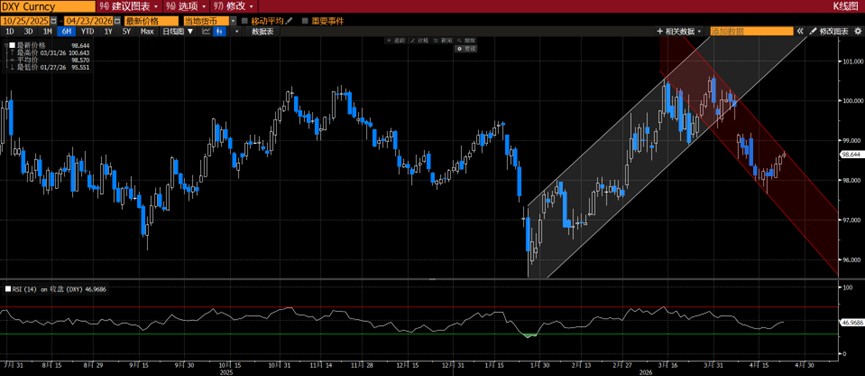
In the next 1-2 weeks, DXY is likely to bottom out in the 97.5-99.0 range. If 97.5 is breached, the medium-term target shifts down to 96.80; if 99.00 is effectively reclaimed, downside risks will temporarily pause. The current technical structure is bearish, and every rebound should be seen as a process of testing resistance.
II. Capital Flows: Money Has Not Fled the US
Although the US dollar has recently been under pressure, the attractiveness of US capital markets has not diminished due to the weakening exchange rate.
On one hand, risk-adjusted returns from the US stock market still lead globally. Even during the USD weakness in the first half of April, the Sharpe ratios of the S&P 500 and Nasdaq 100 remained higher than those of MSCI Europe, MSCI Emerging Markets, and major Asia-Pacific indexes. For globally allocated capital, the "return-first" logic trumps all else—the earning power of USD-denominated assets persists.
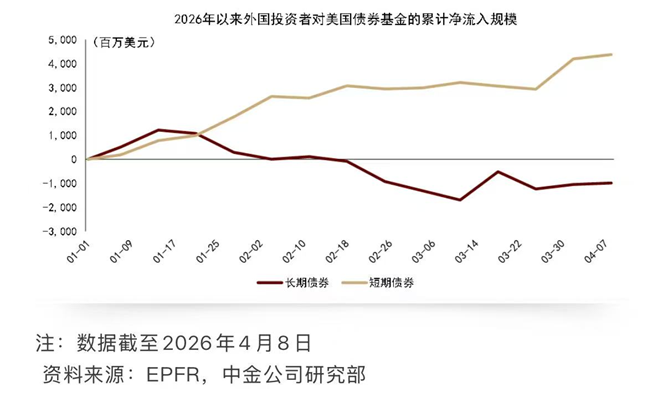
On the other hand, EPFR fund flow data shows that inflows into US equity funds maintained positive growth in Q1 2026, with no sign of a trend reversal. While US stocks saw some corrections in April, the declines were much smaller compared to the fall in the Dollar Index, indicating that capital is not panicking out due to exchange rate weakness but rather digesting short-term volatility and preparing for further deployment. At the same time, after the escalation of the Iran crisis, foreign investors' preference for increasing allocations to short-term US Treasuries has grown even stronger.
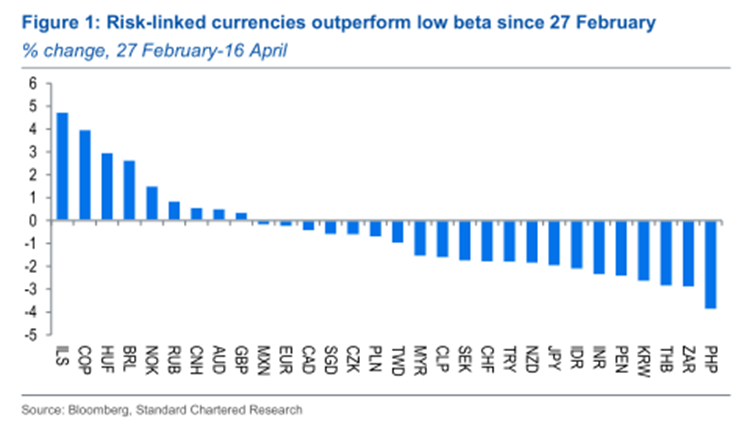
Additionally, during the continued intensification of geopolitical conflicts, the market has observed an interesting phenomenon. As shown in the Standard Chartered statistics below, during this round of conflict and following ceasefire expectations, the best-performing major currencies have all been small-cap currencies (such as the Israeli shekel, the Colombian peso, and the Hungarian forint). The strengthening of these high-yield EM currencies is essentially an extension of "carry trades," not a reshuffling of reserve currency status.
Looking at other economies: the euro's debt crisis shadow has yet to fade, the yen faces persistent deflationary legacy and demographic constraints, and the renminbi is limited in its internationalization process by capital account controls and geopolitical discounts. So-called "de-dollarization" is more about regional attempts at local currency settlement, rather than a systemic reconstruction of the global reserve system.
III. Conclusion
In summary, technicals show that DXY has lost support at the 100 mark, tilting bearish in the short term but with technical support around 97.50. Fundamentally, US equities' resilience and continuous capital inflows provide solid underlying support for the dollar—its challengers are not yet fully formed. In the near term, the dollar is likely to continue its "no better alternative" structural strength, with the 97.5-99.0 range as the key battleground between bulls and bears.
Disclaimer: The content of this article solely reflects the author's opinion and does not represent the platform in any capacity. This article is not intended to serve as a reference for making investment decisions.
You may also like
BAN (Comedian) fluctuates 40.1% in 24 hours: driven mainly by massive buying and technical breakthroughs
What to Expect in the Week Ahead (FOMC Rate Decision and Earnings from AAPL, GOOG, AMZN, META and MSFT)
ENSO (ENSO) fluctuates by 69.3% in 24 hours: Trading volume surges over 100 times, triggering speculative volatility
Trending news
MoreCrypto prices
More





