
One year after Buffett’s retirement: the “Buffett premium” turns into a “discount,” Berkshire has fallen 13%—is the stock undervalued?

Almost a year has passed since Buffett announced his retirement, and Berkshire Hathaway’s stock price has been experiencing one of its most severe periods of underperformance relative to the S&P 500 in its history—the once-coveted “Buffett premium” has now turned into a pronounced discount. However, multiple analysts believe that it is precisely this discount that makes Berkshire a noteworthy investment target at present.
Since Buffett announced his retirement at the annual shareholders meeting on May 2, 2025, Berkshire’s Class A shares have fallen by about 13%, while the S&P 500 has returned approximately 26% over the same period, making for a nearly 40 percentage point gap. Since 2026, Class A shares have dropped another 6% or so to $706,000 (UTC+8), with Class B shares weakening in tandem to around $470 (UTC+8), while the S&P 500 is up about 4% year-to-date (UTC+8).
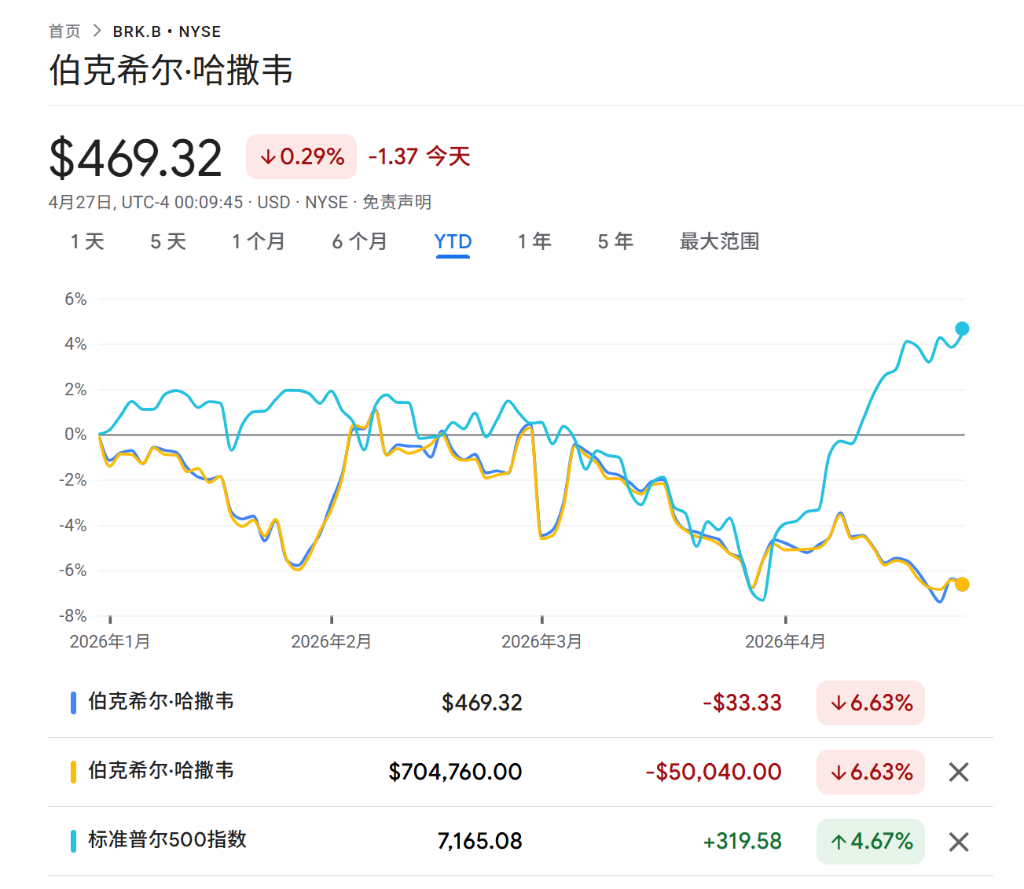
The market’s indifference is particularly evident in valuations: Berkshire’s price-to-book ratio has dropped sharply from a 25-year high of around 1.8x a year ago to under 1.4x today (UTC+8), lower than the average of the past three years. Meanwhile, the company restarted share buybacks this March, nearly two years after the previous repurchase.
Several analysts note that the current stock price has fully, if not excessively, priced in concerns over Greg Abel’s leadership, potentially presenting an opportunity for long-term investors.
The “Buffett Premium” Disappears—How Deep Is the Discount?
Berkshire’s weak share price reflects market worries about multiple factors: the fading of Buffett’s personal aura, cautious sentiment toward Abel, sluggish revenue growth, and doubts about the company’s ability to deploy massive cash reserves effectively.
At the current share price, Berkshire’s price-to-earnings ratio based on expected 2026 earnings is about 23x (UTC+8). But given the substantial amount of low-yield cash and investments held on the balance sheet, the actual P/E, after adjusting for these factors, lands in the high teens—a relatively modest valuation pressure.
Book value has always been an important reference metric for Berkshire’s stock price. According to Barron’s, the company’s Q1 per-share book value was roughly $505,000 (UTC+8), putting the current stock price at less than 1.4x book value (UTC+8).
As for intrinsic value, long-term Berkshire researcher Chris Bloomstran of Semper Augustus Investments offered an estimate earlier this year of $855,000 per share (UTC+8), about 21% above current levels; UBS analyst Brian Meredith’s valuation is $758,000 (UTC+8), about 7% higher. Meredith rates the stock a Buy, with a target price of $871,000 (UTC+8), nearly 25% upside from current levels.
Strong Fundamentals—Cash and Earnings Provide a Safety Cushion
Despite share price headwinds, Berkshire’s fundamentals still provide a significant safety margin.
The company’s businesses generate around $50 billion (UTC+8) in annual earnings, and its balance sheet holds about $373 billion (UTC+8) in cash available for new investments. This year’s share repurchase program could total up to $50 billion (UTC+8). According to proxy statement data cited by Barron’s, the company bought more than $200 million (UTC+8) in stock the day buybacks resumed on March 4. As the share price declined a further 3% (UTC+8), repurchase activity may have continued or even intensified. The company will release its Q1 earnings and 10-Q report on May 2 during the annual shareholders meeting, with specific buyback details disclosed then.
Christopher Davis, investor at Hudson Value Partners, describes Berkshire as the “ultimate HALO stock” (heavy-asset, low-failure-risk type). He notes that the durability and inflation-fighting nature of the insurance business, along with the hard-to-replicate group of industrial operations, make Berkshire especially attractive amid concerns over AI-induced market disruptions. He likens the current stock price to a “coiled spring.”
Berkshire’s core assets include Burlington Northern Santa Fe Railway (BNSF), one of North America’s largest railroads; Berkshire Hathaway Energy, one of America’s largest electric utilities; as well as Lubrizol (chemicals), Precision Castparts (aerospace components), and several other industrial businesses.
The Operational and Deployment Challenges Facing Abel
Abel, Buffett’s successor, is not without his skeptics.
CFRA analyst Cathy Seifert points out that Berkshire’s operating income was nearly flat last year (UTC+8). She says she hopes Abel will take a proactive approach to existing issues and offer a clear roadmap for improving profits and revenues. UBS’s Meredith also observes that BNSF and Berkshire Hathaway Energy lag industry peers in key profitability metrics, with room for improvement.
On the capital deployment front, Abel needs to communicate how he will use the company’s massive cash reserves. Most of the cash can be used for investments, but a portion must be set aside to support the vast property-casualty insurance business.
In terms of portfolio management, Abel will directly manage the vast majority of the approximately $300 billion (UTC+8) equity portfolio, while long-term investment manager Ted Weschler is only authorized for about 6%—slightly above the 5% (UTC+8) allowed during Buffett’s tenure. Buffett had previously planned for Weschler and Todd Combs to jointly manage the entire portfolio; however, Combs left the company in December last year to join JPMorgan Chase for an investment role.
Analysts note that Abel has no formal portfolio management experience and has focused mainly on operations, making it necessary to bring in more investment talent and give Weschler expanded authority.
Corporate Governance Needs to Improve—Potential New Blood on the Board
On the governance front, two of Buffett’s children sit on Berkshire’s 13-member board, which has traditionally been compliant with Buffett. Its independence will need to be strengthened after his departure as CEO.
Some analysts believe that Apple CEO Tim Cook, who will step down as CEO in September but remain chairman, could be an ideal candidate to join Berkshire’s board—he is highly regarded by Buffett and would bring influence and technology insight to a company that is not a leader in tech applications. Berkshire currently holds about $60 billion (UTC+8) in Apple stock, and analysts believe this potential conflict of interest can be managed appropriately.
Overall, many analysts believe Berkshire’s current fundamentals are stronger than what the stock price suggests. Chris Bloomstran projects that, driven by book value growth, Berkshire could deliver around 10% (UTC+8) annualized returns over the next decade. For long-term investors, even with the legendary investor stepping off stage, the case for backing Berkshire may still hold.
Disclaimer: The content of this article solely reflects the author's opinion and does not represent the platform in any capacity. This article is not intended to serve as a reference for making investment decisions.
You may also like
INR: Weakest Asian currency under oil strain – Commerzbank
Robinhood (HOOD) Q1 2026 Earnings Preview: Trading Revenue Resilience vs. Crypto Drag
USD/CAD tests fresh six-week lows sub-1.3630 amid wide US Dollar weakness
Trending news
MoreCrypto prices
More





