
The "AI spending war" remains fierce! The four major giants’ expenditures approach $725 billion, providing new fuel for the AI computing power chain bull market

According to Tongjing Finance APP, among the seven Magnificent Tech Giants in the US stock market (the Magnificent 7), except for Nvidia, the other six have already released their Q1 financial reports and future outlooks. These largest tech companies making the biggest investments in artificial intelligence worldwide issued new signals on Thursday, indicating they are far from stopping the upward momentum of investing in AI computing power infrastructure as they seek to seize an unprecedented "AI moment."
Microsoft (MSFT.US), Amazon (AMZN.US), Meta Platforms (META.US, parent company of Facebook), and Alphabet (GOOGL, parent company of Google) all released their quarterly results and outlooks on Thursday morning, Beijing time (UTC+8). Before these releases, Wall Street analysts unanimously agreed that the most important figure in the earnings reports of these four cloud computing giants would be their anticipated AI capital expenditures. The financial reports released by these four tech giants at the same time sent a unified message: the AI spending war is far from over, with their total capital expenditures for 2026 set to approach $725 billion. These tech giants are willing to endure pressure on cash flow and profit margins rather than fall behind in the race for computing power armament.
Overall, these tech giants aim to convince more investors that their massive investments in AI are about to yield record returns. Therefore, for the global stock bull market driven by the AI computing power industry chain and the AI bull market narrative, their increasingly robust AI capital expenditures are a real positive factor.
Entering this quarter, higher-end estimates showed that the group’s AI spending for this year was about $670 billion. As of Wednesday evening after the earnings releases, this number is approaching $725 billion.
There is no sign of a slowdown in AI capital expenditures; instead, they continue to be revised upward strongly. Meta raised its 2026 CapEx guidance to between $125 billion and $145 billion; Alphabet increased its 2026 CapEx to $180 billion–$190 billion and stated that it would see a "significant" increase in 2027; Microsoft gave an ambitious AI CapEx infrastructure plan for calendar year 2026 of about $190 billion, with roughly $25 billion related to component price increases; Amazon maintained its previous nearly $200 billion capital expenditure plan. Summing up these figures, not counting Tesla’s newly announced multibillion-dollar CapEx plan, the four tech giants’ capital expenditures for 2026 are indeed close to $725 billion.
The Four Giants Send the Same Signal in Earnings: The "AI Spending War" Is Far from Over
Meta was the first to announce its 2026 plan, raising its capital expenditure expectations to between $125 billion and $145 billion, with both ends of the range up by $10 billion. Meta stated in its report that the raised forecast is due to "projected higher prices this year for key components related to AI computing power infrastructure—such as HBM and eSSD memory chips—and, to a lesser degree, increased data centerconstruction costs to support annual capacity for the coming years." Meta's share price fell about 6% after the report was released.
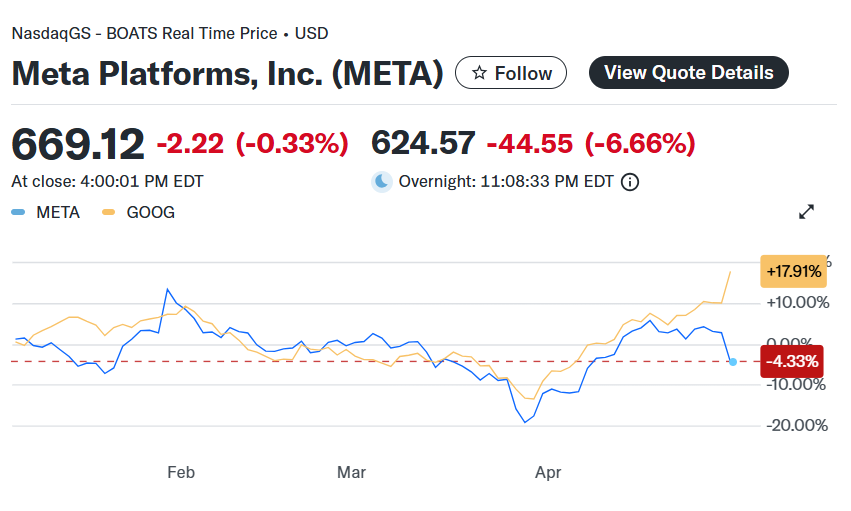
Alphabet’s management told investors during the earnings call that the company currently expects full-year capital expenditures to be between $180 billion and $190 billion, with both limits coming in $5 billion higher. Looking ahead to 2027, the company advised investors that CapEx is expected to "increase significantly." Following the report, Alphabet’s stock price rose 7%, as the report showed Google Cloud’s cloud computing revenue grew much more than expected.
During its earnings call on Wednesday evening US Eastern time, Microsoft told investors it expects capital expenditures for calendar year 2026 to reach $190 billion (UTC+8), which includes a $25 billion impact from rising component prices—similar to Meta’s estimate. The company said: “Given the stronger signal for AI compute resource demand and the increasing usage of AI-related products, as well as the efficiency gains we’re driving across the platform, we remain confident in the returns on these investments.” As of January, Microsoft’s annualized AI capital spending approached $150 billion.
Amazon had stated in January that its 2026 capital expenditures were expected to be nearly $200 billion, and the company told investors during its Q1 earnings call that its capital spending plans "remain largely unchanged."
A large portion of these investments is being used to procure high-performance chips from AI computing power industry leaders such as Nvidia (NVDA.US). Combined with Nvidia’s quarterly report released in late February and recent signals from chip manufacturing giants such as TSMC (TSMC.US), there is almost no sign that any of these hyperscale cloud providers will scale back investments this quarter.
Additionally, tight supply of high-performance CPUs, DRAM/NAND memory chips, and other low-power chips focused on data centers has made some of the older technology names—such as SanDisk (SNDK.US), Western Digital (WDC.US), and Intel (INTC.US)—leaders in the latest round of the stock market rally. HDD giant Seagate (STX.US) saw its share price soar as much as 11% after reporting quarterly results on Wednesday, the latest evidence of the growing frenzy around the AI bull market narrative.
However, in the past week, there have been reports that at least two of these companies—Meta and Microsoft—are seeking to streamline their teams. These investments do not come without cost; after generating large amounts of free cash flow for years, large tech companies are now increasingly tapping debt markets to finance these investments.
In recent months, the contours of the AI deal theme seem to be shifting rapidly. The market’s enthusiasm for software stocks has been washed out, and investor excitement about new AI models from startups like OpenAI and Anthropic seems to rise and fall quickly.
Yet, for the largest tech giants in the world operating at massive scale, all the signals continue to point to AI as a current opportunity presenting only one major risk—underinvestment.
Although Giants' Earnings Vary, Unprecedented CapEx Boom Continues to Power the AI Bull Market
The latest reports from the four cloud giants send a common signal: even if a single company's stock diverges due to ROI, profit margin, or free cash flow pressures, the total volume of AI capital expenditure is not cooling off, but continues to be revised higher.
For example, Microsoft’s earnings are strong, but not without blemishes for an "AI celebration event"—investors acknowledge the increasingly strong demand for AI-related compute resources, but are beginning to ask management to prove that large AI CapEx (AI capital expenditures) can continue to be converted into robust cloud and software business revenue, overall profit margins, and strong cash flow growth. Yet, the Microsoft report indeed confirms explosive expansion in AI computing power demand ($190 billion toward data center expansion and construction), Azure maintaining close to 40% high growth, and the enterprise software base remaining robust, all of which favor continued intensive order support across the AI GPU/AI ASIC, data center CPU, HBM and other AI computing power supply chains.
For the AI computing power chain, this is almost an “order visibility” boost: GPU/ASIC, HBM/DRAM/NAND, HDD, PCB/CCL/MLCC, optical modules, switches, copper cable, data center power equipment, liquid cooling, data center engineering and power infrastructure will all benefit. Especially, the current bottleneck has spread from just GPUs to memory, storage, PCB, networks, and electricity. The giants’ continued CapEx commitments mean upstream hardware suppliers maintain strong pricing power, utilization, and order visibility. Alphabet cloud revenue grew 63% YoY with cloud backlog orders nearing $462 billion, Microsoft Azure grew nearly 40%, and the AI business’s annualized revenue run rate surpassed $37 billion—these data points show that AI investment is not just a narrative but is already materializing in related cloud revenue, enterprise AI demand, and computing power consumption.
Undoubtedly, the AI CapEx boom continues to be the main engine of the bull market, but the market will increasingly scrutinize “who can turn investment into actual revenue, profits, and even cash flow.” Alphabet rose on strong cloud growth and AI demand visibility; Meta fell due to CapEx increases and uncertain return on investment periods, showing the market does not mindlessly reward heavy spending but is screening for winners with clearer ROI. The conclusion: regardless of individual company earnings, the four cloud giants’ shared stance of “more, not less” investment provides strong support for the AI computing power supply chain and the AI bull market narrative driving the current global stock bull market.
Disclaimer: The content of this article solely reflects the author's opinion and does not represent the platform in any capacity. This article is not intended to serve as a reference for making investment decisions.
You may also like
Pound Sterling flat lines vs USD as traders await BoE policy update and US PCE Price Index
Gold recovers from monthly low as USD consolidates post-Fed gains amid US-Iran tensions
Trending news
MoreCrypto prices
More





