
Nvidia rises 1.75% with $28.977 billion in trading volume; AI chip sector sees broad gains on Friday; Memory chip boom continues

Nvidia Performance
According to XingtaiTong APP, Nvidia (NVDA.US) closed up 1.75% on Friday with a single-day trading volume of $28.977 billion, continuing to demonstrate the steady performance of the AI leading stock. Although the increase was relatively moderate, the high trading volume reflects the market's strong confidence in its long-term dominant position.
Nvidia, as the world's absolute leader in AI chips, continues to attract capital in the current tech stock rebound, and its stock price performance is closely related to the entire AI ecosystem.
AI Chip Boom
On Friday, the overall US stock AI chip sector saw broad gains, becoming a key driver for the index's 1.7% surge. Nvidia’s moderate rise complemented the strong performance of stocks like Qualcomm, jointly boosting confidence in the semiconductor sector. With the acceleration of AI server and data center construction, the market’s demand for high-end AI chips remains strong.
Nvidia’s high trading volume shows that institutional investors are actively moving between profit-taking and additional positioning, with evident sector rotation characteristics.
| Nvidia | +1.75% | $28.977 billion | Core AI chip |
| SanDisk | +16.60% | $30.215 billion | Memory chip |
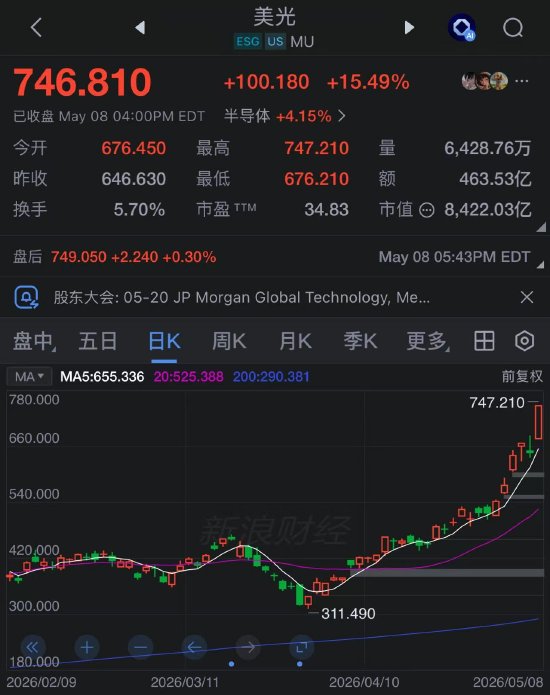
| Micron Technology | +15.49% | $46.275 billion | Memory chip |
Storage Linkage
The boom in AI chips has produced a significant linkage effect with the memory chip sector. Since the end of April, Micron Technology and SanDisk have both accumulated gains of over 40%. DRAM and NAND spot prices have risen by about 25% and 18% respectively, providing strong support for high-bandwidth memory supply for AI servers. The strong demand for Nvidia and other AI training and inference chips is indirectly driving the prosperity of the entire memory industry chain.
The continuous rise in memory chip prices has alleviated some supply chain bottlenecks, while also enhancing the overall economics of AI infrastructure construction.
Market Background
In the current market environment, robust non-farm payroll data combined with strong enthusiasm for AI-themed trading have driven the Nasdaq to another record high. Although Middle East peace talks are suppressing oil prices, they have not significantly diminished the risk appetite for tech stocks. The weakening dollar further benefits dollar-denominated technology assets.
Analysts believe that elevated AI capital spending remains the core logic supporting the semiconductor sector, and as the industry chain leader, Nvidia's performance is a key barometer for sector confidence.
Investment Trends
The dual drivers of AI chips and memory chips are becoming a new main line for the semiconductor industry. Investors can focus on Nvidia's long-term monopoly advantage in the field of AI computing power, and at the same time, seize sector rotation opportunities in conjunction with memory price trends. In the short term, be aware of valuation concentration risk and macroeconomic data fluctuations. It is recommended to use professional tools for chart pattern analysis and risk control.
Editor's Summary
Nvidia saw a moderate rise on Friday accompanied by massive trading volume. The overall strength of the AI chip sector, together with rising memory chip prices, is forming a virtuous cycle, jointly supporting the high prosperity of the semiconductor industry. The current market is driven by AI demand, with prominent structural opportunities, but market breadth and valuation levels still need continuous observation.
Core Event Background: In May 2026, the US AI chip sector continued to perform strongly under Nvidia's lead, while memory chip prices surged sharply due to tight supply and demand. Nvidia’s high trading volume reflects institutions’ enthusiasm for positioning in the long-term AI trend, resonating with the breakout in the memory sector along the industry chain.
Frequently Asked Questions
Q: What does it indicate that Nvidia only rose 1.75% on Friday but had a trading volume of $28.977 billion?
A: High trading volume indicates extremely high market participation, with both profit-taking pressure and new funds entering positions. As a core AI stock, Nvidia's trading activity often leads the sector, making it an important indicator for monitoring fund risk appetite.
Q: What is the linkage between the AI chip sector and the memory chip sector?
A: The massive demand for high-bandwidth memory (HBM) in AI servers directly drives up DRAM and NAND prices. The recovery in memory prices improves supply chain stability, which in turn supports the shipment and performance expectations of AI chip manufacturers like Nvidia, forming a virtuous cycle.
Q: Has the current AI chip investment logic changed?
A: The core logic remains high capital expenditure and explosive demand for computing power. Nvidia maintains its leading position through technological barriers, but tightening supply and rising prices in the memory segment represent a new variable, enhancing the investment appeal of the entire AI infrastructure.
Q: Can the rise in memory chip prices continue for the long term?
A: In the short term, driven by surging AI demand, lagging capital expenditures, and geopolitical logistics, the trend of DRAM up 25% and NAND up 18% is expected to continue. However, if the Middle East situation eases or manufacturers accelerate capacity expansion, prices may face corrections, so tracking quarterly supply and demand data is needed.
Q: How can investors capture opportunities in the AI chip and memory sectors?
A: It is recommended to focus on Nvidia and other AI leaders while also following beneficiary stocks like Micron Technology and SanDisk. Use Gold XingtaiTong APP for technical chart analysis, diversify positions, pay attention to policies, Middle East developments, and corporate capital spending trends to balance growth potential and volatility risk.
Disclaimer: The content of this article solely reflects the author's opinion and does not represent the platform in any capacity. This article is not intended to serve as a reference for making investment decisions.
You may also like
Citibank: If US-Iran negotiations continue to stall, oil prices may rise further
Fed Governor Waller Promotes Centralization of the Fed's Supportive Functions
Trending news
MoreCrypto prices
More





