
Black Friday! Global stocks and bonds plunge: Korean stocks plummet 6%, US Treasury yields soar—what is the market afraid of this time?

Global financial markets experienced a rare "double whammy" of stocks and bonds on Friday, as panic swiftly spread from the bond market to equities.
Long-term government bond yields in the US, Japan, Germany, and the UK all surged sharply, reaching multi-year or even historical highs. At the same time, US equity index futures fell across the board, with the Nasdaq 100 Index declining by 1.5%, while Asia-Pacific and European stock markets also came under pressure, with the Korean index plunging 6%.
The core logic behind this sell-off is both clear and severe: Middle East tensions are pushing up energy prices, inflationary pressures are resurging, and expectations for central bank rate cuts are systematically collapsing. According to Xinhua News Agency citing the Tehran Times on the 15th, the US has rejected Iran’s 14-point written proposal to end the war.
Meanwhile, signals from both stocks and bonds are converging—equity indices remain elevated, but gains are highly concentrated in a few artificial intelligence leaders; meanwhile, the bond market has already priced in higher rates and higher inflation. As oil prices breach $100 per barrel and long-term interest rates keep rising, the market’s concern grows ever deeper: The current rally, relying on liquidity and leverage, is far more fragile beneath the surface than it appears.
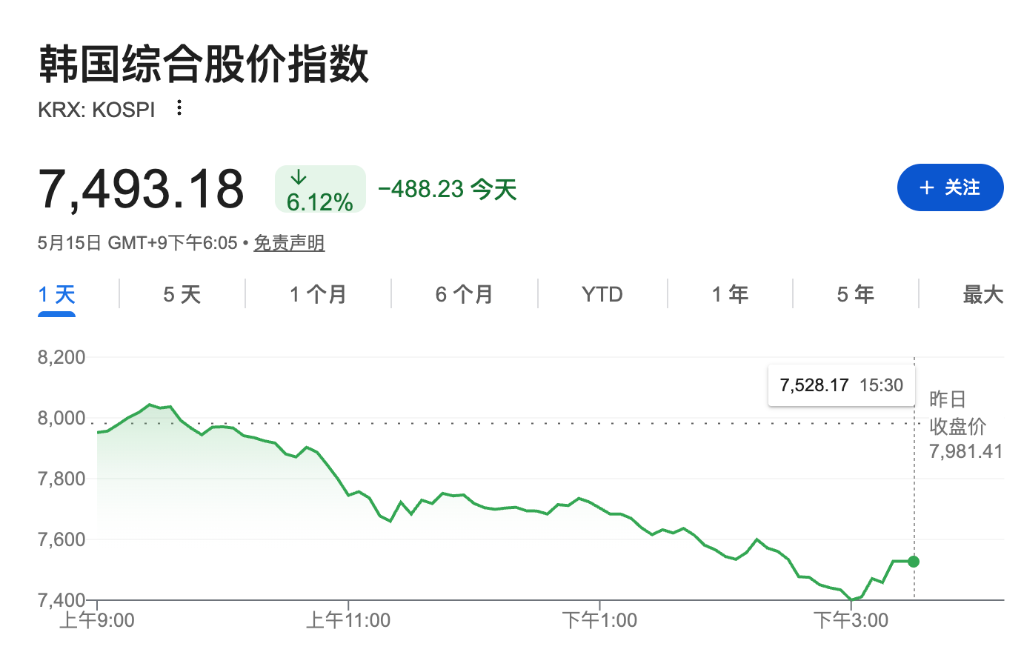
From the trading perspective, on Friday the US 30-year Treasury yield firmly topped 5% (UTC+8); the 10-year US Treasury yield rose to 4.53% (UTC+8), the highest since May 2025; Japan's 30-year government bond yield breached 4% (UTC+8) for the first time since issuance in 1999. Korea's KOSPI index hit a record high of 8,000 intraday but then reversed sharply to close down 6%. This indicates that in a crowded trade and high-leverage environment, sentiment reversals can be far faster than expected.
Korean Stocks Plummet After Record High, AI Bull Market’s Fragility Emerges
The world’s strongest performing stock market was the first to slam the brakes on Friday.
Korea’s Kospi Index touched 8,000 points (UTC+8) in early trading before quickly diving, closing the session down 6%. Samsung Electronics plunged 8.6%, and SK Hynix fell 7.7%. These two chip giants alone contributed two-thirds of the Kospi’s nearly 90% gain this year.
Samsung Securities derivatives analyst Jun Gyun said: “The market is showing signs of fatigue, and caution is spreading.This pullback seems to be due to the rally’s excessive speed, rather than signs of deteriorating earnings or a bubble bursting. It is still too early to draw conclusions.”
The sharp volatility in Korea’s stock market mirrors the broader global environment: when gains are excessively concentrated in a few AI beneficiaries, profit-taking can spark severe index adjustments in a very short time.
US Treasury Yields Soar: Inflation Now Dominates Pricing, Rate Cut Window “Effectively Closed”
The pricing logic in the US Treasury market is undergoing a fundamental shift.
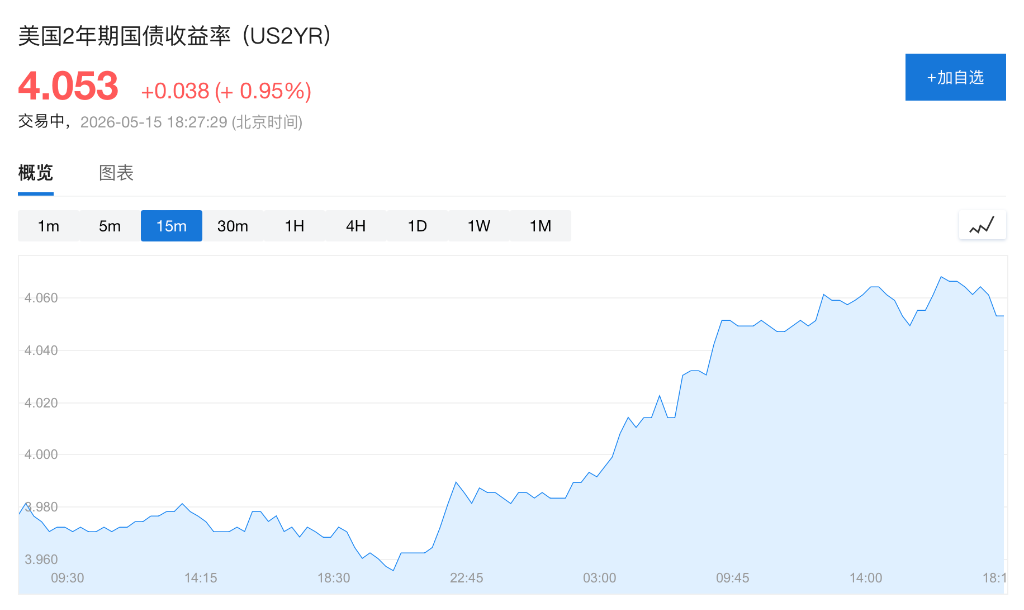
The 2-year US Treasury yield has climbed to 4.075% (UTC+8), obviously above the Federal Reserve’s 3.7% policy rate ceiling. The market is sending a very clear message: financial conditions are tightening spontaneously. The market now assumes that at next month’s Fed policy meeting, the question will no longer be how much to cut rates, but whether an additional rate hike is needed.
Goldman Sachs economists have delayed expectations for the next rate cut to December 2026, with the second cut pushed to March 2027—both by 25 basis points. Meanwhile, the 30-year US Treasury auction yield hit the highest level since August 2007, reflecting mounting long-term supply pressure and rising inflation concerns.
As Walsh replaces Powell as Fed chair, he faces an economic environment profoundly different from his predecessor, where CPI is being driven toward 4% by energy prices. Currently, markets assign nearly a 40% chance of a rate hike before December.
Japan 30-Year Government Bond Yield Breaks 4% for the First Time, Accelerating Exit from Deflation Era
Changes in the Japanese bond market hold far-reaching implications for global asset pricing.
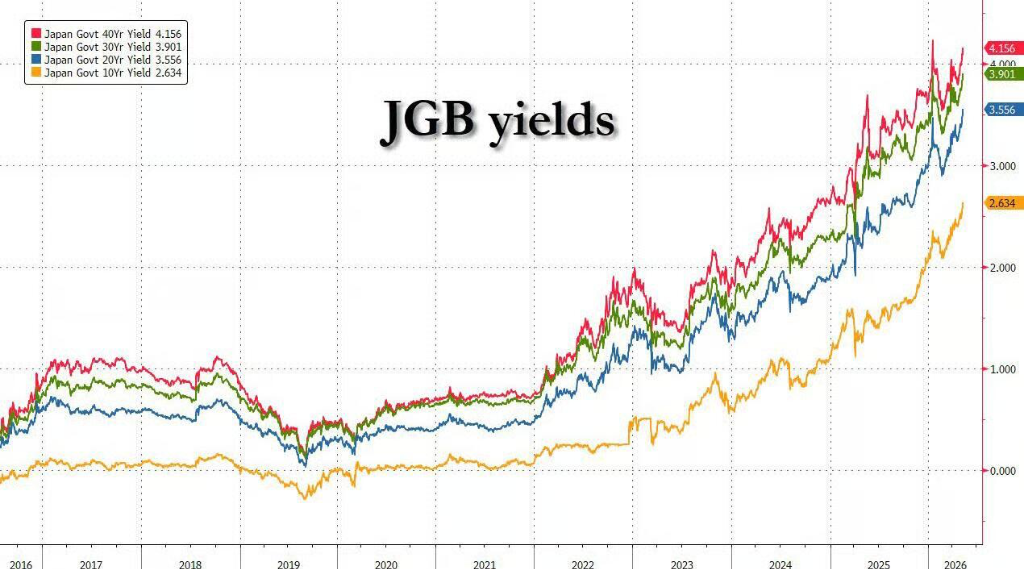
On Friday, Japan’s 30-year government bond yield for the first time broke above 4% (UTC+8), with the 40-year yield rising to 4.23% (UTC+8), both hitting historical highs. The 20-year yield also climbed to its highest level since 1996. Japan, which had long been stuck in a zero-rate environment, is accelerating its exit from the deflation era.
According to Bloomberg, while Japanese Finance Minister Kaori Katayama reiterated there was no need for a supplementary budget for now, concerns about fiscal discipline have clearly intensified in the market. More crucially, the continued depreciation of the yen is forcing the market to price in rate hikes from the Bank of Japan. Natixis Senior Economist Trinh Nguyen noted that Japan is trapped in a vicious cycle: the yen, as a funding currency, is being dumped continuously; imported inflation forces BoJ rate hikes, while rate hike expectations further push up yields.
Japan’s April corporate goods prices saw the biggest annual increase in 12 years, reflecting ongoing geopolitical shocks to global supply chains. SMBC Nikko Securities strategist Rinto Maruyama stated that, for Japan long plagued by deflation, the 30-year bond yield crossing 4% (UTC+8) is historically significant and suggests inflation may finally be taking root in Japan.
UK Gilts and Political Risk: Double Blow to Fragile Market
Amidst a global bond sell-off, UK assets suffered even heavier selling pressure.
This week the pound posted its biggest weekly drop since January 2025, while the 30-year gilt yield climbed above 5.8% on May 12 (UTC+8), hitting a nearly 30-year high. Political turmoil has amplified the pressures of rising global rates.
The additional downside is attributed to the so-called "Burnham premium" currently being priced in. Manchester Mayor Andy Burnham announced a bid to return to Parliament, seeking to challenge incumbent Prime Minister Keir Starmer. Investors worry that a more left-leaning leader could introduce looser fiscal policies, further increasing bond supply. TD Securities rates strategist Pooja Kumra pointed out that the clarity and speed of the by-election timetable may drive continued selling momentum.
The core market worry remains: an expanding fiscal deficit and more long-dated government bond issuance will further increase borrowing costs. The sharp volatility in the UK markets suggests that, amid rising inflation, high rates, and fiscal uncertainty, investor tolerance for policy credibility is rapidly fading.
Inflation Surges, Rates Stuck High, Markets Set Off Alarm
Behind this wave of global selling, a clear macro narrative is taking shape: energy shocks are fueling a resurgence in inflation, forcing central banks worldwide to reassess earlier accommodative expectations. At the same time, global equity markets sit near historical highs. Faris Mourad, Goldman Sachs’ thematic investment head, warned: “Persistently high interest rates are big trouble for equities.”
Market focus has now shifted to next week’s Fed policy signals and Nvidia’s earnings report. Nomura analyst McElligott reminded that after Friday’s options expiration, “gamma release” (a phenomenon where volatility temporarily drops and liquidity suddenly surges after mass options expiry) could open a window for trend reversals next week. Regardless of direction, investors must heed one fact: when the world’s safest asset—government bonds—are undergoing systemic repricing, risk assets can no longer remain immune in their valuation logic.
Disclaimer: The content of this article solely reflects the author's opinion and does not represent the platform in any capacity. This article is not intended to serve as a reference for making investment decisions.
You may also like
Copper: Tariff risk fuels rally – Commerzbank
Gold tumbles nearly 2% as stronger US Dollar, rising yields weigh on bullion

Tom Lee’s BitMine Slashes ETH Purchases by 74% to Take a ‘More Measured Approach’

Trending news
MoreCrypto prices
More





