
Buffett has been dismissive of the airline industry for years, while Berkshire's "new king" buys $2.6 billion of Delta Air Lines

Berkshire's "new king" invested heavily in Delta Air Lines with $2.6 billion, marking the third time this investment giant has ventured into the airline industry—previously, Warren Buffett had scoffed at airline stocks multiple times over the decades.
According to Berkshire's 13F filing submitted on May 15, 2026, for holdings as of March 31, 2026, the company holds 39,809,456 shares of Delta Air Lines, with a market value of approximately $2.6465 billion and a holding ratio of about 6.1%. Delta Air Lines also promptly confirmed this information through its own 13F disclosure.
After the news was announced, Delta Air Lines’ share price rose significantly in after-hours trading. For Berkshire, which is holding nearly $400 billion in cash and seeking investment opportunities, this transaction has also sparked widespread speculation in the market as to whether it will further increase its position in the airline sector.
At 95, Buffett has stepped down as CEO, retaining only the position of Chairman of the Board. This transaction was led by the new management team. Given Buffett’s strong caution and history of losses with airline investments, the deal has drawn particular attention.
Buffett's "fear of airlines": From anecdotes to doctrine
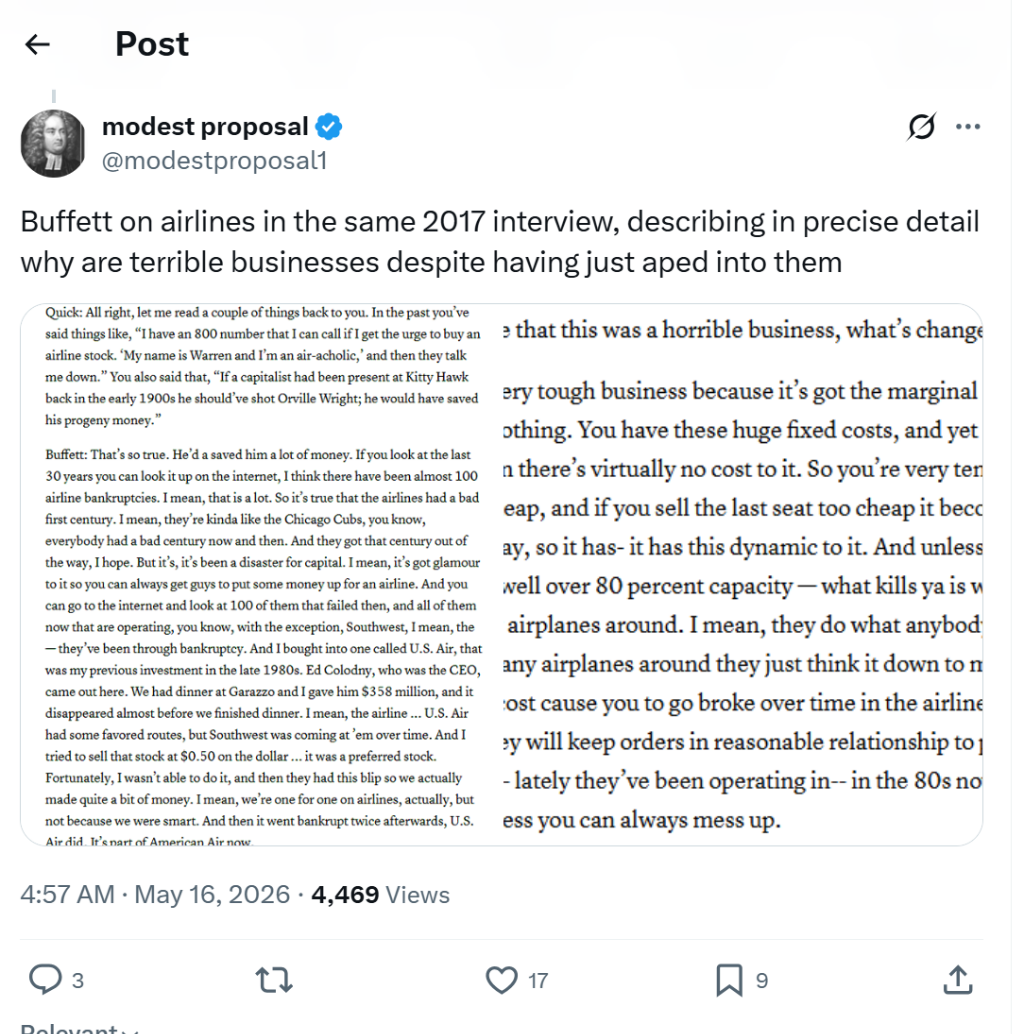
Buffett’s aversion to the airline industry is almost legendary among investors.
In his 1996 letter to shareholders, he quoted Richard Branson’s famous saying, calling the fastest way to become a millionaire "to start as a billionaire and then buy an airline."
In 2007, reflecting on the poor investment return of airlines, Buffett even joked that a “far-sighted capitalist” should have shot down Orville Wright at Kitty Hawk to do humanity a favor. He once said he had a free hotline to call whenever he felt the urge to buy airline stocks: “My name is Warren, and I’m an ‘airlineholic’,” and the person on the other end would talk him out of it.
In Buffett’s view, the airline industry is capital-intensive, highly unionized, and tightly regulated, and the industry’s key features—airports, security, air traffic control, cabin standards—are mostly determined or provided by the government, leaving the sector with an extremely weak moat.
Two failed attempts: From USAir to the pandemic sell-off
Berkshire's history with the airline industry spans nearly forty years.
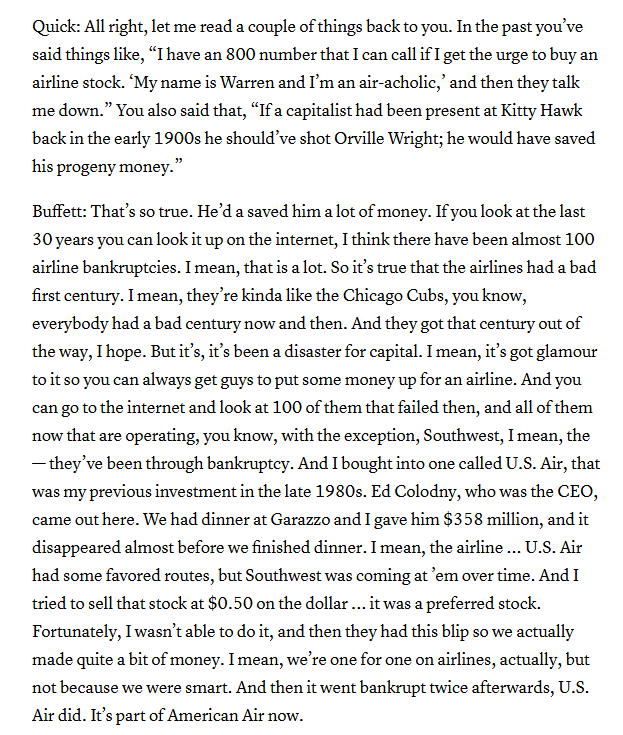
In 1989, Berkshire bought $358 million of USAir convertible preferred stock with a 9.25% coupon, convertible into common shares at $60 each. This structure seemingly made the investment safer than the underlying business risk.
However, between 1990 and 1994, USAir accumulated $2.4 billion in losses, shareholder equity was nearly wiped out, and in 1994 the company suspended preferred dividends to Berkshire. Berkshire subsequently wrote down 75% of the investment. Buffett later characterized this deal as an “unforced error” and “hasty analysis.” In the end, Berkshire barely got its capital back, but Buffett admitted that was just luck.
In 2016, Berkshire reentered the sector, taking stakes in four major carriers: American Airlines, Delta Air Lines, United Airlines, and Southwest Airlines. The logic at the time was that industry consolidation, several bankruptcies and restructurings, and more disciplined capacity management made airline stocks, at low valuations, offer significant upside—Buffett did not change his view that airlines were bad businesses, but believed the timing was right. By the end of 2019, Berkshire held about 11% of Delta Air Lines, 10% of American Airlines, 10% of Southwest Airlines, and 9% of United Airlines.
In April 2020, Berkshire exited all these positions, incurring significant losses, and made it clear it was unwilling to provide funding for “companies that continue to burn cash.”
The third entry: The new leader's strategy
This investment in Delta is an independent decision made under Berkshire's new management team.
In terms of scale, $2.6 billion is merely a drop in the bucket relative to Berkshire's nearly $400 billion cash reserves. Effectively deploying this cash is a core challenge for the new management. The Delta Air Lines position ranks as Berkshire's fourteenth largest holding, suggesting that this is still a tentative allocation in terms of portfolio priority.
Notably, unlike 2016’s diversified holdings, this time Berkshire chose only Delta Air Lines, showing higher concentration and a more specific intent. Delta was clearly happy to proactively disclose this, as it first revealed the information in its own 13F filing.
This is Berkshire’s third attempt at the airline industry. As it faces the pressure of huge cash balances, the market is closely watching to see if the new management will further increase its exposure to the airline sector.
Disclaimer: The content of this article solely reflects the author's opinion and does not represent the platform in any capacity. This article is not intended to serve as a reference for making investment decisions.
You may also like
AIGENSYN fluctuates 44.9% in 24 hours: Continues high-level volatility after Binance listing
The most expensive "other chip" in Silicon Valley has finally arrived at its moment

IRYS fluctuates 80% in 24 hours: Surges then falls back after being listed on Upbit
Trending news
MoreCrypto prices
More





