
Visa captures 90% of on-chain card payments as crypto spending hits record high of $7.8 billion

Visa (V) is taking about 90% of on-chain crypto card payments as total crypto card spending reaches a record $7.8 billion.
According to data from Paymentscan, the volume has increased by 230% since May 2025. At present, stablecoins can be used directly in transactions by people wishing to use cryptocurrencies in payments, without any additional actions involving banks.
The number of crypto cards has surged in 2026 as people have access to stablecoin transactions via a card. Thus, a person may have stablecoins in a wallet and pay with a card at any ordinary store.
Visa takes most on-chain card volume as Jupiter Global spending jumps 648%
Visa’s spending through Jupiter Global has increased by 648% within the past two months. The Jupiter Global system falls under the crypto payment system, which assists Visa in handling most of its card activities via blockchain.
The stablecoins were already being used in trades, payments, savings, and to access US dollars in regions that have an unstable currency.
Visa and Bridge, the stablecoin infrastructure company owned by private fintech firm Stripe, announced two months ago that their stablecoin-linked card program would reach more than 100 countries by the end of 2026. The card is already live in 18 markets after starting in 2025, with Latin America as the first target.
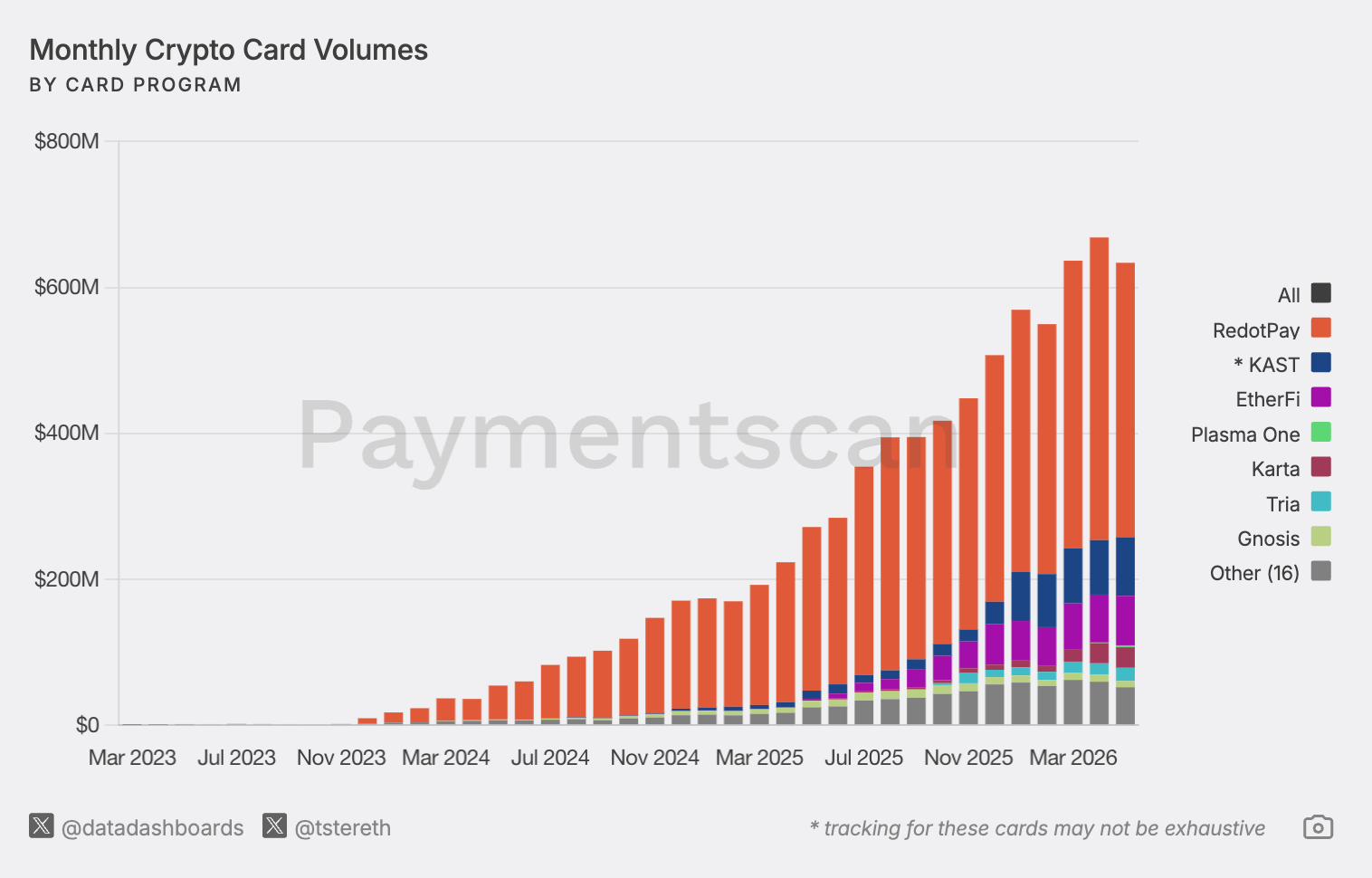 Paymentscan
The first markets included Argentina, Colombia, Ecuador, Mexico, Peru, and Chile. The next rollout covers Europe, Asia-Pacific, Africa, and the Middle East. The cards let users spend stablecoin balances held in self-custody wallets, including MetaMask and Phantom.
Payments run through Visa’s network of about 175 million merchant locations worldwide. In the first version of the setup, Bridge changed stablecoins into fiat at checkout so merchants received local currency.
The newer version, made possible through Bridge’s deal with Lead Bank, lets card transactions settle directly on-chain in stablecoins instead of turning them into fiat first.
Central banks test Project Agorá as stablecoins pressure cross-border payments
While Visa grows its stablecoin card business, central banks and major financial firms are testing their own blockchain payment rails.
Project Agorá, led by the Bank for International Settlements and the Institute of International Finance, has completed a test for cheaper and near-instant cross-border settlement.
The prototype is backed by seven major central banks and 40 large financial firms. It is built to let commercial banks send money across borders by turning bank deposits into tokens. The system uses distributed ledger technology, which is the same broad technology behind cryptocurrencies such as Bitcoin.
The project comes as central banks and old finance firms try to protect their place in cross-border payments. That market is already under pressure from dollar-backed stablecoins, where Tether and Circle (CRCL) are major names.
The Bank of Canada is joining the next testing phase with the Federal Reserve Bank of New York, Bank of Japan, Bank of France, Bank of England, Bank of Korea, Bank of Mexico, and the Swiss National Bank.
Project Agorá also sits across from Project mBridge, a rival cross-border payment system led by China’s central bank. The BIS left Project mBridge in 2024. Project Agorá includes institutions tied to the United States, European Union, Britain, Japan, Korea, Canada, Switzerland, and Mexico.
Cross-border payments still mostly run through correspondent banking. That old system sends money through a chain of lenders. It can be slow, costly, and unclear for users waiting on funds.
“This prototype and its successful testing lay the groundwork for next-generation solutions,” the BIS and IIF said in a report on Wednesday.
They said the project “preserves correspondent banking as the backbone of global payments while applying new technology to enhance its performance.”
The report also said a shared distributed ledger can support safe settlement in a tokenized setup and deal with long-running problems in wholesale cross-border payments.
So far, the tests have been synthetic, meaning no real money was used in the transfers. The firms involved include JPMorgan Chase (JPM), HSBC (HSBC), BNP Paribas (BNPQY), Visa, UBS (UBS), and MUFG Bank (MUFG). They plan to test real cash transfers later, but the report gave no date.
The test sent tokenized bank deposits between currencies on a shared ledger. Allegedly, the settlement happened almost instantly through atomic settlement using tokenized central bank reserves.
Disclaimer: The content of this article solely reflects the author's opinion and does not represent the platform in any capacity. This article is not intended to serve as a reference for making investment decisions.
You may also like
Yen erases the rescue as carry math wins out
Pound Sterling sleepwalks toward Bailey, not PCE
Glassnode Warns Nearly 30% Of Bitcoin Supply Could Face Future Quantum Risks

Strive’s Bitcoin buying spree crosses a rare daily supply line
Trending news
MoreCrypto prices
More





