
South Korea says tokenized stocks may be taxed under existing laws

South Korea’s tax authorities are preparing to treat tokenized stocks as securities rather than virtual assets, a move that could bring the rapidly growing sector into the country’s existing taxation framework once financial regulators finalize their legal interpretation.
- South Korea’s tax authorities said tokenized stocks could face immediate taxation if financial regulators classify them as securities.
- Officials indicated that overseas tokenized stock trades may also fall under existing securities tax rules depending on their economic rights structure.
- The move comes as the global tokenized stock market has grown to nearly $1.5 billion, fueled by rising demand for blockchain-based access to equities such as Tesla and Nvidia.
According to comments from South Korea’s Ministry of Economy and Finance shared with local outlet Bloomberg Bit, the government currently views tokenized stocks as securities in substance despite their blockchain-based structure.
The ministry said that if the Financial Services Commission determines tokenized stocks qualify as securities, taxation could begin immediately under existing capital markets rules without requiring new legislation.
Officials told the publication that tokenized equities may take the form of digital assets, but their economic characteristics more closely resemble traditional securities.
The ministry also pointed to previous guidance from financial regulators, which emphasized that assets meeting the characteristics of securities should be regulated as securities regardless of the technology used to issue them.
Interest in tokenized equities has grown rapidly over the past year as investors seek blockchain-based access to publicly traded companies.
Data from RWA.xyz showed the tokenized stock market reached $1.47 billion as of June 8, up 115% since the start of the year.
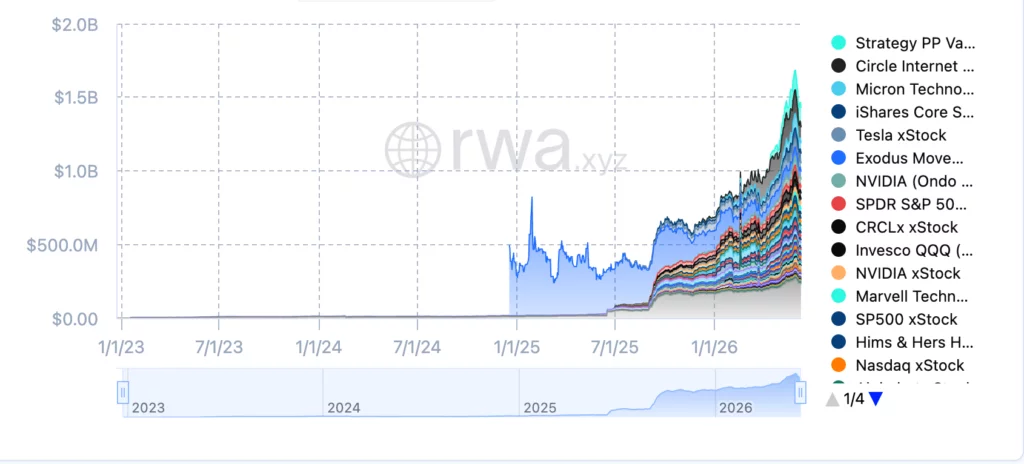
Tokenized stock market value. Source: RWA.XYZ
Demand has been particularly strong among investors seeking exposure to U.S. companies such as Tesla and Nvidia through platforms that offer around-the-clock trading and faster settlement.
Financial regulators move toward legal clarification
Attention is now turning to the Financial Services Commission, which is expected to release revisions to its token securities guidelines and related regulations in July.
Earlier, during the second meeting of a public-private token securities task force in May, the commission said it would develop a detailed roadmap for the tokenization of conventional securities, including listed stocks.
A formal interpretation classifying tokenized shares as securities could clear the way for tax collection during the second half of 2026.
South Korean regulators have already established a foundation for that approach. In its 2023 token securities guidelines, the commission stated that token securities issued in digital asset form fall under the scope of the Capital Markets Act.
However, those guidelines focused largely on fractional ownership products tied to assets such as real estate, artworks, and intellectual property, leaving uncertainty around tokenized versions of ordinary shares.
Because of that uncertainty, many market participants had assumed tokenized stocks would be treated similarly to virtual assets and remain outside the tax net until South Korea’s virtual asset taxation regime takes effect next year.
Overseas trades could also fall under tax rules
The Ministry of Economy and Finance indicated that taxation would not necessarily be limited to domestically issued products.
Officials told Bloomberg Bit that securities taxation under existing law is based on the economic rights attached to an asset rather than where it is issued.
As a result, tokenized stock transactions conducted through overseas platforms could still be subject to South Korean tax rules if the underlying rights are deemed equivalent to securities.
The ministry also noted that future classifications may depend on specific features attached to the tokens. Depending on whether voting rights are included, tokenized stocks could potentially be categorized as ordinary shares, derivative-linked securities, or investment contract securities.
At the same time, South Korea’s tax authorities and the National Tax Service are working to strengthen information-sharing arrangements with foreign tax agencies, including the U.S. Internal Revenue Service, to improve visibility into transactions conducted through overseas platforms.
The regulatory push comes as tokenized finance gains momentum globally.
The research firm attributed much of the growth to platforms that provide blockchain-based access to traditional equities and exchange-traded funds.
Growing activity on platforms such as xStocks and Ondo Global Markets has further accelerated investor interest in blockchain-based securities, increasing pressure on regulators to clarify how existing financial and tax laws should apply to the sector.
Disclaimer: The content of this article solely reflects the author's opinion and does not represent the platform in any capacity. This article is not intended to serve as a reference for making investment decisions.
You may also like
Bitget secures enterprise Claude access for all 2,167 employees at $200 per head
SHIB Chart Breaks Down, But 60% Burn Spike Sparks Bullish Hope
Ethereum price risks $1,500 as ETF outflows pressure ETH
USD/CHF Price Forecast: Trades above 0.7950 after rebounding from nine-day EMA support
Trending news
MoreCrypto prices
More


