

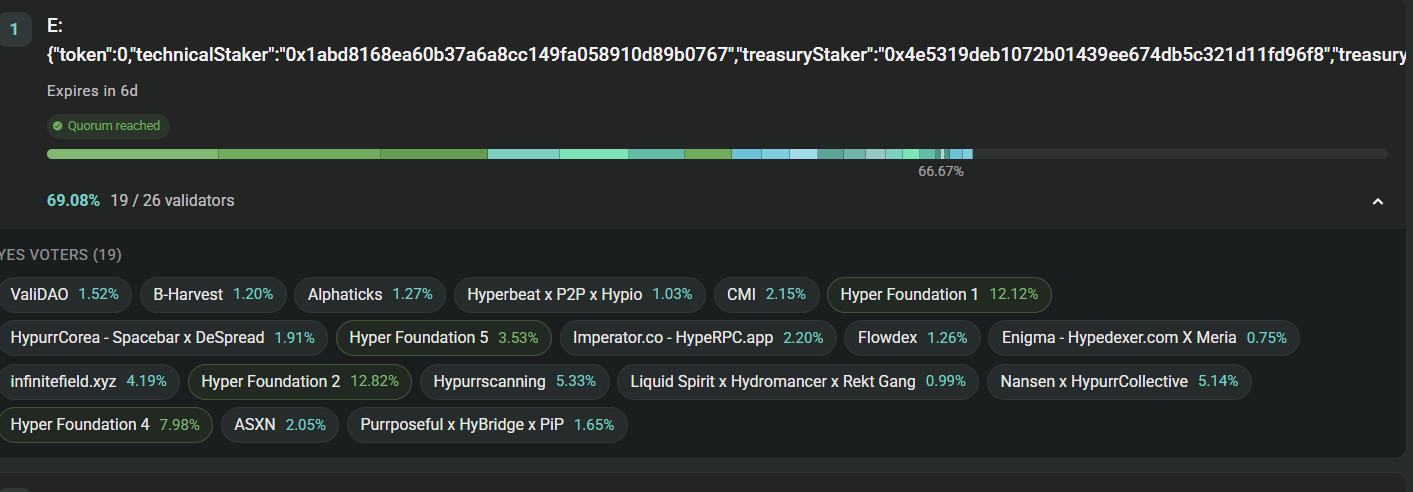
- The AQAv2 vote has passed — 19 of 26 Hyperliquid validators voted YES at 69.08% — exceeding the 66.67% threshold needed with 6 days still remaining.
- Starting August 26, 2026 — the interest earned on $5 billion of USDC sitting on Hyperliquid will start flowing back to the protocol — funding $HYPE buybacks automatically every 30 days.
- Circle handles the technical side. Coinbase handles the treasury. The first payment to the buyback fund arrives October 3, 2026.
- This adds an estimated $135–160M+ per year in new buyback pressure — on top of the $771M already coming from trading fees — pushing the total annual buyback engine toward $900M+.
It passed. With 6 days still on the clock and quorum reached well ahead of the deadline — Hyperliquid’s validator community has given the green light to one of the most significant tokenomics upgrades in the protocol’s history.
As we covered in our AQAv2 validator vote launch article — the vote opened with early support from 6 validators at 9.13%. It has now closed with 19 of 26 validators voting YES at 69.08% — a decisive majority that signals broad institutional consensus within Hyperliquid’s validator ecosystem.
Combined with our Coinbase and Circle commitment coverage and the Will HYPE Reach $100 analysis — today’s vote approval adds the final governance confirmation that the AQAv2 revenue stream is real, activated, and on a fixed timeline.
The Vote — By the Numbers
 Source: Hyperliquid Governance Dashboard
The breadth of the YES vote is as significant as the margin — spanning the Hyper Foundation’s own validators, independent infrastructure providers, data analytics firms (ASXN, Nansen), and community validators. This is not a rubber-stamp vote — it is a genuine cross-ecosystem consensus.
What AQAv2 Actually Does — The Official Announcement
The official Hyperliquid announcement confirms the precise mechanics:
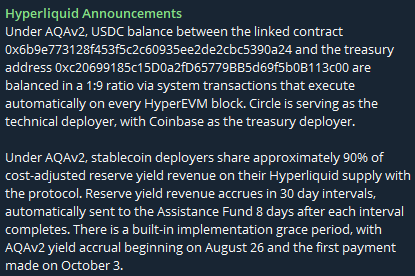
“Under AQAv2, USDC balance between the linked contract 0x6b9e773128f453f5c2c60935ee2de2cbc5390a24 and the treasury address 0xc20699185c15D0a2fD65779BB5d69f5b0B113c00 are balanced in a 1:9 ratio via system transactions that execute automatically on every HyperEVM block. Circle is serving as the technical deployer, with Coinbase as the treasury deployer.”
 Hyperliquid Announcement/Source: @HyperliquidNews (X)
Breaking this down into plain language:
The 1:9 ratio mechanism — For every 1 USDC in the linked contract, 9 USDC sits in the treasury. This ratio is automatically maintained on every HyperEVM block — meaning the balance rebalances continuously without manual intervention. Circle handles the technical infrastructure. Coinbase manages the treasury deployment.
The 90% yield share — Of all the reserve yield generated by USDC sitting on Hyperliquid — 90% flows to the protocol after cost adjustment. This is not a negotiated percentage — it is the AQAv2 standard that will apply to all aligned quote assets going forward.
The 30-day interval cadence — Yield accrues over 30-day periods and is automatically sent to the Assistance Fund 8 days after each interval completes. This creates a predictable, regular flow of USDC into the buyback engine rather than lumpy or discretionary payments.
The timeline:
| Vote passed | June 12, 2026 |
| Yield accrual begins | August 26, 2026 |
| First Assistance Fund payment | October 3, 2026 |
| Subsequent payments | Every 30 days + 8 days |
What This Adds to the HYPE Buyback Engine
As we detailed in our Will HYPE Reach $100 analysis — the existing buyback infrastructure was already extraordinary:
| Trading fees (existing) | ~$771.79M annualised |
| USDC reserve yield (AQAv2 — new) | ~$135–160M+ annually |
| Combined annual buyback | ~$900M–$930M+ |
AQAv2 adds a second independent revenue stream to the buyback engine — one that operates regardless of trading volume fluctuations. Even during periods of reduced market activity when trading fee revenue contracts — the $5 billion in USDC reserves continues generating yield that flows to the Assistance Fund.
As we covered in our HYPE buyback engine analysis — cumulative buybacks have already reached $945.08M — removing 15.09% of circulating supply. From October 3 onward — the pace of removal accelerates with a new ~$135–160M annual input added to the existing $771.79M rate.
Why Institutional Roles Matter — Circle and Coinbase
The technical and treasury deployer roles assigned to Circle and Coinbase are not administrative formalities — they represent the deepest institutional commitment to Hyperliquid’s infrastructure that either company has made.
Circle as technical deployer — Circle is the issuer of USDC itself. Having Circle directly managing the technical infrastructure of AQAv2 means the mechanism has the full operational support of the stablecoin’s creator — not a third-party integration.
Coinbase as treasury deployer — Coinbase managing the treasury side means the largest US-regulated crypto exchange has a direct operational role in Hyperliquid’s yield mechanism. As we covered in our Coinbase and Circle USDC partnership article — this alignment goes beyond partnership — it is structural integration.
Combined with Goldman Sachs’ HYPE position, Bitwise staking 6M+ HYPE, three competing ETFs with $151M in cumulative inflows, and the ICE CEO calling Hyperliquid “bigger than NASDAQ” — the AQAv2 approval adds Circle and Coinbase as operational participants to an institutional stack that has no equivalent in DeFi.
The Broader Significance
The AQAv2 approval is significant for three reasons that extend beyond the immediate revenue impact:
It creates a template for future quote assets. The AQAv2 framework is expected to become the standard requirement for future HIP-4 quote assets and validator-operated perpetual markets. Every new aligned quote asset added to Hyperliquid’s ecosystem will contribute to the same buyback mechanism — compounding the revenue base as the platform expands.
It makes $HYPE fundamentally harder to value cheaply. With two independent revenue streams — trading fees and USDC reserve yield — both growing simultaneously with platform adoption, the floor under $HYPE’s fundamental value has been raised structurally. As we analysed in the Will HYPE Reach $100 article — the $25.37B circulating market cap at $100 was already justifiable against comparable exchange valuations. AQAv2 makes the revenue comparison even more compelling.
It demonstrates governance maturity. 19 of 26 validators approving a complex stablecoin yield-sharing mechanism — with precise technical addresses, ratio mechanics, and payment schedules — reflects a governance ecosystem that is functional, responsive, and capable of executing sophisticated protocol upgrades. As we covered in the HIP-4 prediction markets article — Hyperliquid’s governance has been consistently delivering on its product roadmap.
Bottom Line
AQAv2 is approved. The vote is done. The timeline is locked.
August 26 — yield accrual begins.
October 3 — the first payment hits the Assistance Fund.
Every 30 days after that — $HYPE buybacks receive a new ~$11–13M injection from USDC reserve yield alone.
The combined buyback infrastructure from that point: approximately $900M–$930M annually — trading fees plus USDC yield — operating across two independent streams that compound with every new user, every new USDC deposit, and every new aligned quote asset added to the ecosystem.
The vote passed with 19 validators and 6 days to spare. The tokenomics just got permanently stronger.
Frequently Asked Questions (FAQ)
Did the AQAv2 vote pass?
Yes — 19 of 26 validators voted YES at 69.08% — exceeding the 66.67% quorum threshold with 6 days remaining on the vote timer.
When does AQAv2 yield accrual begin?
August 26, 2026 — with the first automatic payment to the Assistance Fund on October 3, 2026 — and subsequent payments every 30 days plus 8 days thereafter.
What roles do Circle and Coinbase play?
Circle serves as technical deployer managing USDC infrastructure. Coinbase serves as treasury deployer managing the 1:9 USDC ratio maintained automatically on every HyperEVM block.


