
SpaceX (SPCX.US) Market Cap Poised to Surpass Amazon! Musk’s “Space AI Empire” Completely Ignites “MANGOS” Trading

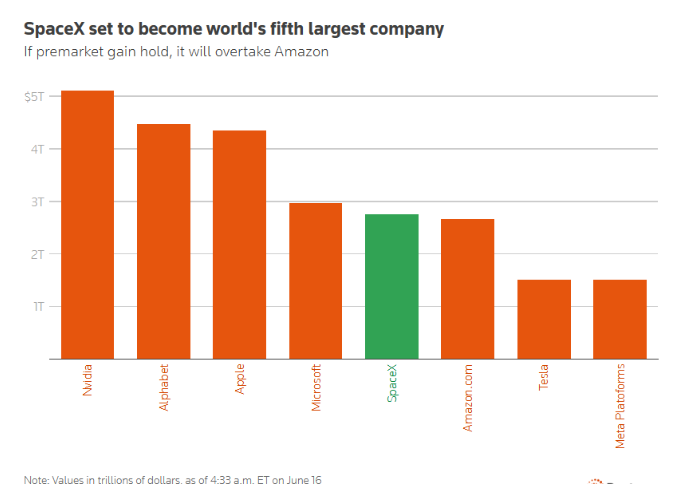
According to Zhitong Finance, following last Friday's globally sensational record-breaking IPO scale by SpaceX (SPCX.US), the American super tech giant founded by Musk and focused on “AI + space exploration”, the global stock market's investment frenzy in commercial aerospace, artificial intelligence, and computing power infrastructure has become even more heated. As of press time, SpaceX shares under Musk rose more than 10% in pre-market trading on Tuesday. With the continuation of gains after the epic IPO, SpaceX is likely to surpass the market capitalization of America's cloud computing and e-commerce supergiant Amazon.com to become the world’s fifth-largest public company by market cap—only behind Nvidia, Alphabet, Apple, and Microsoft.
The stock is now up 10.4%, at $212.50, rising more than 57% over its $135 IPO issue price; if this increase holds, the company's market cap will approach $2.8 trillion. Meanwhile, Amazon (AMZN.US) currently has a market cap of around $2.66 trillion.
As SpaceX’s total market capitalization is poised to overtake Amazon, the investment narrative around US stock market supergiants is quickly undergoing a critical-level evolution: from the former FAANG or MAG 7 to a new "MANGOS" portfolio emphasizing “AI foundational models + AI computing power infrastructure + space communications/data networks.”
The reason “MANGOS” can replace or challenge the “MAG 7” narrative at its core is that it shifts market focus from matured Internet platforms and consumer tech giants to AI-native application assets and AI computing power infrastructure assets. Recently, Wall Street analysts have frequently referenced “MANGOS,” usually defined as Meta (Facebook’s parent), Anthropic, Nvidia, Alphabet (Google’s parent), OpenAI, and SpaceX, though the lineup isn't fully standardized; in some versions, “A” stands for Apple. This reshaping of investment acronyms essentially reflects how investors are using new shorthand to express a new global framework for the pricing of core tech assets.
With index tracking funds (i.e., index ETFs) set to create tens of billions of dollars in new demand for SpaceX shares, and with AI computation infrastructure investments and construction expected to scale up to $3 trillion in full swing, some Wall Street analysts see SpaceX not as the bubble-bursting end of the AI super bull market, but as a powerful amplifier. In other words, the record-breaking SpaceX IPO may suggest that the global “AI super bull market” surrounding the AI computing power industry chain is far from over.
As the world’s richest individual to date, Musk has previously accomplished feats thought impossible—building a commercially viable high-frequency rocket launch business through SpaceX, mainstreaming electric vehicles through Tesla, and providing internet infrastructure from space through Starlink. But some investors remain skeptical about whether Musk can realize his latest “most epic” chip-making project in Austin or achieve his vision of an “AI, autonomous driving, humanoid robots, and space AI data center super blueprint.”
SpaceX IPO surges as much as 57%! Greenshoe Extension, Options Open, Nasdaq 100 Inclusion Expectations Jointly Fuel Capital Chasing SpaceX
“We can say with certainty that this valuation doesn’t make any sense today. People are buying SpaceX because they expect others will too and continue to push the price higher—that’s speculation in its purest sense,” said Swissquote Bank Senior Market Analyst Ipek Ozkardeskaya.
The company (SpaceX) reported $18.67 billion in sales last year, and after merging with loss-making AI leader xAI, it posted a net loss of $4.94 billion—sharply contrasting with many other large tech companies tracked by Wall Street analysts, which have shown continuous strong performance.
Additionally, options trading for SpaceX is expected to begin as early as Tuesday, and early trading is anticipated to be highly active and volatile, while potentially carrying high costs. Speculative forces around options derivatives could speed up SpaceX’s price ascent but any correction after a phase top could be equally sharp.
Analysts and portfolio managers generally caution that average retail investors should be prepared for volatility, especially in SpaceX’s earliest phase as a listed company, as its float is relatively small and valuation is high.
As SpaceX is set for rapid inclusion in the Nasdaq 100 index, the rally may persist in the short term; this means Nasdaq, Inc. will quickly push SpaceX to become an important holding for the passive funds and ETFs that track its Nasdaq 100 index, creating a new source of demand for its stock.
FTSE Russell and MSCI will also include the stock in many of their benchmark market indices, starting June 26 and June 29, respectively.
Nasdaq Inc., FTSE Russell, and MSCI Inc. are all now preparing to quickly include the company in their benchmark index portfolios. According to index rebalancing forecaster Intropic, just 15 days after listing, about 30% of SpaceX’s freely floating shares will be held by passive investors. For comparison, under the indexers’ previous slower inclusion rules, this figure would have been about 4%.
On Monday, SpaceX also announced that its underwriters had exercised the “greenshoe” option to purchase additional shares, raising total IPO proceeds from the initially planned $75 billion to $85.7 billion.
On the eve of SpaceX’s historic IPO, renowned Wall Street investment bank Oppenheimer gave the stock an “outperform” rating and a target price of $190. Based on the initial IPO price of $135, that implies roughly 41% upside potential and a market cap of about $2.5 trillion. The core of Oppenheimer’s bullish report is a redefinition of SpaceX from a traditional commercial aerospace company to a “vertically integrated AI infrastructure comprehensive platform”: not only does it have rocket launching, Starlink satellite networking, and manufacturing engineering capability, but it’s also assigned stories for large language models, AI agents, large ground-based AI data centers, large cloud inference platforms, and future space-orbit AI data centers.
As of 05:02 AM Eastern time, SpaceX pre-market trading value exceeded $1.76 billion, several times that of Nvidia, Microsoft, Tesla, and Apple’s combined volumes. Other major tech stocks including Nvidia and Alphabet edged lower. Tesla fell 1.5%.
Musk’s “Space AI Empire” Redefines Investment Labels for US Mega-caps
SpaceX’s much-anticipated IPO prospectus released last month showed that its self-estimated total addressable market (TAM) is a staggering $28.5 trillion; if this “Space AI Empire” blueprint is ever achieved, it will be close to America’s entire economic output. The company said in the prospectus that it had “identified the largest total addressable market opportunity in human history,” mainly driven by AI super software, with space also making key contributions.
SpaceX is rapidly transforming from a “commercial aerospace and space exploration company” to a “global AI computing infrastructure operator + AI application behemoth,” with more than $300 billion in subscriptions far exceeding expectations and up to $100 billion in retail demand alone, proving market acceptance of its growth narrative. Moving forward, the trend will keep strengthening the path that “SpaceX’s record IPO is expanding the AI super bull market’s boundaries, not draining its liquidity.”
From a global capital flows perspective, this now appears to be the second stage of the AI super bull market. The first stage was driven by AI GPUs and ASICs powering massive training clusters; the second stage is spreading into data center power supply chains, HBM/DRAM/NAND, advanced packaging, liquid cooling, data center CPUs, optical communication/optical interconnects, high-performance Ethernet/data center DCI high-speed interconnection, and also AI end applications including PCs, wearable consumer electronics, humanoid robots, autonomous driving, and especially the space AI computing power infrastructure represented by SpaceX—the “new AI centers.”
After its listing, SpaceX’s market cap rapidly approaches or even surpasses Amazon’s, and with “MANGOS” becoming a hot topic, the investment label for US supergiants is again evolving: from FAANG/MAG 7 to a new grouping of “AI foundational models + AI computing power infra + space communications/data network”—MANGOS, usually standing for Meta (Facebook parent), Anthropic, Nvidia, Alphabet (Google parent), OpenAI, and SpaceX, though in some versions, “A” stands for Apple.
This reshaping of the investment, in essence, means investors are using new acronyms to express a fresh global core technology pricing framework, highlighting how the market weight of benchmark US indices is shifting from mature tech cash flows to monopoly power over AI computing infrastructure, AI application/model platform pricing power, and the scarcity of space infrastructure.
Nvidia represents the AI computing power infra ecosystem, led by data center CPUs, AI GPUs, Infiniband network architecture, and CUDA systems. Alphabet/Meta represent large-scale cloud and AI application delivery; OpenAI/Anthropic represent foundational AI large model platforms; SpaceX stands for space-based satellite Internet communications, AI agent application ecosystem, defense-related military industry and aerospace, as well as space AI data center infrastructure. In other words, MANGOS is not just a new name, but an industrial reshuffle for US tech: moving from the “mobile Internet/cloud computing/digital advertising platform” era to a new structure led by “AI large models—AI computing infrastructure—satellite network architectures—AI agent application gateways.”
Disclaimer: The content of this article solely reflects the author's opinion and does not represent the platform in any capacity. This article is not intended to serve as a reference for making investment decisions.
You may also like
Inveniam to acquire MANTRA, combining tokenized asset infrastructure with AI-ready private market data
Euro: Limited upside versus Dollar – NBC
Market Bulls Take Control: 3 Altcoins Positioned for the Next Big Move
Poland bets on copper boom as Lumina eyes new mines
Trending news
MoreCrypto prices
More


