
Half of the officials support another rate hike, but gold prices once surged above 4,300—hidden mysteries behind the divergence

Forex Net, June 18 — The signing of the US-Iran peace agreement weakened the safe-haven US dollar, and spot gold rose by about 1% to above $4,300 during the Thursday Asian session. However, hawkish signals from the Federal Reserve remain, and non-yielding assets continue to be under pressure.
On Thursday (June 18) during the European session, spot gold rose about 0.6%, with its price running near $4,290 per ounce, after briefly surpassing the $4,300 mark.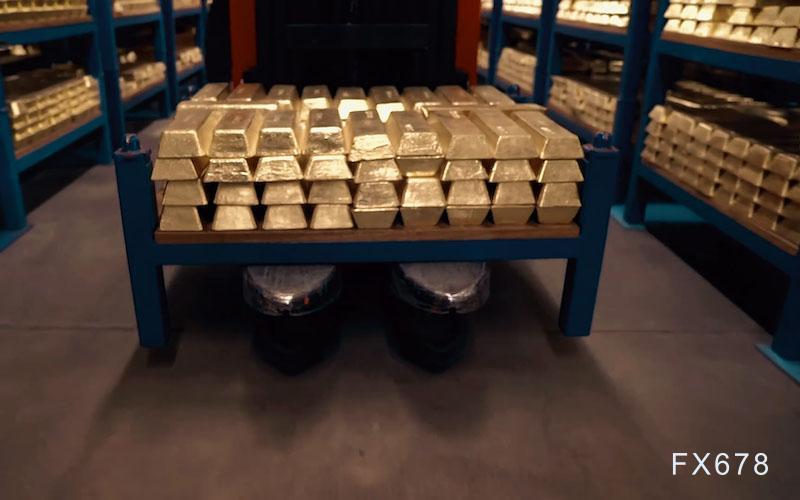
The US-Iran Peace Agreement Weakens the Safe-Haven Dollar, Giving Gold a Breathing Space
On June 18 local time, Pakistan Prime Minister Shehbaz Sharif confirmed that the United States and Iran have signed the milestone document "Islamabad Memorandum of Understanding between the United States of America and the Islamic Republic of Iran" via electronic remote channels. The agreement becomes effective immediately, with its core aim to end the long-term hostile relationship between the two countries and to reopen the global energy artery Hormuz Strait, substantially alleviating market concerns over potential interruptions to Middle Eastern energy supply.
Trump simultaneously stated that the 60-day negotiation period set for the final Iran nuclear deal is not a hard deadline. If negotiations do not progress as expected, extensions are flexible, which soothed market fears of negotiation breakdowns or renewed geopolitical conflicts and significantly improved global investor risk appetite.
Previously, during Wednesday’s Federal Reserve FOMC meeting, signals were hawkish. The dot plot showed that half the officials supported another rate hike this year, completely cooling rate cut expectations. The safe-haven dollar surged, reaching new highs since late March, continuing to suppress precious metal prices. After the easing of US-Iran tensions, geopolitical safe-haven trades faded quickly, and long positions accumulated in US dollars and US treasuries took profits, leading to a slight pullback in the dollar index.
Since gold is priced in US dollars, dollar weakness directly enhances its investment appeal. A large flow of funds shifted from dollar assets into the precious metals market to buy the dip, providing key support for gold’s short-term rebound. However, high expectations for Federal Reserve interest rates have not dissipated and will continue to limit the upside of this round of gold's rebound.
The Federal Reserve's Hawkish Stance Limits Dollar Decline; Non-yielding Assets Like Gold Remain Under Pressure
The market as expected greeted the latest Federal Reserve rate decision. At the first FOMC meeting presided over by new Chair Walsh, the Fed kept the federal funds rate target range at 3.50%-3.75%, in line with mainstream expectations.
However, the core highlights from this meeting lean hawkish, with all dovish language comprehensively removed from the policy statement, completely ending the market’s rate-cut fantasy, and clearly signaling a bias towards rate hikes in future policy, sharply reversing market liquidity expectations.
Impacted by the hawkish resolution, the market quickly priced in subsequent monetary policy. Interest rate futures showed the probability of a 25 basis point rate hike in December climbed to a high of 85%. This expectation led US Treasury yields to surge overnight, continuously supporting dollar bulls.
Under these circumstances, gold, which yields no interest, is obviously under pressure, with bullish bets dropping sharply. Although gold recently rebounded from the year’s low near $4,020–$4,025, the current rally lacks core bullish drivers. Under the continued pressure of high rates and a strong dollar, the sustainability of this rebound is questionable—only persistent follow-up buying can confirm the effectiveness of this recovery; otherwise, it is highly likely to return to a choppy adjustment pattern.
Institutional Views
UBS holds a cautious short-term outlook for gold prices and has significantly lowered its short-term price forecasts. It believes the June FOMC delivered clear hawkish signals, with half the officials supporting another hike this year, rate-cut expectations now pushed into 2027, and real yields for US treasuries persistently rising—substantially increasing the cost of holding non-yielding gold and forming the core headwind for gold. The minor rebound from US-Iran easing is mainly sentiment-driven with limited sustainability; gold's sensitivity to safe-haven events has significantly waned, and funds continue to flow out of gold ETFs.
Technically, the gold price rebound is capped by the MA20 moving average, with near-term support seen in the $4,000-$3,850 range. However, the medium-to-long-term outlook remains optimistic; the structural demand from continuous global central bank buying and diversified foreign reserves will persist. The year-end target price is maintained at $5,200. It is recommended to reduce positions on rebounds in the short run and consider accumulating long positions after deeper pullbacks.
JP Morgan notes that while in the short term, the hawkish rate environment will limit gold’s upside, the current rally from the $4,023 low lacks persistent incremental buying, with the 20-day moving average at $4,378 acting as strong resistance. Without a significant pullback in inflation data, gold is unlikely to trend upward in a sustained fashion.
However, they remain firmly bullish on the outlook from Q4 to the end of the year, giving a 2026 year-end target price of $6,000. Their long-term support logic includes continued US fiscal deficits, weakening dollar credibility, ongoing gold accumulation by global central banks, and persistent geopolitical risks, all highlighting gold’s value as a reserve asset. The US-Iran agreement curbs energy inflation and is only a short-term negative for the dollar, making it difficult to reverse the medium- to long-term strengthening trend of the dollar. They recommend not chasing rebounds and waiting for the gold price to test the $4,050–$4,100 support for phased long-term accumulation.
Technical Analysis
According to the daily chart, after spot gold previously tested this year's low of $4,023.85, a mild recovery ensued. The current price remains under all moving averages, with short-term MA20 ($4,378.79) and mid-term MA50 ($4,554.03) layering resistance, and the overall arrangement still in a bearish pattern with the mid-term downtrend intact. The key support below is at the previous lows of $4,023.85 and $4,099.02, forming the core bottom zone for this round of decline.
From an indicator perspective, the MACD double lines remain below the zero axis, DIFF barely crosses DEA for a minor golden cross, and the volume of red bars is minimal—though bearish momentum is weakening, bullish momentum is notably weak; RSI stands at 43.60, in a neutral-to-weak range, not yet oversold, and downward risks have not been fully released.
In terms of trend structure, gold has been oscillating downward from its all-time high of $5,596.33; this rebound is only a technical correction after the steep decline. The price met resistance near the 20-day moving average and fell back, showing limited upward strength. If unable to hold above $4,378 level (UTC+8) in the short-term, the rebound could quickly fail, revisiting the $4,023 low (UTC+8); only a strong breakout above the MA50 at $4,554 (UTC+8) can reverse the short-term bearish structure. Overall, technicals are dominated by bears, and near-term price action is expected to center on low, weak, oscillating recovery, with no clear trend reversal signal yet.
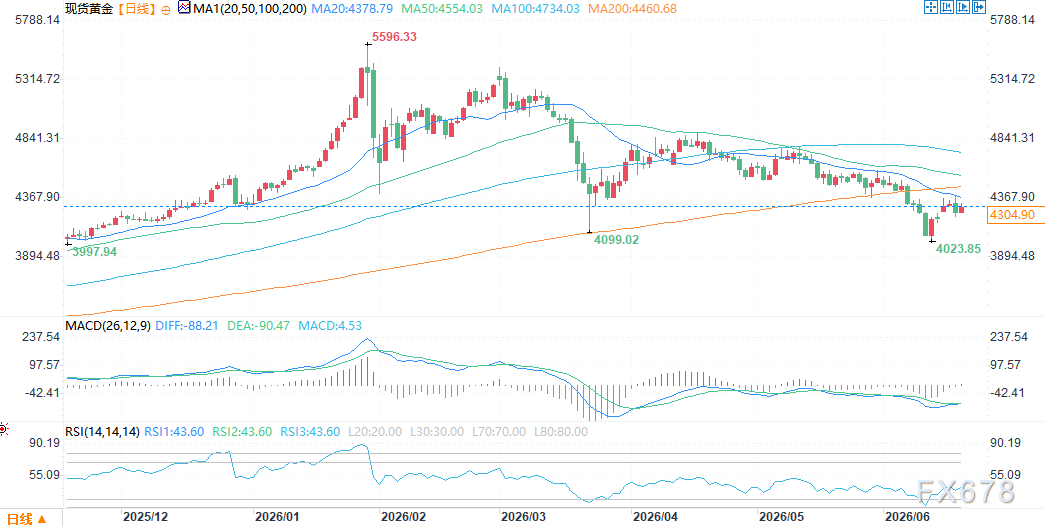
(Spot gold daily chart, source: Easy Forex Net)
At 16:04 (UTC+8) on June 18, spot gold was quoted at $4,290.60 per ounce.
Disclaimer: The content of this article solely reflects the author's opinion and does not represent the platform in any capacity. This article is not intended to serve as a reference for making investment decisions.
You may also like
A New XRP Catalyst? Ripple’s Schwartz Teases ‘New Ways People Are Using XRP’ Before Swell 2026
The Market Just Played Its Cruelest Trick — These 5 Altcoins Could Reward Those Who Refused to Panic Sell

MSCI to decide on Argentina’s potential return to global indexes next week
Digital asset treasury companies face challenges as public model weakens
Trending news
MoreCrypto prices
More


