- Algorand is celebrating its 7th anniversary today, having launched in 2019, with the team marking the milestone by reaffirming its long-standing focus on reliability and real-world readiness.
- Alongside the birthday, Algorand released a major update to its Post-Quantum Cryptography (PQC) Roadmap — having already deployed Falcon post-quantum signatures on Mainnet since beginning quantum threat preparation in 2022.
- The updated roadmap targets broad quantum resilience by the end of 2027 — with native post-quantum accounts arriving in Q3 2026, full multisig hybrid support by end-2026, and quantum-resistant VRF and consensus updates planned for 2027.
- The approach prioritises hybrid security — supporting both traditional Ed25519 and post-quantum Falcon signatures simultaneously — designed to protect users against future quantum threats with minimal disruption to existing accounts and seed phrases.
Algorand is seven years old today — and instead of marking the occasion with a purely celebratory announcement, the network used the milestone to reinforce something more substantive: a detailed, multi-year plan to make Algorand quantum-resistant before quantum computing becomes a genuine threat to blockchain cryptography.
The Algorand team reflected on the anniversary with characteristic understatement:
“We were ready in 2019, and we’re just as ready in 2026. Here’s to the next seven.”
That framing — consistency and readiness over hype — is the throughline connecting Algorand’s seven-year history to today’s quantum security announcement. While much of the crypto industry remains focused on short-term price action and narrative cycles, Algorand’s anniversary messaging doubled down on infrastructure built to last for decades.
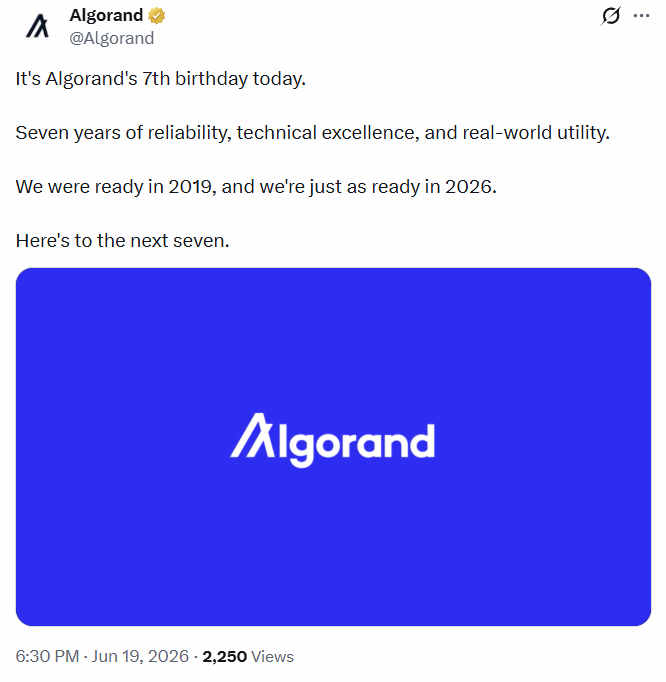 Source: @Algorand (X)
Seven Years of Building for the Long Term
Algorand launched in 2019 with a founding emphasis on technical rigor, security, and real-world readiness — positioning itself differently from many Layer-1 blockchains that prioritised rapid feature expansion or aggressive token incentive programs to drive early growth.
The network’s anniversary messaging reinforces this consistent identity: rather than chasing short-term hype cycles, Algorand has positioned its seven-year track record as evidence of building infrastructure designed for long-term institutional and real-world utility. Today’s quantum cryptography announcement is presented as a continuation of that same philosophy applied to one of the most significant long-term threats facing all blockchain networks: the eventual arrival of practical quantum computing.
The Quantum Threat — Why This Matters for Every Blockchain
Quantum computing poses a unique and serious risk to blockchain cryptography. Most current blockchain signature schemes — including the Ed25519 scheme used across much of the industry — rely on mathematical problems that are computationally infeasible for classical computers to solve, but that sufficiently powerful quantum computers could theoretically break.
If quantum computers reach the necessary scale and capability, they could potentially:
- Forge signatures on transactions, compromising account security
- Derive private keys from public keys exposed on-chain
- Undermine consensus mechanisms that rely on cryptographic randomness
This is not an immediate threat with current quantum computing capabilities — but it is a long-term certainty that the cryptography research community broadly agrees networks need to prepare for well in advance, given the multi-year timelines required to safely transition cryptographic infrastructure at scale.
The concern is not theoretical to the wider industry either — as we covered in our Google quantum computing Bitcoin warning article, Google has explicitly warned that advancing quantum computers could eventually crack Bitcoin’s underlying cryptographic security — a concern that prompted CZ’s response downplaying the urgency while still acknowledging that crypto will need to evolve to remain post-quantum secure over time.
Algorand’s Head Start — Already Live Since 2022 Preparation
What distinguishes Algorand’s announcement from purely theoretical quantum-readiness discussions elsewhere in the industry is the fact that meaningful implementation has already happened.
Algorand began preparing for quantum threats as early as 2022 — and has already deployed Falcon post-quantum signatures on Mainnet. Falcon is a NIST-selected post-quantum cryptographic signature scheme, designed specifically to remain secure against attacks from both classical and quantum computers.
This existing deployment gives Algorand a meaningful head start relative to many other blockchain networks that remain in the discussion or research phase regarding quantum resistance. The roadmap update announced today builds directly on top of this already-functioning foundation rather than starting from a purely theoretical position.
The Updated Roadmap — Path to Full Quantum Resilience by End-2027
The newly released roadmap lays out a clear, staged timeline toward comprehensive quantum resilience:
Q3 2026 — Introduction of native post-quantum accounts, beginning with Falcon-1024, alongside the rollout of cryptographic agility — a foundational capability that allows the network to support multiple signature schemes simultaneously rather than being locked into a single cryptographic standard.
End of 2026 — Native support for Falcon-512 and post-quantum multisig accounts with hybrid capabilities — extending quantum resistance to the multisig setups commonly used by institutions, treasuries, and high-value account structures.
2027 — Full quantum-resistant upgrades, including dedicated research into quantum-resistant Verifiable Random Functions (VRFs) and corresponding updates to Algorand’s consensus mechanisms — addressing not just individual account security but the cryptographic randomness underlying the network’s core consensus process.
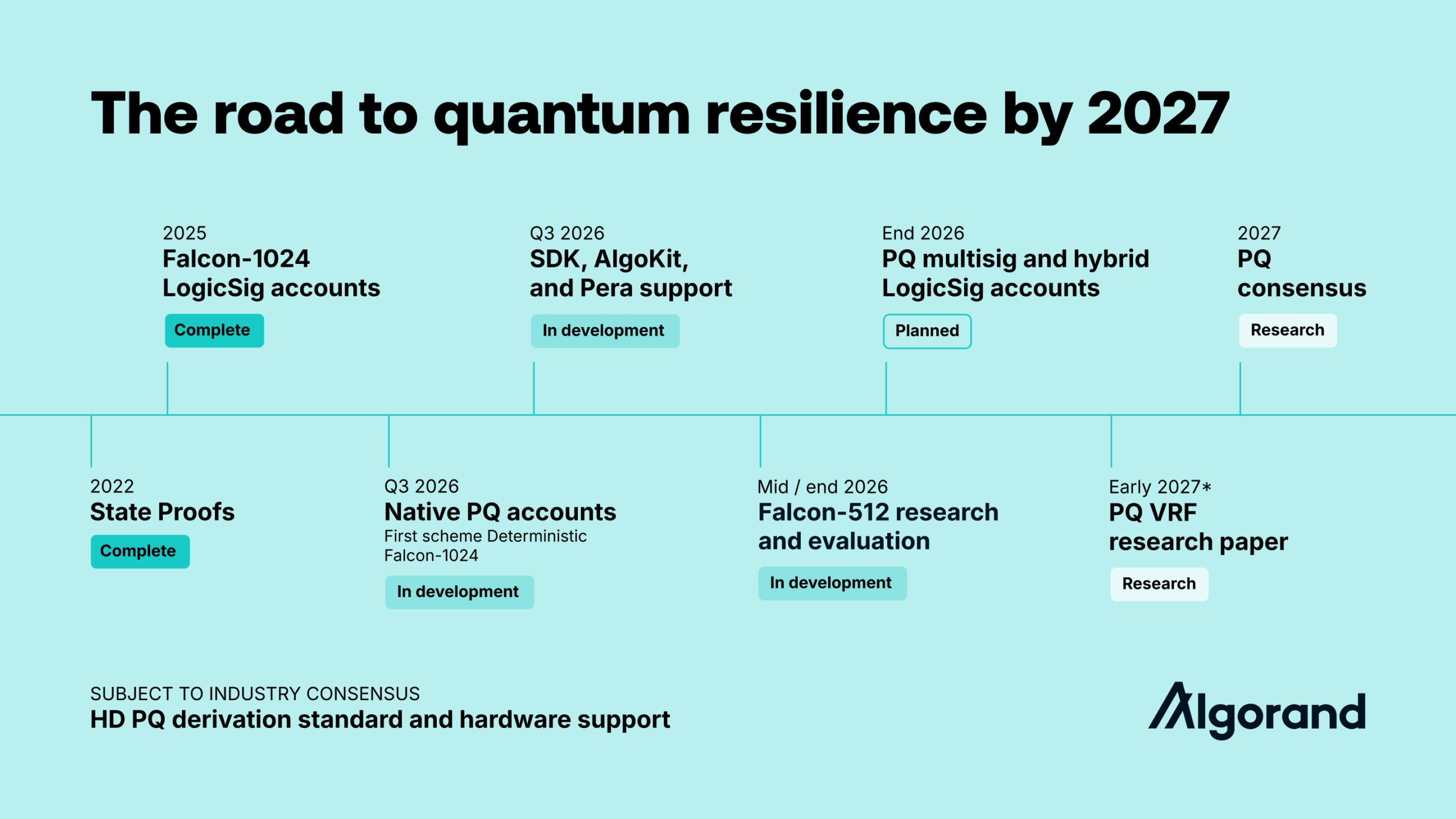 Post-Quantum Cryptography Roadmap Update Algorand/Source: @Algorand (X)
What This Means in Practice — Hybrid Security During Transition
The most important practical detail in Algorand’s approach is its commitment to hybrid security throughout the transition period. Rather than forcing an abrupt and disruptive switch from current cryptography to post-quantum standards, Algorand’s roadmap allows accounts and transactions to use both traditional Ed25519 and post-quantum Falcon signatures simultaneously.
This hybrid approach delivers several concrete benefits:
Stronger protection where it matters most — High-value accounts, institutional use cases, and multisig setups — exactly the kind of accounts most likely to be targeted by sophisticated future attacks — gain meaningfully stronger protection through early post-quantum adoption.
Cryptographic agility for future-proofing — Building the capability to support multiple signature schemes simultaneously means Algorand can adopt future NIST cryptographic standards as they are finalised, without requiring another fundamental architectural overhaul each time the standards evolve.
Minimal disruption for everyday users — Critically, the roadmap maintains continued support for the familiar 25-word seed phrases and 32-byte addresses that existing Algorand users already rely on. The quantum security upgrade is designed to happen largely beneath the surface, without requiring most users to change how they interact with their accounts.
The roadmap also explicitly emphasises collaboration with hardware wallet manufacturers and broader ecosystem tooling updates — recognising that a successful transition to quantum resistance requires coordination across the entire surrounding infrastructure, not just changes to the core protocol itself.
Why Algorand’s Proactive Approach Stands Out
As quantum computing capabilities continue advancing, the blockchain industry broadly faces a genuine long-term vulnerability: networks that have not prepared their cryptographic infrastructure risk eventual exposure to attacks that could break currently-standard signature schemes.
The distinction Algorand is drawing with today’s announcement is specifically between discussion and implementation. Many blockchain projects across the industry continue to discuss quantum risk as a theoretical future concern requiring eventual attention. Algorand’s position — having already deployed live Falcon signatures on Mainnet since beginning preparation in 2022, and now publishing a detailed staged roadmap through 2027 — represents active implementation rather than ongoing deliberation.
For a network celebrating seven years built on a foundation of reliability and institutional-grade infrastructure, leading with concrete quantum security progress on its anniversary is a consistent reinforcement of that same long-term positioning. While Bitcoin’s own quantum exposure remains a subject of ongoing industry debate, Algorand’s already-implemented roadmap positions it as one of the few networks treating the transition as a near-term engineering priority rather than a distant theoretical concern.
Bottom Line
Algorand’s 7th anniversary announcement combines two reinforcing messages: seven years of consistent, reliability-focused infrastructure development, and a detailed, already-partially-implemented roadmap toward full quantum resistance by the end of 2027.
The hybrid security approach — supporting both Ed25519 and Falcon post-quantum signatures simultaneously — is the practical centrepiece of the plan, designed to deliver meaningfully stronger protection for high-value and institutional accounts while minimising disruption for everyday users who will continue using the same seed phrases and addresses they already know.
While much of the blockchain industry continues treating quantum resistance as a future discussion point, Algorand’s Mainnet-deployed Falcon signatures and staged 2026–2027 roadmap demonstrate a network actively building toward that future rather than waiting for the threat to become urgent.
Frequently Asked Questions
How old is Algorand now?
Algorand officially turned 7 years old on June 19, 2026. It launched in 2019 and is celebrating its anniversary today.
What post-quantum cryptography has Algorand already deployed?
Falcon post-quantum signatures are already live on Mainnet — Algorand began preparing for quantum threats as early as 2022, giving it a head start relative to many other blockchain networks.
What is the timeline for Algorand’s full quantum resilience?
Native post-quantum accounts (Falcon-1024) arrive in Q3 2026, Falcon-512 and multisig hybrid accounts by end-2026, and full quantum-resistant upgrades including VRF and consensus updates throughout 2027 — targeting broad quantum resilience by end-2027.
What is hybrid security and why does it matter?
It allows accounts to use both traditional Ed25519 and post-quantum Falcon signatures simultaneously — protecting against both current and future quantum threats while minimising disruption to existing users.
Will users need to change their seed phrases or wallets?
No — the roadmap maintains continued support for the familiar 25-word seed phrases and 32-byte addresses that existing Algorand users already use, with the quantum upgrade designed to happen largely beneath the surface.