
With the threat of Fed rate hikes looming, gold suffers a bloodbath—how long can the 4050 support line hold?

Huitong Network, June 24—— Driven by rising expectations of a Federal Reserve rate hike, the US Dollar Index has soared to its highest level since May 2025, putting sustained pressure on spot gold, which has continued to decline, reaching a two-week low near $4,050. Although the sharp drop in oil prices has alleviated some inflation concerns, the market remains focused on sticky core inflation, with rate hike bets undented. Technically, bears are in control, this year's low at $4,023 is in jeopardy, and the market is watching PCE data for direction.
Amid ongoing undercurrents of international geopolitical tension and dramatic fluctuations in the oil market, gold—traditionally the safest haven—has remained under persistent pressure this week, quietly sliding to its lowest price level in nearly two weeks. During the Asian session on Wednesday (June 24), spot gold (XAU/USD) recorded its second consecutive day of decline, closing lower in five out of the past six sessions, and at one point approached the key psychological level of $4,050 per ounce, just a step away from the yearly low set earlier this month. This abnormal performance is not driven by a full revival of risk appetite; rather, it's a much more powerful macro force at play—relentless expectations of another Federal Reserve rate hike are boosting the US Dollar, exerting systematic pressure on the non-yielding asset, gold.
Rate Hike Expectations “Revived” —US Dollar Strength Looms as a Sword over Gold Prices
The dominant narrative in the current gold market is undoubtedly the Federal Reserve’s hawkish shift in monetary policy. Although last week’s inflation data had briefly offered hope for easing price pressures, investors clearly remained wary of any loosening. On the contrary, following the latest Fed rate decision, market bets on at least another 25 basis point hike before 2026 have not faded, but intensified.
According to statements from the Fed’s 19 members, as many as nine clearly believe current policy rates are still insufficient to effectively curb inflation, making further hikes necessary.
The reason why a stronger dollar so severely impacts gold lies in their negative correlation. Since gold is priced in dollars, a stronger dollar means higher costs for holders of other currencies to purchase gold, thus dampening physical demand.
At the same time, heightened rate hike expectations push up bond yields, further increasing the opportunity cost of holding non-interest-generating assets like gold. This prompts large funds to exit gold and shift to US dollar assets for higher returns. Even the ongoing escalation of geopolitical risks such as the Iran nuclear issue has failed to spark safe-haven demand for gold, indicating that in the current macro environment, monetary policy far outweighs geopolitical concerns.
Oil Collapse Eases Inflation Fears—But Gold is “Not Buying In”
Curiously, the recent sharp decline in oil markets should have been a potential positive for gold. Over the past month, international oil prices have tumbled significantly—particularly on June 24th, when news of the reopening of the Strait of Hormuz was confirmed, pushing oil prices to their lowest level since early March.
Specifically, Iranian military sources told Fars News Agency that, with coordination from the Islamic Revolutionary Guard Corps Navy, a limited number of vessels are now permitted to transit the strait each day. Meanwhile, the US Treasury also announced a 60-day temporary sanctions waiver, granting permission for transactions involving Iranian crude, petroleum, and petrochemical production, transport, and sale. These developments have greatly eased previous extreme fears of a disruption in global energy supply, thus keeping oil prices pressured.
Logically, falling oil prices directly reduce transportation and industrial production costs, which in turn lowers end-consumer prices and helps relieve the energy component pressure in consumer price indexes, thus diminishing the urgency for Fed rate hikes—a positive for gold. However, the market has chosen to “ignore” this positive signal.
The reason,
Market participants generally believe that short-term volatility in energy prices alone is not enough to alter the Fed’s assessment of the overall inflation trend. Thus, oil price declines have not shaken rate hike expectations nor provided effective support for gold.
Geopolitics: “Reality and Illusion”—US Dollar is the Main Beneficiary
On the geopolitical front, recent news on the Iran nuclear issue has presented a rare mix of conflicting signals. Rather than suppressing the dollar, this uncertainty has actually reinforced the greenback's safe-haven appeal. On Monday, US Vice President JD Vance stated publicly that the peace talks in Switzerland have achieved a substantive breakthrough, with Iran agreeing to allow the IAEA to conduct on-site inspections of its nuclear facilities. Following this, US President Trump boldly announced that Iran had “fully and completely” agreed to the highest level of nuclear inspections for an extended future period. These statements were initially interpreted by the market as signs of easing Middle East tensions.
Yet, the plot quickly reversed. Iranian state media, citing a Foreign Ministry statement, explicitly denied the US claims, stressing that Tehran had not made any new commitments regarding nuclear inspections. This denial means the stalemate on the Iran nuclear issue remains unresolved, keeping geopolitical risk premiums elevated. Interestingly, when geopolitical risks rise, investors are now opting first for the most liquid safe havens—US dollars and Treasuries—not gold. Especially as the Fed’s rate-hike cycle continues, the dollar, with its dual advantages of yield and safety, is drawing in a flood of capital, creating a “crowding-out effect” on gold. In other words, most of the safe-haven flow triggered by geopolitical uncertainty is now headed for the US dollar, not gold, forming yet another key drag on gold prices.
Technical Outlook “Red Light”—Bears in Firm Control
From a technical analysis perspective, short-term gold movement is also less than optimistic. On the four-hour candlestick chart, gold has recently failed multiple attempts to break above the 100-period simple moving average (currently near $4,290), cementing this MA as a formidable resistance zone. More critically, gold convincingly broke below the $4,100 mark this week and has continued below that level, signaling a new round of bearish positioning. In terms of momentum, the RSI is hovering around 33—approaching oversold territory. While this hints at potential short-covering rebounds in the short term, the MACD remains deeply negative with both lines trending downward, indicating strong ongoing downside momentum, and suggesting that any rebounds are more likely selling opportunities rather than a trend reversal.
Overall, gold’s downside risk remains dominant in the short term, with the next key target being this month's earlier yearly low in the $4,023–$4,024 region. Bulls will need to convincingly reclaim the 100-period moving average at $4,290 to temporarily relieve bearish pressure and enable bottom consolidation. Until then, any attempts to rebound to the $4,280–$4,290 resistance range are likely to trigger new selling, as current momentum does not show signs of a sustainable bullish reversal.
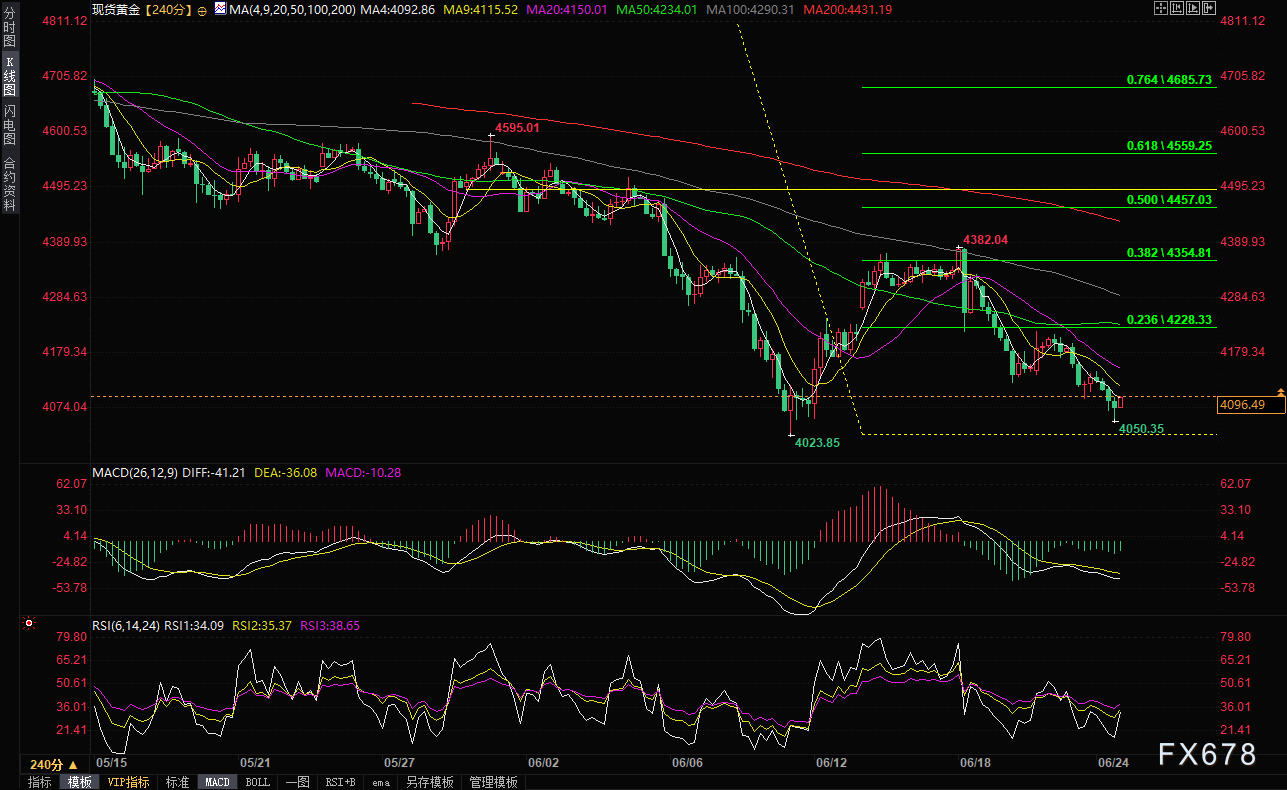
(Spot gold 4-hour chart, source: Yihuitong)
Summary: The Rate-Hike Narrative Continues, This Week’s PCE Data May Be the Final Straw
In summary, gold’s current predicament is the result of multiple bearish factors resonating: rising Fed rate hike expectations fueling the dollar, falling oil prices failing to reverse inflation fears, geopolitical tension reinforcing the dollar’s safe-haven status, and a technical breakdown dominated by bearish sentiment. Among all these, the evolution of rate hike expectations remains the key variable for gold’s medium-term trend. Looking ahead, traders are focusing on the upcoming US Core Personal Consumption Expenditure (PCE) Price Index on Thursday—the Fed's preferred inflation gauge, whose reading will guide market pricing for future hikes and trigger the next wave of gold volatility. Until then, gold bulls might have to stay on the defensive, waiting for a fresh fundamental catalyst to break the current weak pattern.
Frequently Asked Questions (FAQ)
Answer: While falling oil prices do ease overall inflation pressure, the Federal Reserve is now focused on core inflation, which is influenced by sticky elements like wages and rents and is not sensitive to energy price changes. Thus, markets believe a one-off energy price fall is insufficient to alter the Fed’s stance on persistent inflation, and rate hike expectations remain high. With the dollar strong, the cost of holding a non-yielding asset like gold rises, naturally weighing on prices.
Answer: According to the latest dot plot, 9 out of 19 members see a need for higher rates. While not a majority, this ratio is enough to keep the market on high alert. The case for more hikes centers on the still-tight labor market, slow retreat of core services inflation, and the near-obsessive stance on price stability from the new chair Walsh. Even if economic growth slows on the margin, as long as inflation hasn't clearly returned to 2%, rate hike options won’t be taken off the table.
Answer: In today's global financial system, the US dollar is both the key trading and primary reserve currency. When geopolitical uncertainty arises, institutional investors usually prefer the most liquid, convertible dollar assets to avoid risk. The dollar also enjoys higher yields at present, adding a return advantage to its safe-haven role. Gold, while also a safe-haven asset, yields no interest and its liquidity lags Treasuries during tumultuous times. Thus, in the current climate—where conflict has not escalated to war—the safe-haven flow favors the dollar over gold.
Answer: The RSI near 33 does indicate potential short-term excessive selling, and historically, bounces initiated by short-covering often occur in oversold regions. However, oversold readings alone are not a reversal signal. As long as MACD stays negative and the moving average system remains bearish, any rebound is likely to be seen as a selling window. Gold must first reclaim $4,100, and then the $4,287 level (the 100-period moving average) before a true trend reversal can be spoken of; until then, rebound sustainability is doubtful.
Answer: The Core PCE data is the Fed’s most important inflation gauge. If it comes in higher than expected, this will directly boost bets for a September or December rate hike; the dollar may surge, and gold risks breaking this year's low at $4,023. Conversely, if data is softer than expected, rate hike odds will drop, the dollar would retreat, giving gold a chance to rebound—possibly triggering strong short-covering. Thus, the PCE report is likely to be the key turning point for whether gold breaks down or stages a “comeback” in the near term.
14:15 (UTC+8), spot gold last at $4,093.68 per ounce.
Disclaimer: The content of this article solely reflects the author's opinion and does not represent the platform in any capacity. This article is not intended to serve as a reference for making investment decisions.
You may also like
Ethena’s 13% price rally – Here’s how all these gains were wiped out!
British Pound: Head and shoulders signals gains against Euro – Societe Generale
Japan must take bold action or risk further significant weakness in the yen - JP Morgan
Bitway (BTW) Price Prediction 2026, 2027, 2028, 2029, 2030-2050
Trending news
MoreCrypto prices
More


