
The White House May Intervene to Support the Market: Gold Trading Logic Amid US Stock Pullback

ForexNet, June 24th—— This time, it may be the White House’s turn to backstop the market. Pay attention to the “golden pit” opportunity when gold prices are negatively impacted by market panic.
For a long time, the market has believed in the “Fed put,” meaning that when US stocks or major asset classes experience a sharp correction and market panic spreads, the Federal Reserve will usually respond with interest rate cuts, liquidity injections, or other monetary easing measures to backstop market liquidity and avert a crisis. This implicit market support rule has never been officially confirmed, but has been validated through numerous crashes, such as the 1987 US stock market crash, the global financial crisis, and the COVID-19 pandemic, making it a widely recognized asset safety net among investors.
However, in recent years, there has been a key change in the market landscape. The White House, represented by Trump, has formed an independent “White House put” system distinct from monetary policy, also known in the market as the “Trump put.” Now, traders regard White House policies and statements on par with Federal Reserve monetary policy.
Key Difference: Monetary Backstop VS Political Backstop with Differing Fundamental Logic
The two backstop logics are fundamentally different.
The Fed’s backstop relies on monetary policy. When asset declines tighten financial conditions and suppress risk appetite, the central bank will intervene to counterbalance;
The White House’s backstop relies on political policies. When tariffs, sanctions, or geopolitical actions trigger sharp stock market drops, US Treasury volatility, or a collapse in business confidence,
Whether it’s the recent equity sell-off triggered by new tariffs, or the global risk asset volatility caused by Middle East geopolitical tensions, the US administration has repeatedly adopted the approach of softening its stance and reassuring markets amid steep declines.
White House Backstop Characteristics: Highly Subjective Discretion
At its root, the US political environment is closely tied to capital market performance. Trump’s public statements and social media posts have consistently regarded rising stock prices as both a political achievement and a governance tool. The market also has reached a consensus: the White House cannot tolerate sustained deep declines in capital markets. When market prices approach critical panic points, political interventions are bound to emerge.
However, unlike the Fed, whose responsibilities and targets (inflation and employment) are clearly defined,
Trading Pattern: Marginal Diminishing Effect of Backstops
From a historical trading perspective, during the early stages of sharp US capital market corrections—at points of extreme panic—a strong contrarian opportunity often arises, representing high-quality left-side entry points.
In the early days, market-supporting announcements or rescue policies from the Fed or the White House had a powerful effect—every official statement could quickly repair market sentiment and trigger rapid index rebounds;
But as the frequency of official backstops and calming rhetoric increases, the market gradually digests these expectations. The market-boosting effect from policy pronouncements steadily weakens at the margin, and the rebound becomes less powerful.
Current Fundamentals: Midterm Elections Sharply Raise Intervention Probability
Considering the current environment, political pressure from the US midterm elections has been intensifying, and there is a much stronger desire among policymakers to stabilize capital markets and protect citizen asset returns. If US stocks start to fall rapidly and market panic intensifies, the probability of the White House and the Fed coordinating market-stabilizing measures and releasing positive signals increases sharply, further lowering the threshold for a dual backstop response.
Practical Insights: Restrain Panic, Seek Opportunity in Dual Stock-Gold Strategy
This defines the core market mindset for today’s traders: During periods of extreme panic and pessimism in the capital markets, it is generally not a time to exit. Instead, one should restrain emotional panic, rationally identify oversold opportunities, and pursue a contrarian strategy to seek opportunity in risk.
In terms of portfolio strategy, during irrational and sharp corrections in US stocks, risk appetite is suppressed, and even traditional assets like gold may experience selling pressure. This easily creates “golden pits” (temporary undervaluation zones where asset prices fall below their intrinsic value) due to emotional selling.
For example, on Thursday, the US PCE and core PCE price indices will be released. With inflation data expected to stay high, both US stocks and gold may face fresh pressure from inflation headwinds. Combined with the White House put, this could present well-timed buying opportunities when the negative news is fully priced in.
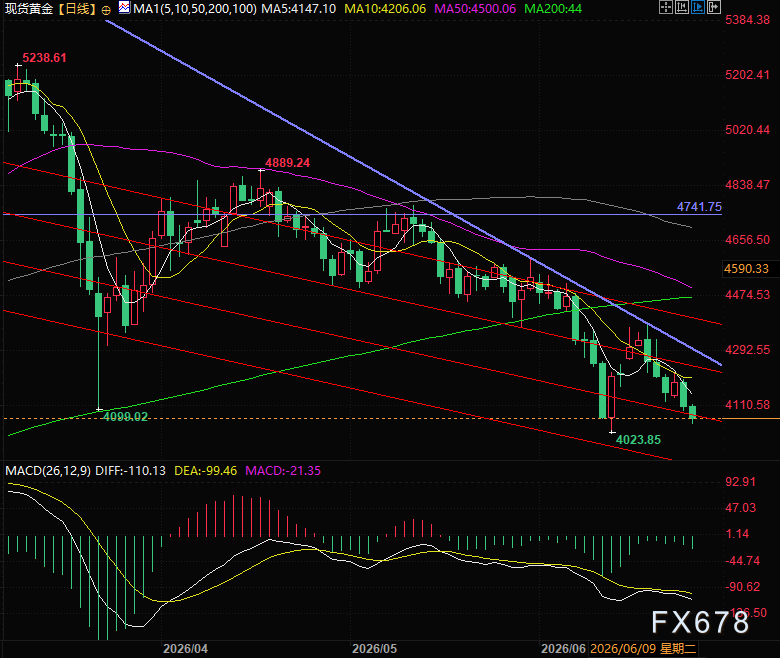
(Spot gold daily chart, source: Yihuitong)
As of 17:36 in the GMT+8 time zone, spot gold is trading at $4,067 per ounce.
Disclaimer: The content of this article solely reflects the author's opinion and does not represent the platform in any capacity. This article is not intended to serve as a reference for making investment decisions.
You may also like
FuelCell Energy signs 380 MW deal with Fit Energy to power data centers
SBI Holdings launches Japan’s first trust bank-backed yen stablecoin
XRP Price Prediction: Bears Hold Control as Weak Capital Flows Keep Recovery Prospects Limited
Trending news
MoreCrypto prices
More


