
Australia’s Unemployment Rate falls in May: What 4.4% means for AUD/USD

Australia’s Unemployment Rate fell to 4.4% in May from 4.5% in April, according to the official data released by the Australian Bureau of Statistics (ABS) on Thursday. The figure came in line with the market consensus.
Furthermore, the Australian Employment Change arrived at 40.3K in May from a decline of 40.7K in April (revised from -18.6K), compared with the consensus forecast of a 25K increase.
The participation rate in Australia increased to 66.7% in May from 66.6% in April. Meanwhile, Full-Time Employment increased by 5.2K in the same period from a decline of 21.7K in the previous reading (revised from -10.7K). The Part-Time Employment rose by 35.2K in May versus a fall of 19.0K prior (revised from -7.9K).
Sean Crick, ABS head of labour statistics, said with the key highlights noted below
Over the past few months, we have recorded higher proportions of unemployed people waiting to start jobs who then remained unemployed in the following month.
The backlog of people waiting to start a job has eased in May, contributing to the 40,000 rise in employment and 18,000 fall in unemployed persons.
In April, less people took leave during the Easter holiday period and instead worked their usual hours, contributing to non-seasonal strength in hours worked.
The employment data fails to boost the Australian Dollar (AUD). At the time of writing, the AUD/USD pair is trading 0.09% lower on the day to trade at 0.6893.
What do Australia’s employment data mean for the Australian Dollar?
Australia's employment data provides insights into labor market conditions, economic growth, and inflationary pressures. This report is closely monitored by the Reserve Bank of Australia (RBA) when assessing the appropriate stance of monetary policy.
Stronger-than-expected employment data or a falling Unemployment Rate signal a resilient labor market and a healthy economy, which supports the Aussie by leading to a more hawkish stance from the Australian central bank.
On the other hand, weaker-than-expected employment data or A higher Unemployment Rate may indicate slowing economic momentum and softer labor demand. This might lead markets to expect a more dovish stance from the Australian central bank.
Technical Analysis: AUD/USD keeps the bearish vibe in the near term
In the daily chart, AUD/USD trades with a bearish near-term bias, holding well beneath the 100-day simple moving average (SMA) and the 20-day Bollinger middle band near 0.7045. Price is edging just over the lower Bollinger band support, suggesting the latest slide is pressing against volatility support, while the Relative Strength Index (14) around 27 signals oversold momentum that could slow immediate downside but does not yet challenge the prevailing negative structure.
On the downside, the lower Bollinger band at 0.6882 is the first support to monitor, and a clear break below this floor would open the door to a deeper extension of the decline. On the topside, initial resistance is located at the 20-day Bollinger SMA around 0.7045, followed by the 100-day SMA at 0.7083 and then the upper Bollinger band near 0.7208, levels that together define a broad cap on recovery attempts while price holds below them.
(The technical analysis of this story was written with the help of an AI tool.)
Disclaimer: The content of this article solely reflects the author's opinion and does not represent the platform in any capacity. This article is not intended to serve as a reference for making investment decisions.
You may also like
US arbitration giant rolls out ‘legal layer’ for agentic commerce
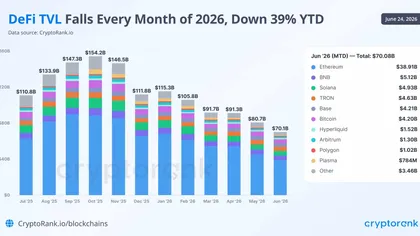
DeFi’s $70B slide – Is crypto’s trust problem getting worse?
Euro: Downtrend stretched near 1.1325 against US Dollar – UOB
Trending news
MoreCrypto prices
More


