
Is the Myth of Gold as a Safe Haven Broken? "Death Cross" Approaching, Geopolitical Decoupling, Bulls Liquidated by Liquidity

The market dynamics of gold are undergoing a fundamental shift. The geopolitical premium and safe haven narrative that once repeatedly propelled gold prices to new highs have quietly faded away, with Federal Reserve policy expectations and the US dollar trend becoming the new core drivers dominating price action.
Goldman Sachs has lowered its year-end target to $4,900, and Deutsche Bank warns that in a more hawkish rate scenario, gold prices could fall toward $3,800. At the same time, gold prices have broken below multiple key support levels, a “death cross” signal is imminent, and technical pressures have significantly intensified.
On June 25, spot gold once again breached the psychologically important $4,000/oz threshold. Since hitting a historic high near $5,600/oz at the end of January this year, gold prices have corrected by about 29% in total.
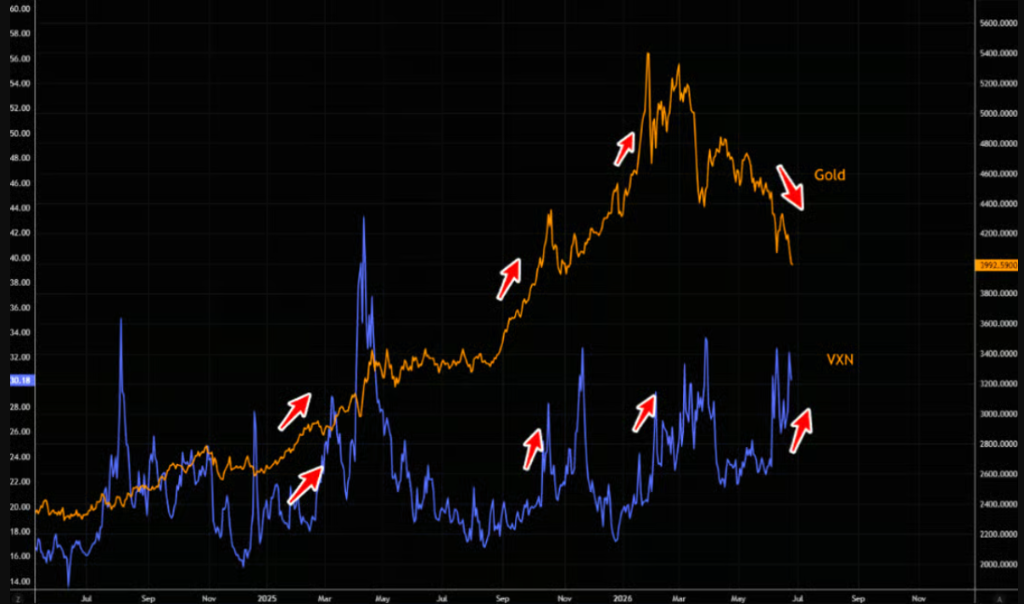
The practical significance of this shift for investors is that the logic of positioning based on old gold narratives is failing. Gold’s volatility structure has flipped abnormally, showing that long positions remain crowded while downside hedging demand is rising sharply.
Shift in Driving Logic: From Geopolitics to Fed & Dollar
The gold pricing mechanism has undergone a structural transformation. Since November last year, gold prices have shown a highly negative correlation to the US Dollar Index (DXY), to the point where the latest surge in the dollar has even made gold prices appear “lagging.” Meanwhile, the connection between gold and Federal Reserve policy expectations has grown ever tighter, rather than with geopolitical risks.
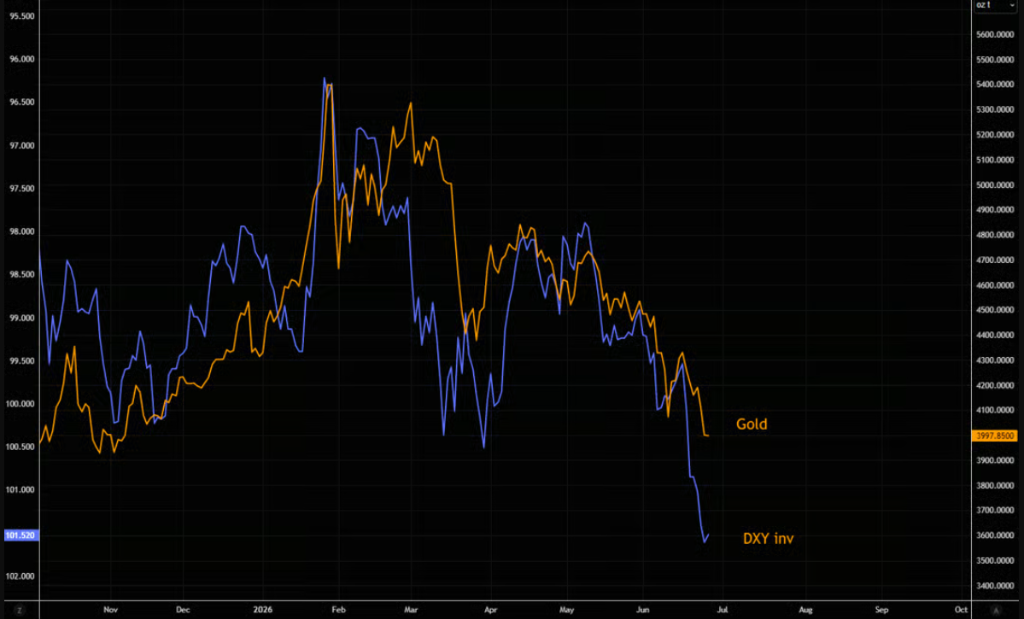
Under the leadership of Chair Warsh, the Fed’s hawkish stance continues to strengthen. Combined with the stronger dollar and a stabilizing situation in the Middle East, these macro factors are collectively suppressing gold prices. According to Bloomberg data, gold failed to play its traditional safe haven role during the Iran conflict, instead moving inversely to oil. This suggests the market has proactively priced out the worst-case scenario. More notably, amid a broader cross-asset selloff, investors have chosen to sell gold to supplement liquidity instead of treating it as a safe harbor.
This means the function of gold as a “global panic hedge” has been greatly weakened. The factors that drove gold higher from 2025 to January this year are sharply different from the current pricing logic.
Death Cross Approaches, Key Supports Breached
Technical signals are just as concerning. Gold is still trading below its 200-day moving average and near-term trendlines; the long-standing compression pattern has already broken downwards, with multiple key supports falling in succession.
If gold closes decisively below the critical $4,000 mark, market focus will shift to the next support zones near $3,800 and $3,600. Historical data shows that the advent of a death cross is often accompanied by sustained weakness in gold, while a golden cross usually signals strong performance.
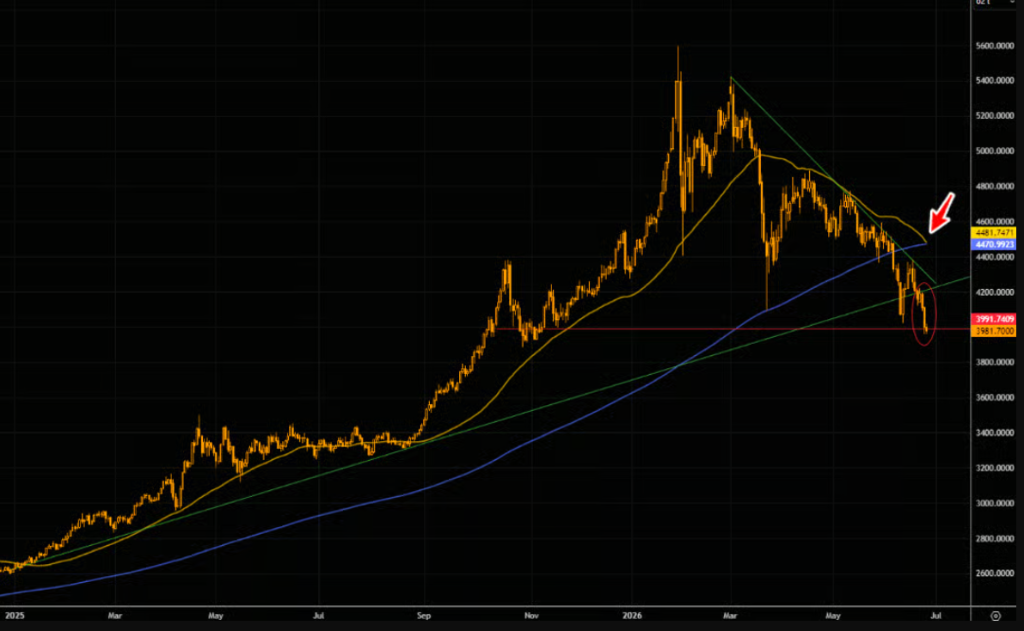
In terms of momentum indicators, the weekly RSI has reached its most oversold levels since the end of 2022. However, the oversold condition may persist longer than most expect—some market commentators have remained bullish even when gold was more than $1,500 higher than its current level, a strategy that is neither trading nor proper risk management.
Wall Street Divergence: Goldman, Deutsche Lower Targets while UBS Awaits Rebound
Major institutions have markedly different views on the gold outlook. Goldman Sachs has cut its year-end target price to $4,900 from previous levels; Deutsche Bank, under a more hawkish rate outlook, warns of potential downside towards $3,800; UBS, meanwhile, remains relatively optimistic, projecting a recovery in gold prices later this year.
Behind these differing stances lies a fundamental divergence regarding the Fed’s policy path. In an environment dominated by hawkish expectations, gold’s nature as a non-yielding asset makes it particularly pressured.
Although physical demand from China and India remains resilient, forward-looking indicators are flashing warning signals. The premium of the Shanghai Gold Exchange over Comex has flipped to a discount, a bearish signal in history pointing to weakening Chinese import demand.
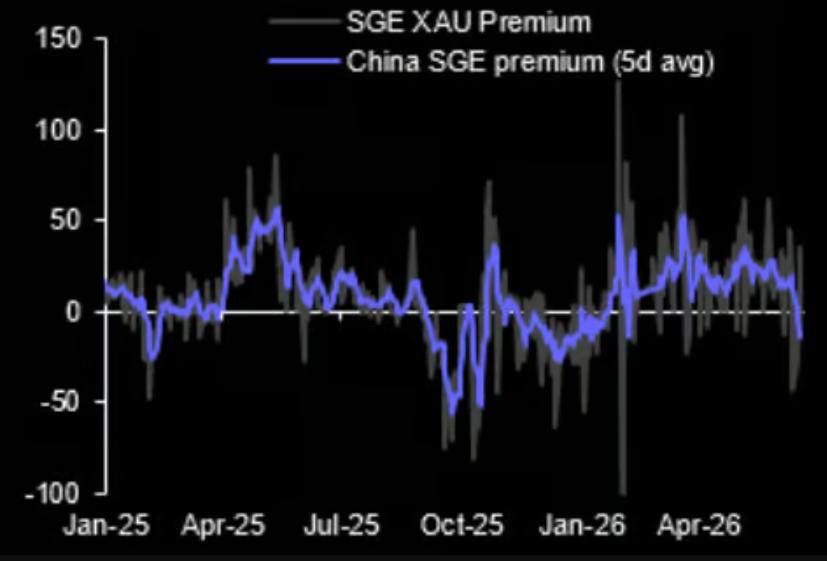
Deutsche Bank also notes that a strengthening renminbi and a stabilizing domestic real estate market could further dampen China’s domestic demand for gold. From a longer-term perspective, central bank gold purchases globally remain around 50 tons per month, providing a measure of support for gold prices, but ETF holdings are still below early-year levels, with no clear revival in institutional allocation appetite.
Crowded Longs, Soaring Demand for Downside Hedges
Gold’s volatility structure is flashing unusual signals. Gold typically displays an upward volatility skew—volatility rises as prices go up. This latest decline has upended that pattern, with volatility spiking dramatically during gold’s drop, evidencing that investors are still largely net long and are scrambling to hedge downside risks.
This structural anomaly means that if gold prices fall further, forced liquidations could trigger a self-reinforcing, negative feedback loop. Gold’s current trading logic has clearly shifted towards focusing on the Fed, the dollar, and positioning structure. Until these drivers change substantively, investors relying on old gold narratives need to remain highly cautious.
Disclaimer: The content of this article solely reflects the author's opinion and does not represent the platform in any capacity. This article is not intended to serve as a reference for making investment decisions.
You may also like
Bearish Bets Surge on IBIT and MicroStrategy as Bitcoin Slumps Below $59,000
CertiK joins XDC Network to secure trade finance and RWA tokenization

XRP price risks fresh losses as sellers tighten grip below $1.07 support
Lummis Pushes Back Against Dimon’s Criticism of Crypto Bill
Trending news
MoreCrypto prices
More


