
When will the cloud giants rebound?

Cloud
After last night's Micron earnings report, as expected, global stock market sentiment reversed. All of the U.S. investment banks that I'm able to observe have basically raised their price targets for Micron. For instance, among the six major American investment banks, the most conservative, Goldman Sachs, rated it Neutral with a target price of 1100, while Morgan Stanley rated it Overweight with a target price of 1200, and the other four are all above 1400. It’s clear this earnings report really impressed institutional investors. Let’s continue to discuss the expected developments and catalysts for memory/storage according to J.P. Morgan.
First, J.P. Morgan believes that the recent volatility in memory/storage is mainly due to capital flows and sentiment, not fundamental problems—which everyone is already aware of. Next, it was observed that signed long-term deals for storage manufacturers have slowed down since May this year, but this doesn’t necessarily represent a demand issue but more likely indicates negotiations have entered a crucial stage. Moreover, the rollout of large-scale long-term deals hasn’t happened yet—they might not materialize until the second half of this year, and the key players are likely to be major American cloud service providers.
Continuing with this, in Micron’s earnings report yesterday, they mentioned having four hyperscale clients, which we estimate could be Nvidia, Microsoft, Google, and Anthropic. There are more opportunities for future signings, including Amazon, OpenAI, SpaceX, and Meta. Based on proportional relationships and J.P. Morgan’s models, the minimum $100 billion contract Micron mentioned yesterday could eventually be worth $250 billion or more, representing a total market cap of about $1.8 to $2 trillion. More details need to be monitored, but the overall framework will likely develop in this direction.
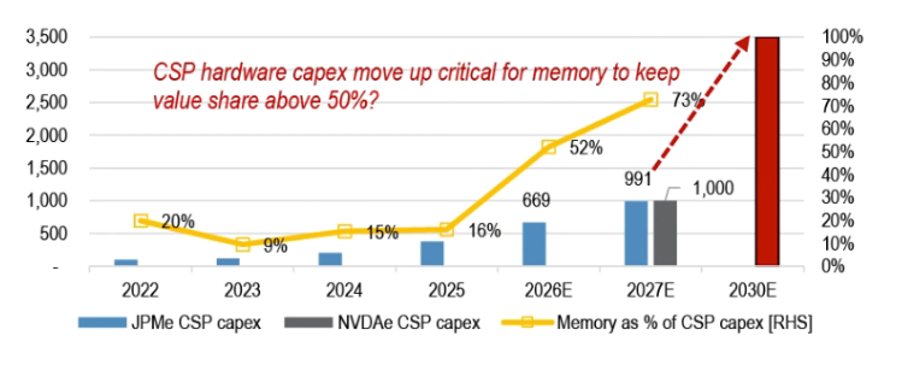
Next, even more important is capital expenditure. According to J.P. Morgan’s estimates, storage's proportion in total capital expenditure has risen from less than 20% in 2022 to an estimated 52% in 2026, and in 2027 it could surpass 70%.
These two numbers are much more optimistic than our earlier rough calculations, especially the 70% share projected for next year. Think about it: assuming the proportion among CPU, GPU, and storage is relatively fixed. If 15% is allocated to land, electricity, and other supporting infrastructure, and 85% to AI semiconductors, with storage accounting for 73%, and CPU, GPU, and all other units only taking up 15%, then by that calculation, J.P. Morgan’s ratio is indeed quite exaggerated. But even if storage only accounts for 60% or 55%, the squeeze effect caused by storage is still extremely significant.
To put it simply, the following three scenarios may unfold next:
A. Capital expenditure remains unchanged, and incremental computing power slows. Cloud and model, as well as all semiconductors besides storage, come under pressure, while the storage thesis continues.
B. Capital expenditure increases, and incremental computing power is maintained. Cloud takes the pressure, everything else continues as before.
C. Capital expenditure is lowered, incremental computing power slows, cloud rebounds, and everything else comes under pressure.
Jason believes that while market expectations are high and the pressure on cloud is not insignificant, there are no signs or evidence at all suggesting that cloud operators will start to cut back on spending. On the contrary, from TSMC's statements at the Shanghai Conference Center forum, there is even more confidence in this wave of capital expenditures. Therefore, we are inclined to believe that spending will remain unchanged or be increased, the main cloud players will continue to feel the pressure, other semiconductors remain relatively positive, and the storage thesis will remain strong.
Looking ahead, Microsoft’s earnings at the end of July will likely disclose next fiscal year’s capital expenditures, so this will be a key observation point.


Disclaimer: The content of this article solely reflects the author's opinion and does not represent the platform in any capacity. This article is not intended to serve as a reference for making investment decisions.
You may also like
Only 5% of Pump.fun tokens survive past 90 days, CoinGecko study finds
Hanging Man!
Base to Activate B20 Token Standard on Mainnet Today
Bitcoin Miners Operating at Break-Even as Industry Faces ‘Most Complex Restructuring’
Trending news
MoreCrypto prices
More


