
South Korean Stock Market Plummets, Why Is the Won Appreciating?

Morning FX
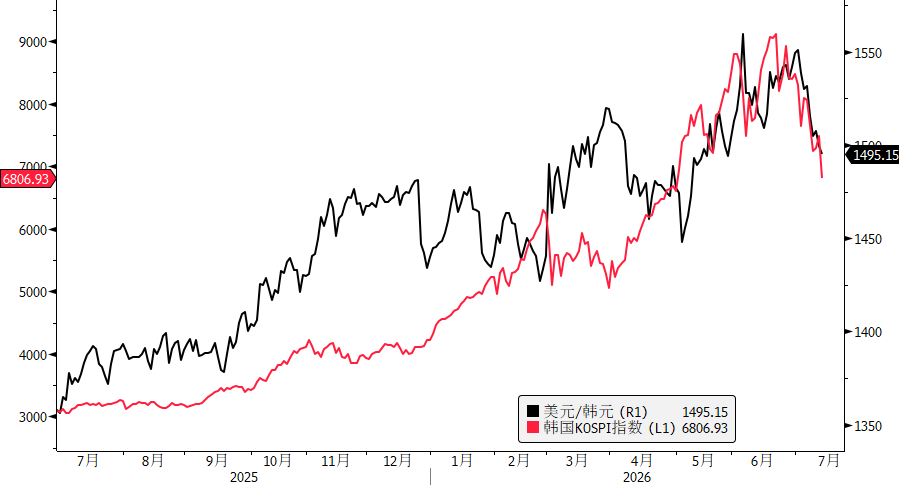
Since the beginning of this year, the Korean won and the South Korean stock market have shown an obvious negative correlation. In the first half of the year, the South Korean stock market was the top-performing market in the world, but the won hit bottom among Asian emerging markets. However, since July, a sharp fall in the Korean stock market accompanied a reversal in the won’s trend, with the won rising from the 1550 level to break above 1500.
1. Reasons forthe won’s depreciation in the first half of the year
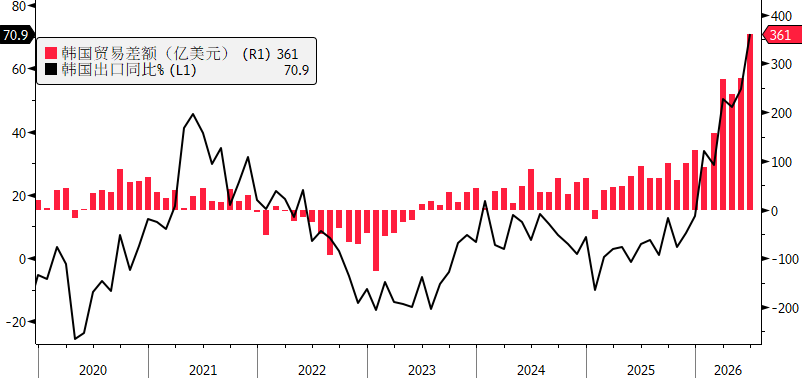
From a fundamental perspective, multiple indicators of the South Korean economy have improved significantly: Long-term spending on AI computing power has supported resilient exports, with year-on-year export growth reaching 70.9% in June 2026, and a total trade surplus of $138.3 billion from January to June, setting a new record high.Semiconductor exports drove South Korea’s Q1 GDP growth to 17.1%. The Bank of Korea signaled a hawkish rate hike stance, with the market expecting the first hike in July and a total of two increases within the year.
So, what exactly caused the continuous depreciation of the won?
Rise in the Korean stock market --> increase in value of Korean shares held by foreign investors --> higher won FX exposure --> foreigners passively buy USDKRW forwards to hedge.
According to BNP statistics, at the beginning of the year, foreign investors held about $920 billion in Korean equities; now that number is estimated to have risen to $1.6 trillion (mainly driven by valuation gains). Assuming a 10% hedge ratio, every 1% move in KOSPI requires about $1.6 billion in FX hedging adjustments.
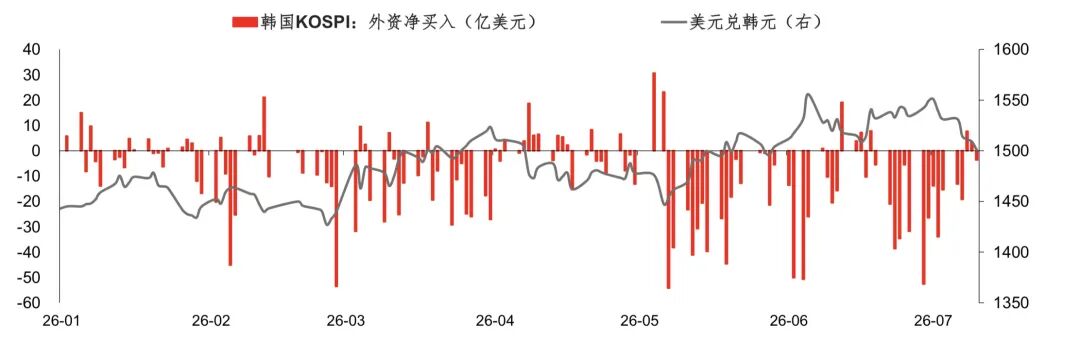
Since the start of the year, foreign investors have sold a cumulative $102.5 billion in Korean equities. This selling is not due to pessimism about Korean stocks, but is passive reduction mandated by fund rules: Overseas funds have strict restrictions on the maximum position in a single stock. The sharp rally in Samsung and SK Hynix boosted their weights above the limit, resulting in forced, passive selling.
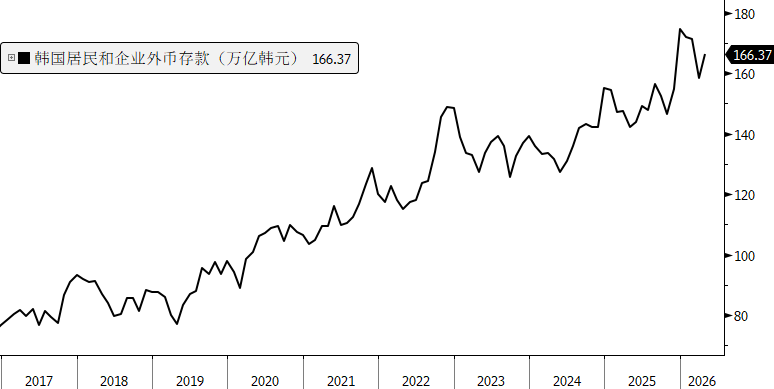
Korean companies have increased their direct investment in the US with retained overseas dollars, and both corporate and resident foreign currency deposits have risen significantly.
2. Reasons for the recent appreciation and rebound of the won
Reason 1: Decline in Korean stocks brings FX hedging sell flows from foreigners
The logic is the opposite of the first half of the year: Korean stocks fall --> value of Korean shares held by foreigners declines --> won FX exposure declines --> selling USDKRW forwards to reduce positions.
In fact, the recent sharp drop in KOSPI was not dominated by foreign selling. Data shows foreign outflow has slowed in the past week. After SK Hynix’s US ADR listing, the market saw focused closing of highly crowded long storage chip positions, while a sudden Middle East geopolitical event severely hit risk appetite across Asia, driving this round of sharp falls in Korean equities.
Reason 2: Dollar settlements from SK Hynix’s US listing
SK Hynix went public on Nasdaq on July 10, raising $26.5 billion. According to the company’s disclosure, part of the raised funds will be used for domestic capital expenditure, and the market expects FX settlements to continue from July to August.
3. Conclusion:
1. The won has become increasingly similar to the yen, with the currency rate weakening when the stock market rises, and strengthening when the market falls. This is mainly due to FX hedging needs derived from the valuation changes in foreign-held equities.
2. The recent sharp fall in Korean stocks is more of an “expectation gap correction + profit-taking at high valuations.” The long-term demand logic for AI computing power and fundamentals for memory chips remain unchanged. It is expected that after short-term forced deleveraging, Korean stocks will resume their upward trend, putting renewed pressure on the won.
3. From amid-to-long-term perspective, Korean semiconductor companies have recently announced major local capital expenditure plans. These companies will need to convert dollar revenues to won for spending, which will benefit the won from a supply-demand angle. The USDKRW is expected to remain in the 1450-1550 range.
[June US CPI Prediction Contest]
This round’s contest target: US Core CPI YoY in June (market expectation 2.9%, prior value 2.9%). Leave your prediction in the comments; the five closest to the actual value will receive an exquisite Morning FX creative T-shirt, and the 6th–10th place winners will receive a creative canvas bag. Go to the comments section to submit your answer!
Disclaimer: The content of this article solely reflects the author's opinion and does not represent the platform in any capacity. This article is not intended to serve as a reference for making investment decisions.
You may also like
XRP Price Prediction Today: Can Bulls Break $1.20 as Whale Buying Continues?

Robinhood Markets Inc. (HOOD) Stock Price Prediction 2026, 2027, 2030 – 2040
Formal proofs advance cross-domain state preservation for bridges and rollups
ONDO Price Surges 12% as Bulls Confirm Breakout—Is $0.50 the Next Target?
Crypto prices
More


