
Goldman Sachs: 6500! Korean stocks are approaching a key level!

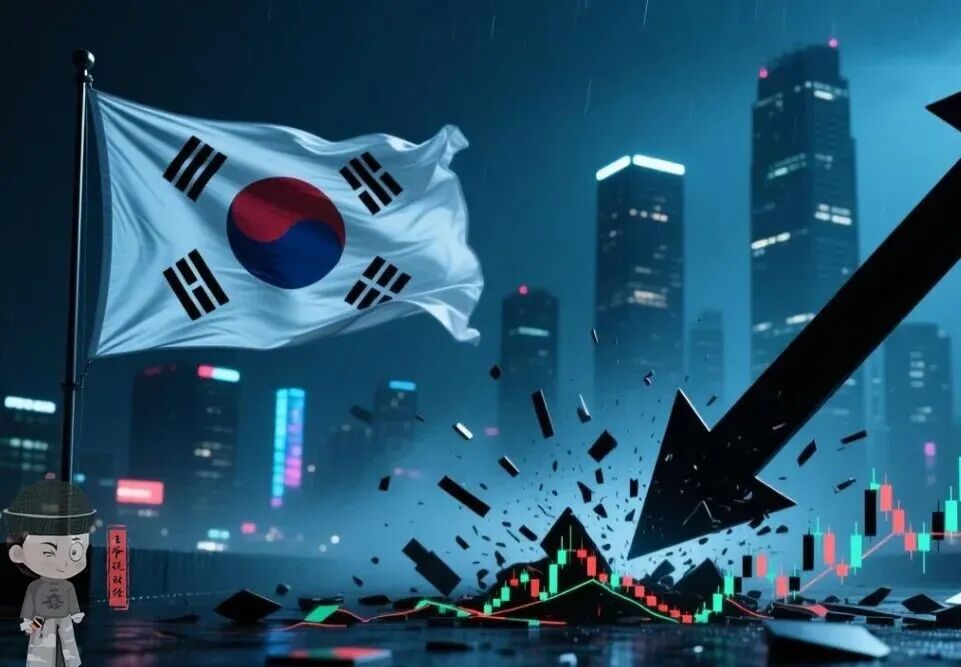
The Korean stock market is standing at a technically dangerous edge.The 6500 level is not only a Fibonacci retracement level on technical charts, but also serves as the "stress test line" for the ongoing Korean stock market deleveraging cycle .Goldman Sachs believes the core reason is not a deterioration of fundamentals, but rather a chain sell-off triggered by deleveraging of single-stock leveraged ETFs.The 6800 level has become a key support; if breached, the next target may move lower toward 6500; Goldman Sachs still judges that this episode is a liquidity-driven position unwind and recommends bottom-fishing in storage and technology stocks on the dip.
I. Overview: The Technical Significance of 6500 Points
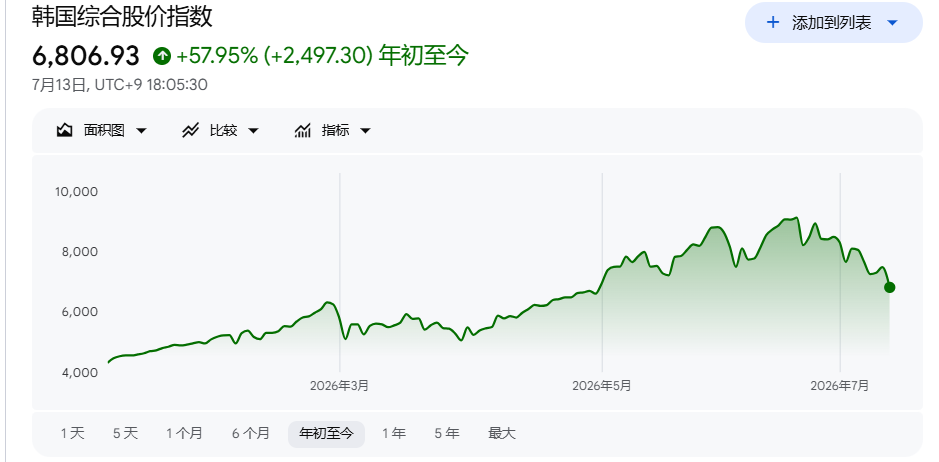
On July 13, 2026, the Korea KOSPI Index plunged by nearly 9%, closing at 6806.93—falling below the psychological 7000 level. This marks theseventh circuit breaker triggerin 2026. On the day, foreign and domestic institutions recorded a combined net sell-off of more than $2.6 billion.
The Goldman Sachs Korea trading desk stated clearly in their report that if the6800 levelis lost as a short-term support, the next critical technical level will be6500. This means that 6500 is not just a psychological level but is Goldman's technical line based on the38.2% Fibonacci retracement over a three-year period—which implies an extra 4.5% downside from the July 13 close (about 6800 points).
II. Core Analysis: The Triple Meaning of 6500
1. Technical Aspect: Key Fibonacci Retracement Level
Goldman Sachs defines 6500 as the "second line of defense," calculated using the KOSPI’s 38.2% Fibonacci retracement over the past three-year bull run. Should this level break, the next support lies in the6100 to 6000 zone, representing a further 10%–12% downside from the July 13 close.
Goldman also points out that one standard deviation in KOSPI’s volatility is about 2.8%, yet recently the index has tended to seeswings exceeding 2 standard deviations, making the6000 zone more likely to provide stronger support. In addition, the 14-day RSI for KOSPI has dropped to 37.2, approaching the oversold region—which at the very least suggests that technical selling momentum is close to exhaustion.
2. Market Structure Aspect: Deleveraging "Stress Test"
The importance of 6500 is not only in technical analysis, but also in its deep connection to theleverage liquidation threshold.
Once Korean retail investors fully leverage,as long as stocks decline around 20%, margin calls or forced liquidations are likely. Both Samsung Electronics and SK Hynix have a margin ratio of 45%. Since the June high, the KOSPI has cumulatively dropped more than 27%—which means many leveraged positions have already hit or are approaching liquidation levels.
Forced liquidation data shows that from July 1 to 10, total forced liquidations reached KRW 344.2 billion. If the index falls further toward 6500, it will triggera new and larger wave of forced liquidations, forming a negative feedback spiral of "decline → liquidation → further decline". At its core, 6500 is a race betweenmarket absorption capacity and the speed of leverage unwinding.
3. Psychological Aspect: Bull-Bear Demarcation
The 6500 level also carries special psychological significance. In February 2026, Morgan Stanley raised KOSPI’s annual base target from 5200 up to6500, with a bullish scenario at 7500. In other words, 6500 was once Wall Street’s top investment bank's "annual benchmark target price" for Korean equities—now this price has shifted from a "target" to a "support", and its strength or weakness will profoundly impact the market’s long-term confidence.
III. Divergence Between Fundamentals and Capital Flows
1. Goldman Sachs View: Position Adjustment, Not Structural Top
Chris Cha, head of Goldman’s Korea trading desk, states in the report:Today’s market action is position-driven selling, not a structural peak. The report emphasizes,the storage chip industry has not seen any negative fundamental catalyst, nor have profit expectations been downgraded—the decline is essentially aposition-driven swing in index heavyweights.
Looking at the structure of capital flows, foreign selling is almost entirelypassive in nature—program trading accounted for US$1.18 billion net outflow (the vast majority of total foreign net selling of US$1.13 billion). Meanwhile,long-only institutions (LOs) remain largely silent, and block trading activity is "surprisingly quiet". This structure shows no significant systematic withdrawal by long-term capital.
2. Institutional Consensus: Attractive Risk-Reward After Correction
According to feedback gathered by Goldman’s sales team during their Singapore roadshow, theinstitutional consensus is that the recent correction has brought very attractive risk-reward ratios, with some clients already rebuilding positions in storage chips. The main bullish argument isstructural equipment shortage—which is expected to delay industry capacity expansion until the second half of 2028, thereby supporting the semiconductor cycle fundamentals.
3. The Concern of Minority Bears
A minority of bears worry about adecline in average selling prices (ASP) in Q4 2026and the risk ofthe HBM4 cycle peaking. This divergence implies that even if 6500 serves as support, the market's ability to return to an uptrend still depends on subsequent trends in storage prices and the sustainability of AI capital expenditure.
IV. Investment Analysis
1. Short-Term Risk: Three Scenarios in the 6500 Defense Battle
| Holds 6800 | 6800 receives effective support | Correction is merely emotional, short-term stabilization expected |
| Breaks 6800, tests 6500 | Further index decline | Deleveraging pressure intensifies, need to watch for capital support near 6500 |
| Breaks below 6500 | Second line of defense lost | Could trigger larger-scale forced liquidations, targeting the 6000 zone |
Goldman Sachs points out that KOSPI has recently tended to see swings exceeding 2 standard deviations, meaning the 4.5% downside from 6800 to 6500is not unimaginable. Investors should be alert to a further rise in short-term volatility.
2. Mid-Term Opportunity: Liquidity Flush, Not Fundamental Collapse
Goldman's core view is that this is a"Liquidity Flush" rather than a "Fundamental Collapse". The difference is stark—should corporate earnings start to deteriorate, the downturn could last over a year; but in a mere liquidity event, once the selling is done, quality assets tend to rebound first.
Global AI capital expenditures have not stopped. Meta continues expanding AI data center investment, TSMC advanced packaging orders are booked to 2027, and the global HBM supply remains tight. The Korean government has even announced the creation of a "Future Response Fund", with continued investment focus on AI semiconductors and data centers. The industrial trend remains intact, what has changed isthe market surge was too swift, leverage too high, and capital too crowded.
3. Key Watch Indicators
Whether 6500 can hold depends on the evolution of the following variables:
Whether forced liquidation volume has peaked: If subsequent published reduction data stops rising, selling pressure may be nearly purged
Whether 6800 can be reclaimed: If the index returns above 6800 soon, it's less likely 6500 will be tested
Whether long-only institutions enter the market: Currently, institutions are on the sidelines; if they begin buying on the dip, it will be a key stabilization signal
Whether storage fundamentals remain robust: Ongoing financial reports from Samsung and SK Hynix and AI demand data
Direction of regulatory policies: The Korea Financial Supervisory Service has already expressed strong concerns about leveraged ETFs; if further restrictions are introduced, liquidity could be further affected
V. Summary and Outlook
6500 is not just a Fibonacci retracement on the technical chart, but also the "stress test line" for the ongoing Korean equity market deleveraging process .
From a technical perspective, if 6800 is lost, 6500 becomes the battlefield between bulls and bears. From the capital perspective, 6500 may trigger a new wave of forced liquidation, but could also attract long-term capital looking to buy the dip—this depends on the contest between market absorption capacity and speed of deleveraging. From a fundamental standpoint, the structural logic for the storage industry has not changed, and Goldman along with some institutions believe the current correction has created an attractive risk-reward profile.
For investors,it is not advisable to bottom-fish aggressively while volatility is high in the short term; instead, closely monitor key indicators such as forced liquidation data, foreign capital flows, and the defense of the 6800 level. If there is clear evidence of capital absorption around 6500 and forced liquidation volumes peak and recede, this could indicate the liquidity flush is nearing its end—at which point, fundamentally strong storage and semiconductor equipment sectors may see a mid-term entry window. Conversely, if 6500 is lost, beware of further downside toward the 6000 zone.
Disclaimer: The content of this article solely reflects the author's opinion and does not represent the platform in any capacity. This article is not intended to serve as a reference for making investment decisions.
You may also like
XRP News : Ripple Linked to 79% of Major Financial Institutions in Crypto

Analyst Egrag Crypto highlights $XRP’s 44 RSI level as key to trend reversal
BANK breaks 8-month falling channel, rallies 124%: Can bulls hold $0.2850?
Ethereum’s staking ratio hits all-time high of 34%
Crypto prices
More


