
Essay: Review of the Model's 7% Drawdown Stress Test During Structural Market Crash, Exposing Two Issues

Hello everyone, this is You Dou.
This article is only a review of my own quantitative model's trading strategy. If you're a discretionary trader or narrative investor, you might want to skip it to avoid discomfort.Some people say what I've posted recently could lead to having no friends—sorry, I didn't have any to begin with.
Different trading strategies inevitably lead to different results. When a market is driven by leverage, the model can't make those profits—instead, it remains consistent and only earns its share within the rules. Isn't this, too, a form of discipline, a kind of faith?
The Dow even hit a new high in July. But if you were holding those structural leaders since April, your experience would be quite different—the sharpest drop was 40% in 17 trading days.
This year is a structural market: when stocks are rising, it's only certain sectors; when they fall, it's also local crashes. So this review doesn't compare with the index—the index wasn't even part of the test.
To get straight to the point: from June 30 to last Friday’s close, the account’s net value was -0.5%, a drawdown of about 7.23% from the yearly high.
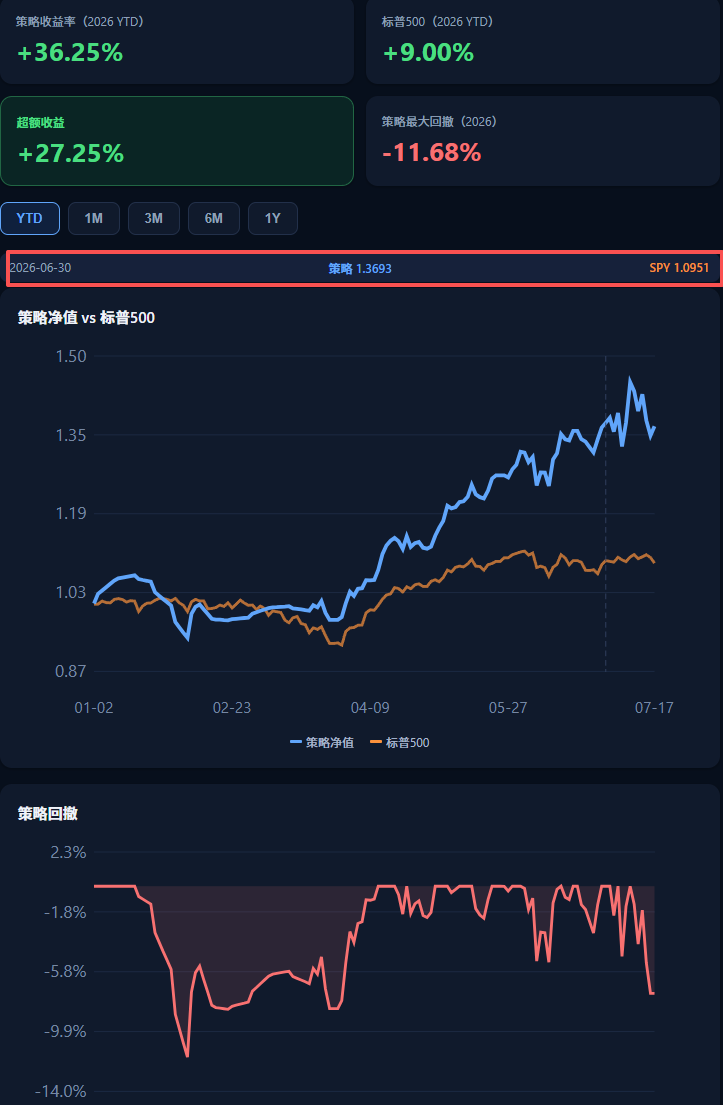
7% is not a victory—it's just losing less.By the way, this isn't the deepest drawdown this year—the end of February to early March saw a maximum drawdown of 11.68%. The system has faced two tests this year, and this was the second.
Let's discuss two things separately: why the major losses were avoided, and where this 7% drawdown came from.
I. Two Moves That Avoided Major Losses
The model has a set of alert levels: Level 3 is normal, with the whole strategy executed; Level 2 restricts aggressiveness; Level 1 is a full contraction.
On June 12, the alert was raised from Level 3 to Level 2. In Level 2, the system only allows position reductions or swaps, no new aggressive positions—except for one special case, discussed below.
Before that, in early June, positions were already rotated: tech stocks on the right side were cleared, replaced with lower-valued consumer and pharmaceutical stocks—the so-called "old man stocks"—to build a safety cushion ahead of a pullback.
Both these moves took place a month before the crash. It's not that I predicted anything—I can't predict. It was rule-triggered and executed. That's why, while hot stocks dropped 40% in 17 trading days, the account only drew down by 7%.
II. Where the 7% Drawdown Came From
The only new position opened under Level 2 alert was the pullback model—Model X. It does just one thing: catch pullbacks. When others fall, it buys incrementally; when there’s a rebound to the target, it exits entirely.
In fact, July even brought a new high, thanks to Model X significantly increasing positions to capitalize on the rebound.
From July 1 to now, Model X participated in 14 previous pullback stocks, with 10 trades already closed:
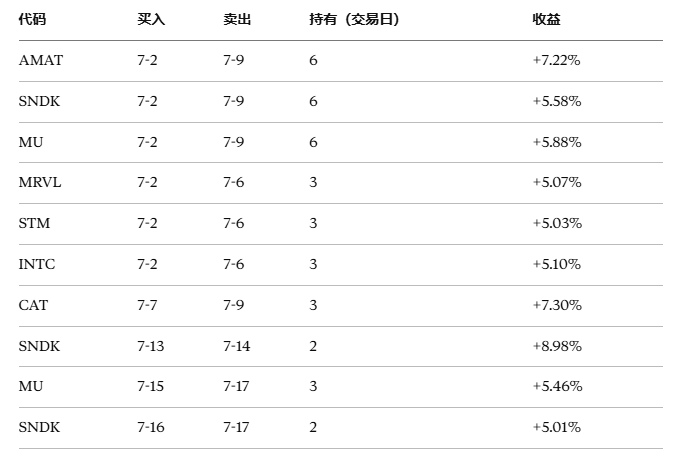
All 10 trades were profitable, with average holding periods of 3-4 trading days.
Realized contribution: +5.42%
(Unclosed position details are tracked and updated only within the member community and won't be expanded on here.)
Unrealized floating loss: -8.07%
Model X July net contribution: -2.7%
III. Two Issues Exposed This Month
1. Signals concentrated on the same day. On July 2, Model X triggered 11 signals, all concentrated in the semiconductor sector, hitting the full aggression quota at once. The signals were independently calculated, but the stocks are not independent—when the whole sector corrects, essentially these 11 signals are a single large position in the same direction. The model currently lacks a de-correlation mechanism for homogeneous signals, which is the main structural reason for this round’s floating losses.
2. Exit criteria fail during prolonged declines. Model X is designed for "catch rapid drops, sell on rebound." But if a stock doesn’t rebound and instead grinds down slowly, the original exit criteria won't be triggered, causing longer holding periods. This has been adjusted: for non-core stocks, once the quota is filled, exit criteria have tightened—no longer waiting for the original target, but prioritizing an exit.
IV. Not Falling in Love With Individual Stocks
Let’s talk briefly about the idea of lowering cost by trading around a position. My view remains: the more a stock drops, the weaker its "personality" and the less likely it will rebound. The strong stay strong, the weak stay weak. Trades with fewer buys and quick rebounds are the truly strong stocks—the more you average down, the more you're likely catching weak ones.
The relationship between a quantitative model and individual stocks is different from discretionary trading. Quant is a playboy—never committed, never in love with any particular stock. Its shortcomings are clear too: it can’t make outsized gains from single names and will occasionally cut the wrong position—but will execute cuts regardless.
An old example: ALAB, bought at the end of last December, stopped out in March this year at a 33.74% loss. The stock subsequently rallied 300%. There’s nothing to argue here, as the original inclusion in the stock pool was based on a lagging fundamental assessment. This is a historical issue, not something exposed in this cycle, but it illustrates the same point: the system isn’t a prophet; it just ensures mistakes aren’t fatal.
But what it gains is something else: no greed for what’s beyond its understanding, missing what should be missed, not missing what shouldn't be missed. The final returns don’t come from any one miracle trade but from the win rate contribution of overall trading.
Survival first, opportunity second, system over judgment. Lessons learned from this round—7% tuition, two exposed problems, and keep moving forward.
Disclaimer: The content of this article solely reflects the author's opinion and does not represent the platform in any capacity. This article is not intended to serve as a reference for making investment decisions.
You may also like
BlackRock crypto ETFs attract $343 million net inflows in five days
Recent Bitcoin buyers panic-sell amid $90M capitulation: $66K is BTC’s last stand
DTCC XRP Bombshell That Gets XRP Army Talking
South Korea investigates 30 crypto market manipulation cases under landmark virtual asset law
Crypto prices
More


