
Weekly Preview: Super Central Bank Week Faces "Hawkish Test"—Will the Federal Reserve Take Sudden Action?

Due to the triple impact of surging energy prices, new US tariffs, and skyrocketing AI capital expenditures, global investors' inflation panic is being reignited.
On the energy and geopolitical fronts, as the Middle East crisis spreads from the Strait of Hormuz to the Red Sea and Trump warns of a possible “large-scale attack” on Iran to push for a peace deal, Brent crude oil futures broke above $100/barrel for the first time in two months. On Friday, prices eased along with diplomatic optimism, closing at $98.38, but still up nearly 12% for the week and rising for a third consecutive week; natural gas prices surged in tandem.
In addition, the US government proposed imposing new tariffs of 10% to 12.5% on selected trading partners, posing a direct threat to global supply chain costs.
Moreover, tech giants’ massive investments in AI (such as Alphabet raising its capital expenditure forecast for this year to $205 billion) and price increases by companies like Apple due to chip shortages have further reinforced long-term inflation drivers.
Inflation risks and fiscal concerns have triggered violent swings in financial markets. This week, global bond markets have raised investor caution as G7 bond yields surged. On Friday, the US 30-year Treasury yield was just below the highest level since 2007, UK gilt yields saw the longest streak above 5% in nearly 20 years, and the eurozone’s benchmark German 10-year bond yield approached the highest since 2011.
The rise in US Treasury yields pushed up the dollar. The US dollar index rose more than 0.7% this week, its biggest weekly gain since mid-June. The yen hit 40-year lows, recording its largest weekly drop in more than two months.
This week, the Nasdaq led the decline among US stock indices, with tech stocks suffering a double whammy from both macroeconomic and fundamental factors. The Philadelphia Semiconductor Index plunged 5% on Friday, with memory chipmakers taking the initial hit.
Despite the simultaneous spikes in real rates and rate hike expectations, precious metals still posted rises, supported by geopolitical hedges and dip-buying demand. Spot gold once again held the $4,000 support level.
Investors remain cautious ahead of the Federal Reserve’s policy meeting next week, with many expecting it could deliver a hawkish surprise. Below are the key market focuses for the coming week (all times GMT+8):
Central Banks: Super Central Bank Week! Oil Back Above $100—Will the Fed Act Suddenly?
Federal Reserve:
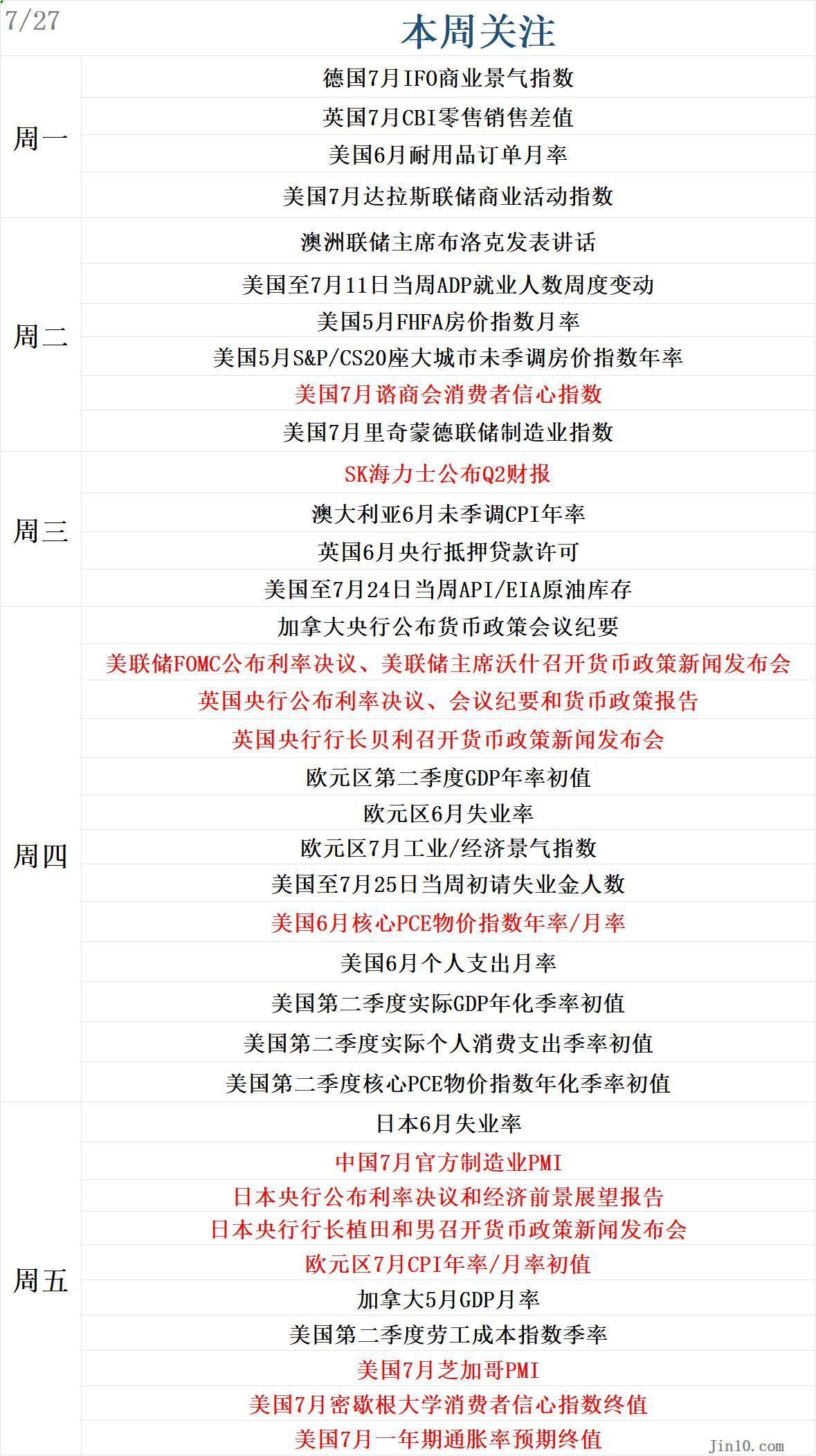
Thursday 02:00 (GMT+8), the Fed FOMC announces its interest rate decision;
Thursday 02:30 (GMT+8), Fed Chair Walsh holds monetary policy press conference
Faced with the abrupt shift in the inflation outlook, although markets expect the Fed, Bank of England, and Bank of Japan to remain on hold at next week’s “super” central bank week, policy expectations have shifted. Central bank governors will reveal their level of concern over oil prices returning to ~$100 a barrel. While none are currently expected to act, varying degrees of vigilance over more energy-driven inflation are likely. With the European Central Bank signaling readiness to hike again, investors are betting that most regions could act as soon as September.
The Fed will unveil its latest rate decision in the early hours of next Thursday (GMT+8). As divisions persist both on Wall Street and within the Fed itself, the future monetary policy path is highly uncertain. Market consensus is that the Fed will hike, but not until September.
However, federal funds futures trading also reflects a significant probability—up to 35%—that the Fed could raise the benchmark lending rate by 25 basis points as early as next week, with a September hike fully priced in.
The renewed oil surge has prompted some officials—potentially Dallas Fed President Logan and Cleveland Fed President Harker—to now support a rate hike. This has triggered broad discussion over whether the new Fed Chair, Walsh, may surprise investors with a rate hike.
Bloomberg economists say: “We expect a hawkish stance. Walsh may emphasize that inflation remains too high and keep September’s hike in play, but soft CPI data should be enough to deter action this month.”
Analyst Barbara Rockefeller even predicts that Bloomberg may publish an article at any moment pointing out that central banks could hike rates between regular meetings, citing historical precedents.
Other Central Banks:
Tuesday 11:05 (GMT+8), Reserve Bank of Australia Governor Bullock speaks;
Thursday 01:30 (GMT+8), Bank of Canada releases minutes of the monetary policy meeting;
Thursday 19:00 (GMT+8), Bank of England announces rate decision, minutes, and monetary policy report;
Thursday 19:30 (GMT+8), Bank of England Governor Bailey holds a monetary policy press conference;
Friday (time TBA), Bank of Japan announces rate decision and economic outlook report;
Friday 14:30 (GMT+8), Bank of Japan Governor Ueda Kazuo holds a monetary policy press conference
According to a Reuters poll, all 70 economists expect the Bank of England will maintain the bank rate at 3.75% at the July 30 meeting. The median forecast sees the BOE holding rates at 3.75% until at least mid-next year.
UBS economists say sluggish UK economic growth and a weak labor market lower the need for a BOE rate hike. “The BOE can address second-round risks by keeping rates at the current restrictive level for longer without further hikes.” However, they add that an increase in energy prices and a preference for hikes among some members mean a hike cannot be ruled out.
According to Nikkei, the Bank of Japan plans to keep rates at 1% during its July 30-31 policy meeting. Of the nine-member BOJ Policy Board, the majority are expected to vote to keep rates unchanged. While most see current financial conditions as accommodative and accept a need to hike further to stabilize prices, many feel there is no rush to act. The board may raise its FY2026 real GDP growth outlook at next week’s meeting.
Three informed sources revealed that next week the BOJ may maintain its warning that inflation risks will exceed the 2% target, while suggesting these risks have not significantly increased compared to three months ago. The quarterly outlook report will focus on continued inflation risks from the Middle East conflict, strong global AI demand, and rising import costs caused by the weak yen.
JPY/USD approached the closely watched 165 level after hitting 40-year lows on Thursday. IG Australia analyst Tony Sycamore says he expects USD/JPY to keep rising toward 165. “At this moment, trying to support the yen is like trying to stop a speeding train.”
Additionally, MUFG analyst Derek Halpenny says that if energy prices keep surging and the US-Iran conflict further escalates, the euro and pound could face downside risks. He notes that while expectations are converging for the Fed, ECB, and BOE to hike in the future, investors may believe the US economy is better able to withstand potential monetary tightening.
On next week’s gold price outlook, Forex.com Senior Market Strategist James Stanley says, “I know it’s easy to get bearish right now because every rally has been met with heavy selling so far. But note how $4,000 has provided strong support, and each dip below has seen buying emerge. I think long-term-focused institutions—central banks, pension and hedge funds—will view this as an opportunity and look through the near-term volatility.”
Stanley adds, “With the Fed meeting next week and equity market pullbacks starting to sting, I think Chair Walsh may support President Trump with a softer-than-expected hawkish message. In the longer term, we’re unlikely to see a tight policy or budget balance any time soon. So even in the current countertrend environment, the bull case for gold still stands.”
Key Events: Middle East Powder Keg and Tariff Bludgeon—Trump’s Two-Front Game
US Pauses Night Air Strikes on Iran, Houthi-Saudi Conflict Intensifies
From Friday night into Saturday (GMT+8), the US significantly paused its 13-day run of night strikes on Iran, with neither explanation nor advance notice. The Iranian government and local media did not report any imminent attacks, raising further doubts over the Trump administration’s actual strategy in the war.
At almost the same time, conflict between Houthi forces and Saudi Arabia escalated. The Houthis claim to have launched missiles and drones at Saudi Aramco facilities in Red Sea port cities Jizan and Yanbu; Saudi officials and Aramco did not immediately confirm this. Saudi authorities briefly issued an emergency alert before retracting it, saying the danger had passed.
Yemeni TV reports that the Saudi-led coalition launched retaliatory strikes against Houthi military positions later Saturday. The coalition had already hit Houthi ports used for attacks at sea the previous day.
The Houthis also claim to have blockaded Saudi ports and attacked two Saudi-linked oil tankers in the Red Sea. This further exacerbated tensions, compounded by US night air strikes on Iranian facilities and Tehran’s retaliatory responses, increasing already high risks around regional energy shipments.
Trump himself expressed increasing frustration over Iran’s delay in reopening the Strait of Hormuz. On Friday, he said the US is “locked and loaded” for a large-scale strike on Iran, though he had yet to decide to proceed. According to France’s LCI TV, Trump said of Iran, “If we can't get 100% of what we want from Iran, we would absolutely consider resuming full-scale war.”
The New York Times reports Trump’s delay in escalating strikes was partly due to advisor concerns, including the risk that war could deplete regional stockpiles of “Patriot” interceptor missiles and other air defense weapons.
According to Axios, citing two regional sources, an Omani delegation has arrived in Tehran for talks on Strait of Hormuz operations. It is unclear if the US will accept any negotiation outcome.
Axios also reports that the Israeli Prime Minister’s Office confirmed Trump will meet Israeli PM Netanyahu at the White House next Tuesday (GMT+8).
Trump is considering renewed large-scale military operations against Iran, possibly including a joint operation with Israel as seen in the “Epic Rage” strike on February 28. His meeting with Netanyahu may be critical for Trump’s decision and bilateral coordination; Netanyahu heads to Washington next week, likely delaying any major escalation until after their meeting.
Tariff War Heats Up Again
The Trump administration unexpectedly broke its silence this week by intensively rolling out a series of tariff actions:
First, on Monday, the US invoked Section 338 of the Tariff Act of 1930 to threaten a 50% tariff against Canada; on Tuesday, it gave generic drug makers a two-year ultimatum to relocate to the US or face a 100% tariff;
On Wednesday, a 25% supplemental tariff on Brazil took effect, prompting relief measures by Brazil’s government; Thursday saw a 10% and 12.5% surge in tariffs against major trading partners based on forced labor investigations, keeping baseline tariffs at 10%;
Friday brought a lawsuit by small businesses, while Trump threatened new tariffs on EU goods after Google was fined by the EU.
Experts say Trump aims to rebuild tariff barriers and that the fiscal windfall from tariffs has moved markets from aversion to dependence. Regardless of the next president, fully revoking these tariffs will be difficult, and a Democratic White House would more likely adjust than scrap them, underscoring the lasting stickiness of Trump’s protectionist agenda.
Douglas Irwin, a trade historian and Dartmouth economics professor, told Bloomberg TV that, despite legal challenges, overall, Section 301 tariffs “are on firmer legal ground.” “It’s not clear courts will overturn these tariffs, so they may be around for some time.”
Key Data: US GDP and Core PCE Take Center Stage—Super Thursday Data Storm Approaches!
Tuesday 20:15 (GMT+8), US ADP weekly employment change for week ending July 11;
Tuesday 22:00 (GMT+8), US July Conference Board Consumer Confidence Index, US July Richmond Fed Manufacturing Index;
Thursday 17:00 (GMT+8), Eurozone Q2 GDP annualized preliminary reading, Eurozone June unemployment rate, Eurozone July industrial and economic sentiment indices;
Thursday 20:30 (GMT+8), US Initial Jobless Claims, US June Core PCE Price Index YoY/MoM, US June Personal Spending MoM, US Q2 real GDP annualized QoQ preliminary / real personal spending preliminary / Core PCE annualized preliminary;
Friday 17:00 (GMT+8), Eurozone July CPI YoY/MoM preliminary;
Friday 21:45 (GMT+8), US July Chicago PMI;
Friday 22:00 (GMT+8), University of Michigan US July final consumer sentiment index, US July one-year inflation expectation final
Also on Thursday (GMT+8), investors and policymakers will get the latest updates on US economic activity, the Fed’s preferred inflation gauge, and consumer spending.
Government data is expected to show US Q2 GDP growing at 2.1% annualized thanks to consumer and business investment. Another report is forecast to show a key inflation gauge—the PCE index—slowed in June as gasoline prices fell, though gas has since rebounded.
For Europe, economist consensus sees Q2 GDP rebounding to 0.2% growth, and July inflation rising to 2.9%. These reports arrive Thursday and Friday, and may confirm ECB President Lagarde’s view—in Thursday’s remarks—that the economy is “showing some improvement” but the inflation shock from the Iran war “is not over yet.”
Earnings Season: Tech Giants’ Major Test—Apple, Microsoft, Meta, and Amazon All Set to Report
US stocks posted a weekly loss on Friday, with renewed Middle East fighting underscoring investors’ growing unease that the US-Iran conflict is heading for a dead end. Oil is back above $100/barrel, and the bond market’s warning signs suggest both short- and long-term inflation expectations are rising.
Major US stock indices are also on track to finish the month lower. If the slide continues into next week, it would mark an ominous start to August and September—the two weakest months for stocks in the election cycle. According to the Stock Trader’s Almanac, in midterm years, the S&P 500 has averaged drops of 0.4% in August and 0.8% in September.
Still, many investors remain long. Corporate profits remain strong; according to FactSet, S&P 500 constituents are expected to deliver 38% year-over-year Q2 earnings growth, far surpassing initial forecasts.
Dirk Willer, Citi’s Global Macro and Asset Allocation Head, remains bullish on equities but notes there is a steady drumbeat of potential risks that could upend the rosy outlook—from escalating Middle East conflict to a more hawkish Fed. Still, he’s confident the market can “climb the wall of worry.” “The market continues to climb the wall of worry,” he wrote recently.
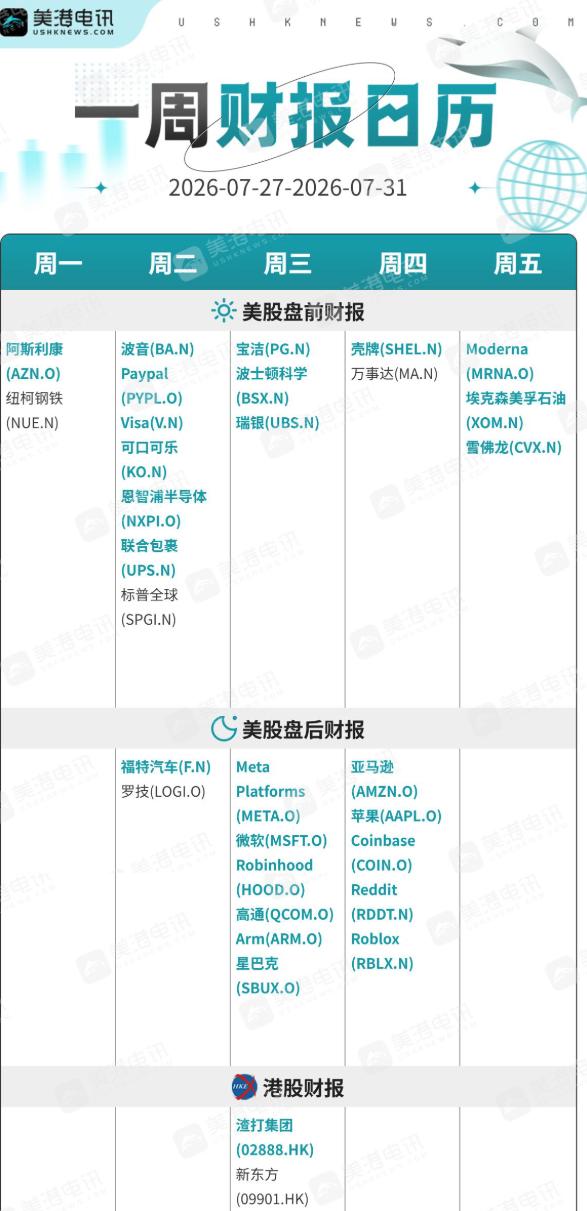
Next week brings a flood of big tech earnings, as Apple (AAPL.O), Meta Platforms (META.O), Amazon (AMZN.O), Microsoft (MSFT.O), Qualcomm (QCOM.O), SK Hynix, and others will all report results.
Investors will scrutinize these tech giants to judge how long the pattern of “heavy AI spenders get punished, semiconductor manufacturers get rewarded” can last. On the surface, Alphabet delivered solid earnings this week, but its spending plans and negative free cash flow left investors on edge.
Mahoney Asset Management CEO Ken Mahoney said, “Investors are genuinely worried these companies are throwing all of their cash at AI and data centers, with nothing left for buybacks or dividends. In the earnings calls, aside from conceptual chatter, you don’t hear much on investment returns.” He added, “That’s why we’ve been out of the megacap cloud stocks for a while—it’s a looming risk.”
The weakness in mega cap tech also raises questions for semiconductors, since chip rallies depend on hyperscalers persisting with heavy AI spending. Investors are still optimistic on chip stocks, but caution is rising, especially as more tech giants pull back from record highs.
Disclaimer: The content of this article solely reflects the author's opinion and does not represent the platform in any capacity. This article is not intended to serve as a reference for making investment decisions.
You may also like
Dogecoin Price Rebounds as Shiba Inu Gains Strength—Can DOGE Rally Higher This Month?
BNB Chain takes its consensus speed upgrades to Stanford’s Science of Blockchain Conference
XRP trades at $1.10, struggles to break 50 EMA resistance
Dogecoin rebounds 6%, whale wallets buy 1 billion DOGE as bulls eye $0.16
Crypto prices
More


