
SpaceX Approaches $100, Where Is the Market Expectation Gap?

SpaceX's share price is under pressure from the upcoming lock-up expiration, but Morgan Stanley believes this precisely creates a buying window based on a valuation mismatch.
During Monday's trading session, SpaceX's share price fell to 108.66 at one point, hitting a new low since listing, and is now down more than half from the high of $225.64. With the lock-up period coming to an end, some investors think the share price could drop further to $100.
According to Chasing Wind Trading Desk, Morgan Stanley analyst Adam Jonas recently published a report stating that if the share price really drops to $100, it would imply the market values SpaceX's AI business at zero or even negative, and the implied 2028 EBITDA expectation for rocket launch + Starlink would be about 30% below the bank’s baseline forecast.
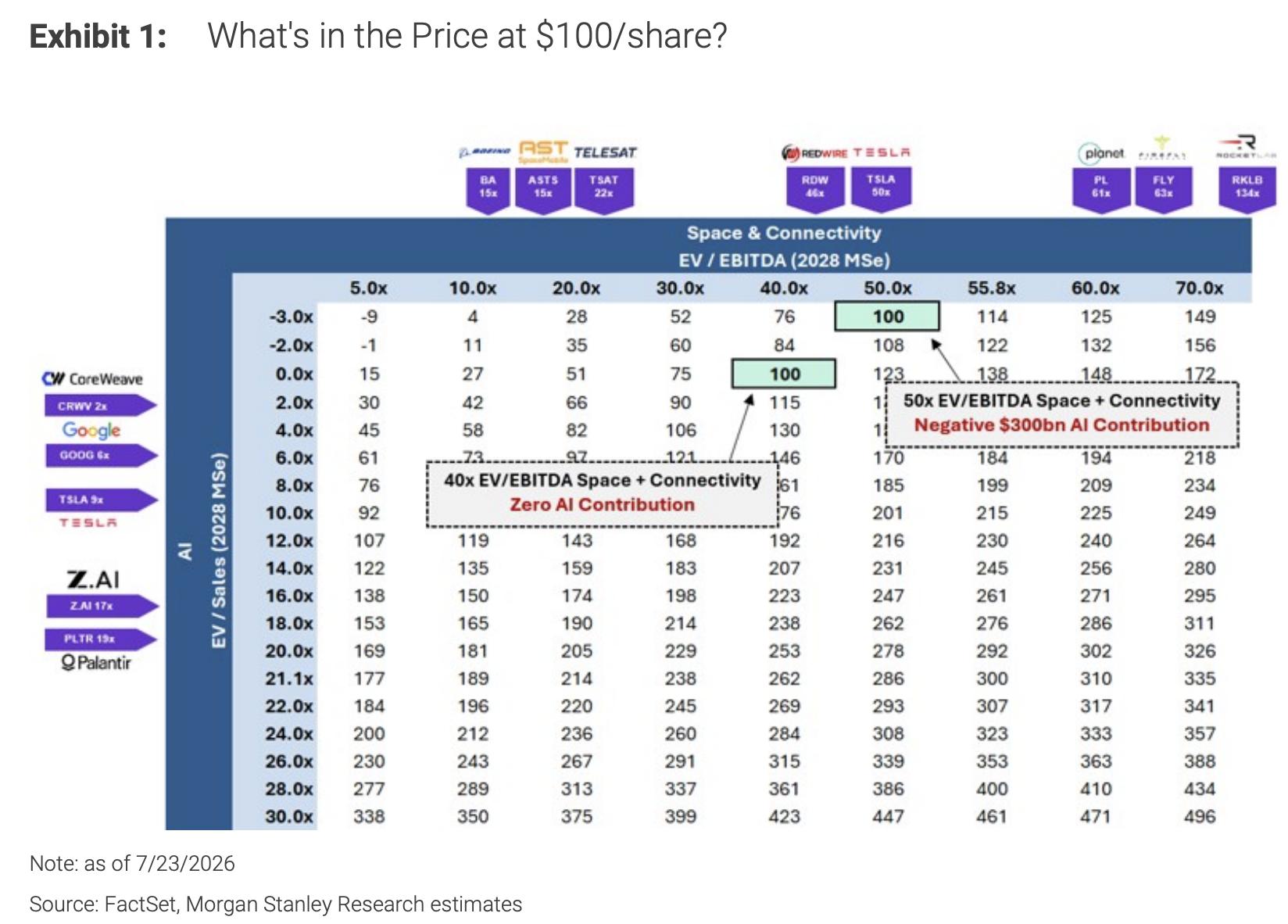
The bank maintains an Overweight rating on SpaceX, with a target price of $300. It believes that the current gap between pessimistic sentiment and fundamentals constitutes an attractive entry point—investors at prices below $120 are essentially receiving all of the company's AI business optionality for "free," while the core rocket launch + Starlink business alone already covers the current share price.
Divergence Between Market Sentiment and Fundamentals
Although there have been no major changes in SpaceX's fundamentals over the past few weeks, bearish conviction has been gradually strengthening, while bulls are more inclined to wait for clearer catalysts.
From investor conversations, the core disagreement centers around the valuation of AI business. Most investors heavily discount or even ignore the value of Grok and Cursor, believing that AI monetization opportunities are primarily concentrated in the neocloud segment.
The reasons include: AI business capex being disproportionately high compared to rocket launch + Starlink, significant uncertainty in the economic model, and management devoting too much effort to this business.
Some investors even assign a negative value to AI, believing that high capex will erode overall value. Morgan Stanley disagrees, regarding this pricing approach as too conservative, and argues that it overlooks multiple potential monetization paths for AI.
What Does $100 Mean?
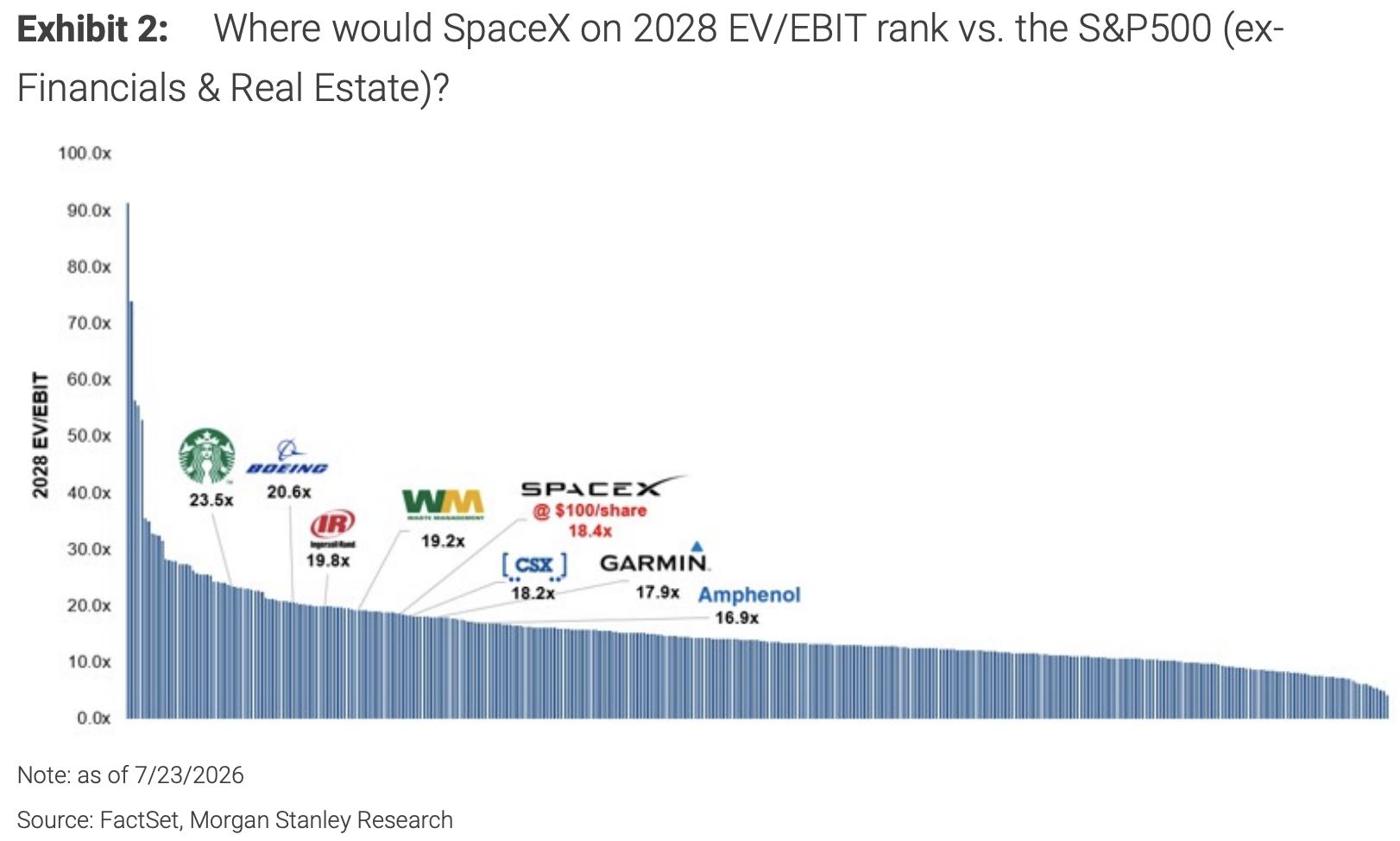
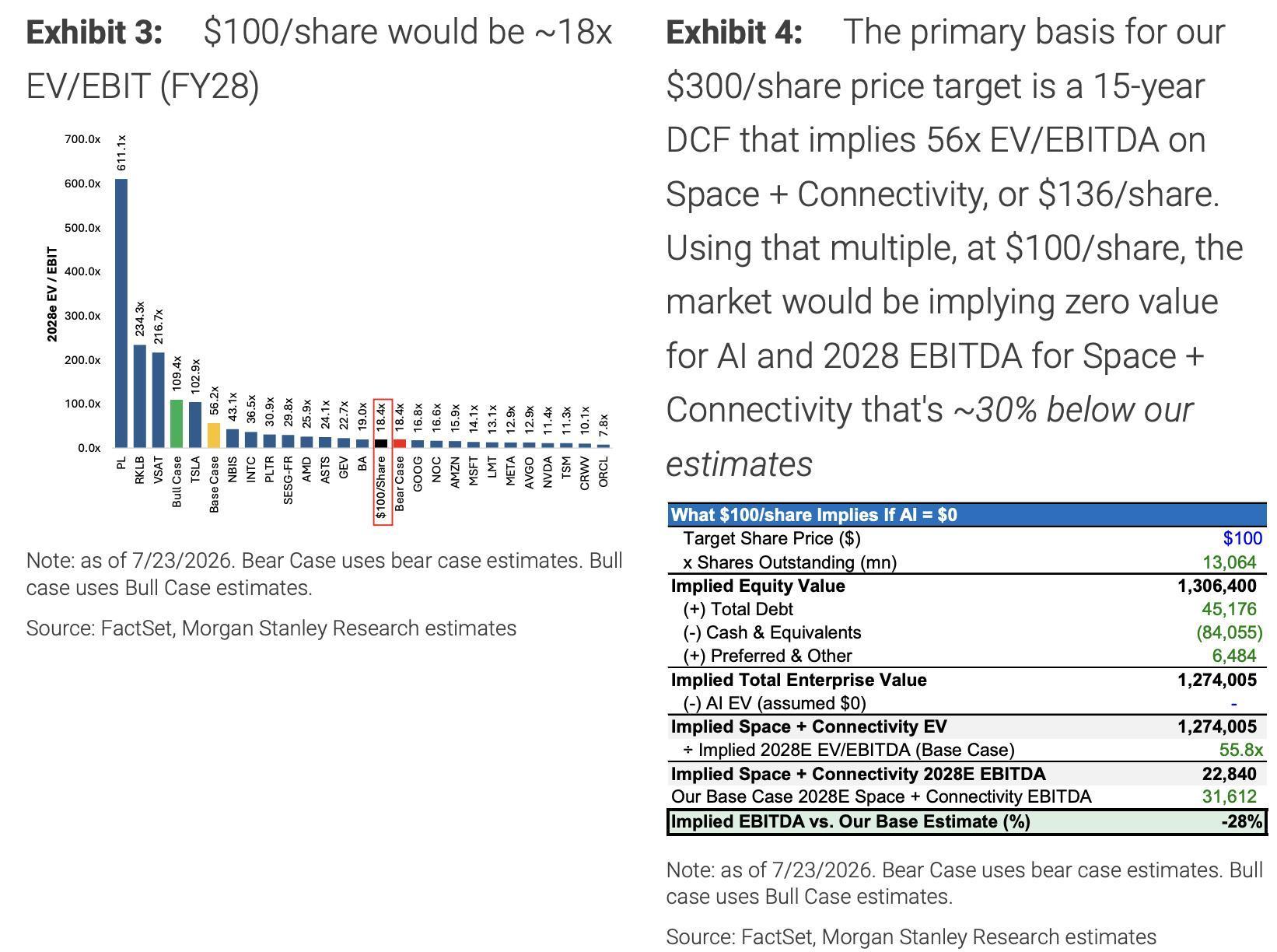
Based on the bank's 2028 baseline forecast—$157 billion in revenue (including an average of 6 GW computing power at $16.5 per watt, and 35 million average consumer users at $46 monthly ARPU), and $69 billion EBIT—if the share price drops to $100, SpaceX’s implied FY28 EV/EBIT would be 18x, roughly at the median level of peers. However, its compound annual revenue growth rate from 2025 to 2030 is 76%, about three times the peer median of 26%.
For reference, an 18x EV/EBIT ratio would rank about 81st in the S&P 500 (excluding financials and real estate), comparable to Boeing (21x), Waste Management (19x), CSX (18x), and Garmin (18x).
Breaking down the business further, if you assign a 40x EV/EBITDA multiple—a bit below the spatial peer median of 46x—to the rocket launch + Starlink business, the AI business has an implied value of exactly zero; if you use a slightly higher 50x multiple, the AI business has an implied negative $300 billion value. Morgan Stanley believes both scenarios are unreasonable.
The Core Business Already Supports the Current Share Price
Even if the AI value is completely removed, SpaceX’s rocket launch + Starlink business alone is enough to support the current share price.
The bank’s 15-year DCF model values the rocket launch + Starlink business at $136 per share on a standalone basis, applying a 56x EV/EBITDA multiple. Under the $100 share price assumption, the market would be implicitly pricing in a 28% lower 2028 EBITDA versus Morgan Stanley’s baseline forecast, and assigning zero value to AI.
Currently, SpaceX accounts for more than three-quarters of global quality-to-orbit and maneuverable satellites in orbit. Its connectivity business is growing nearly 50% this year, with EBITDA margins at 40%. Buying SpaceX at current valuation is equivalent to getting a market-dominating, high-growth, high-certainty space and connectivity business at a discount, while the AI options are almost “free add-ons.”
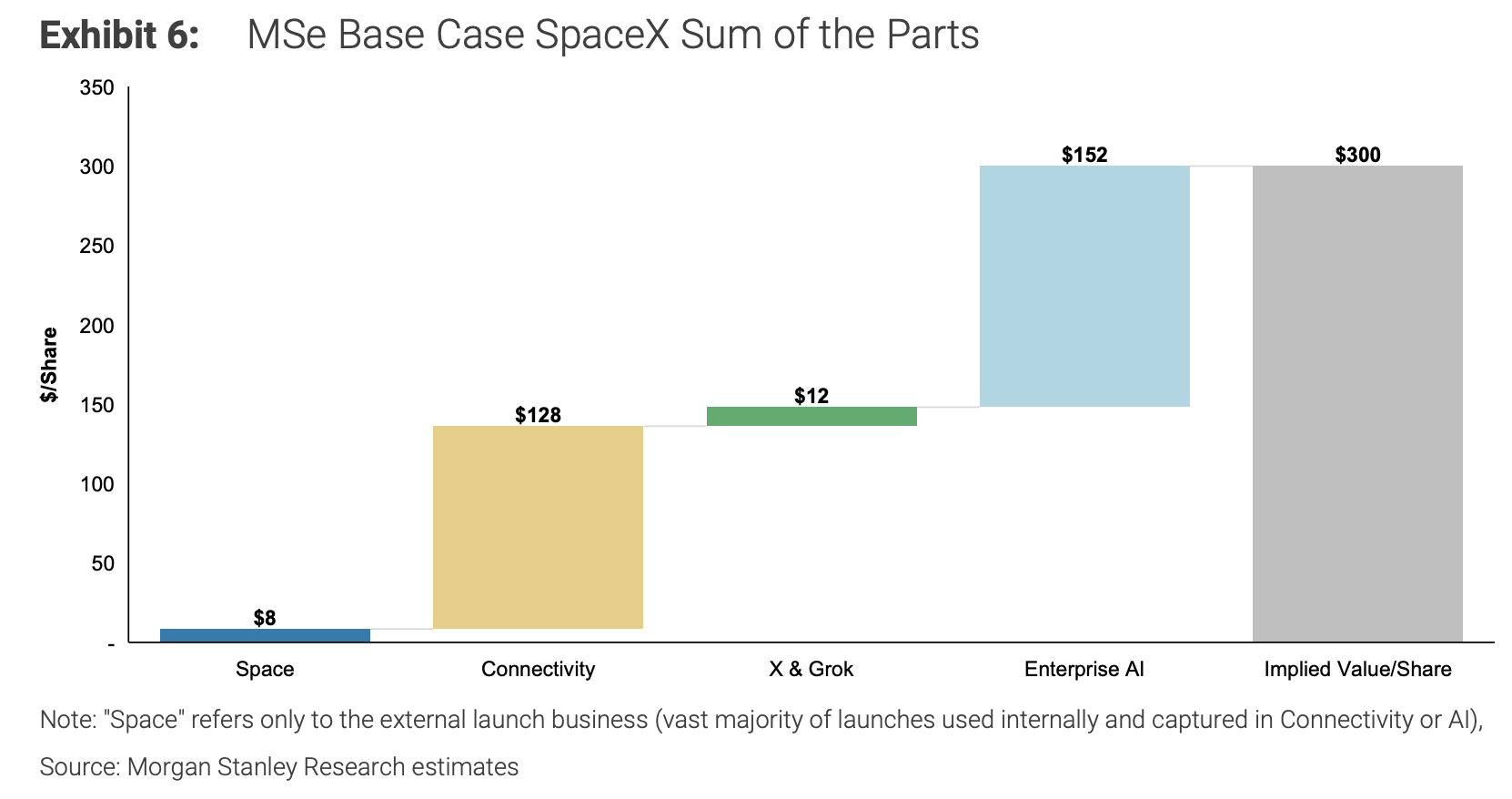
Based on the sum-of-the-parts valuation, Morgan Stanley’s $300 target price is comprised of: $8 for Space business, $128 for Connectivity, $12 for X and Grok, and $152 for enterprise AI business.
Recent Positive Catalysts
On the launch side, Starship’s 14th and 15th test flights are expected in September and October, respectively, which may include the first catch of the V3 Starship booster, first orbital flight (with synchronous deployment of operational V3 satellites), and the first catch of the Starship upper stage.
On the AI business front, Grok 4.6 (a 2-trillion parameter model) is expected to be released within a month, and Grok 5.0 (a 6-trillion parameter model) is expected by the end of the year. The Cursor acquisition is expected to close by the end of Q3, at which point annual recurring revenue (ARR) for Cursor and major updates to Grok platform adoption will be disclosed.
In terms of computing power expansion, SpaceX expects to double its capacity from current levels to 2 GW by the end of the year, potentially securing more large neocloud contracts.
Given that the market is currently assigning little to no value to AI, any positive development above could trigger a share price rebound.
Main Risks Cannot Be Ignored
In the short run, the share price faces dual pressure: first, additional supply pressure from the upcoming lock-up expiration, and second, the possibility that the upcoming financials will not address investors' top concerns.
The downside scenario (target price $75) assumes: Starship delays compress the story, AI monetization significantly lags expectations, rocket launch + Starlink account for more than 90% of total valuation, and Starship operations are delayed to 2029.
Other major downside risks include: slowing Starlink user growth, persistently high per-watt cost of AI infrastructure, lengthened AI business buildout cycles, increased funding needs leading to equity dilution, and regulatory uncertainties.
The upside scenario (target price $600) assumes Starship, orbital computing power, and Terafab are rolled out rapidly across the board, AI accounts for over 60% of the overall valuation, and computing deployment grows at a 46% CAGR.
Disclaimer: The content of this article solely reflects the author's opinion and does not represent the platform in any capacity. This article is not intended to serve as a reference for making investment decisions.
You may also like
Finding Crypto Millionaires in New York Just Got Easier
Charles Schwab crypto research head says Clarity Act not priced into Bitcoin
NFL urges CFTC to strengthen rules on sports prediction markets: report
Crypto prices
More


