
Meta Q2 Earnings Preview: AI Spending Guidance and Ad Monetization in Focus
 2026/07/28 06:42
1. Investment Highlights at a Glance
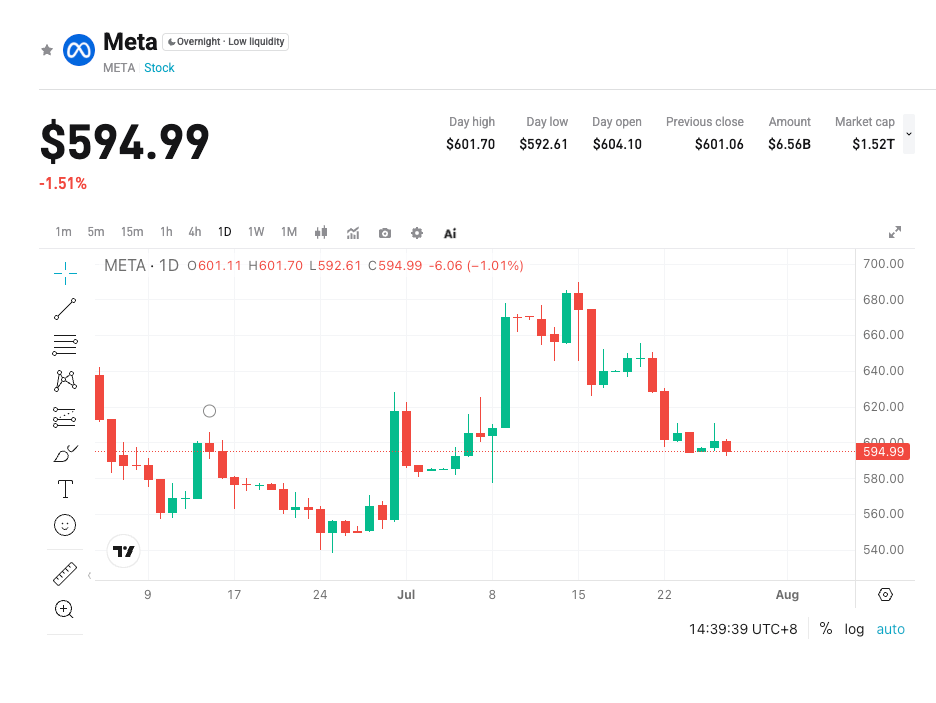
Meta will report its second-quarter 2026 results after the U.S. market close on July 29 (early morning Beijing time on July 30). Consensus expects revenue of approximately $60.258 billion (+7.01% QoQ) and EPS of $7.23 (-30.79% QoQ). Following Alphabet’s recent drop of 6.89% after AI-related capital expenditures doubled year-over-year and free cash flow turned negative for the first time, investors are closely watching Meta—another heavy AI spender—for clarity on whether its advertising business can continue delivering AI-driven efficiency gains and whether full-year capital expenditure guidance will be raised again.
2. Four Key Focus Areas
Focus 1: AI-Driven Conversion Performance in Advertising
Advertising remains Meta’s dominant cash-flow engine. First-quarter 2026 ad revenue reached $55.024 billion, accounting for 97.7% of total revenue. Both Bank of America and Deutsche Bank are constructive: BofA raised its Q2 revenue estimate to $60.6 billion and EPS to $7.5, citing strong ad demand plus AI efficiency gains that could push results above consensus. Deutsche Bank described channel checks as “overwhelmingly positive,” with advertisers seeing higher conversion rates and improved return on ad spend thanks to AI-powered ranking, retrieval, and automation. Advantage+ is now used by 82% of Meta advertisers, and the value-optimization suite has reached an annualized revenue run-rate of more than $20 billion (more than double the level a year earlier). Clear outperformance in ad growth and AI contribution would provide direct support for the valuation.
Focus 2: Whether Capex Guidance Will Be Raised Again
In April, Meta raised its full-year 2026 capital expenditure guidance to $125–145 billion, nearly double the $72.2 billion spent in 2025, primarily for GPUs, data centers, and AI infrastructure. Bank of America notes that higher memory and chip costs could prompt management to lift the range further to $135–150 billion. Markets remain concerned that elevated spending will continue to pressure near-term profits and free cash flow; the latest guidance delivered on the earnings call will be a key catalyst or pressure point for the stock.
Focus 3: Path to Monetizing AI Compute Externally
On July 1, reports that Meta is planning to sell AI compute capacity and model access to external customers—potentially via two models: hosted full-model access (comparable to AWS Bedrock) or raw GPU rental (comparable to CoreWeave)—sent the stock up 8.81%. Deutsche Bank’s base case assumes Meta will add 5 GW of compute capacity in 2026, reaching 7 GW by year-end, and plans to rent out 15–20% of idle capacity while prioritizing internal needs for ad recommendation, the Muse model, and AI agents. This initiative is viewed as a critical step in converting AI infrastructure from a pure cost center into a revenue-generating asset. Near-term progress and management commentary will determine whether the market buys the story.
Focus 4: Implications of the Revenue–EPS Divergence
Consensus shows revenue rising quarter-over-quarter while EPS is expected to decline sharply. This divergence clearly reflects institutional concern that heavy AI spending is eroding profitability. Results that deliver both strong ad growth and controlled capital spending would help ease the valuation pressure created by this gap; the opposite outcome could trigger an Alphabet-style sell-off.
3. Risks and Opportunities Coexist
Upside Catalysts:
- Advertising revenue and AI-tool contribution clearly exceed expectations, with Advantage+ and related products continuing to lift conversion rates and ARPU.
- Capital expenditure guidance remains unchanged or is raised only modestly, accompanied by a clear timeline and scale for external compute monetization.
- Management emphasizes that AI is already delivering measurable returns in advertising and user experience, reinforcing the narrative that the spending is justified.
Downside Risks:
- Full-year capital expenditure guidance is raised substantially into the zone that concerns investors, further pressuring free cash flow.
- Ad growth falls short of expectations or AI conversion benefits fail to materialize fully, reinforcing the “spend without return” narrative.
- Options implied volatility is already elevated (IV 51.87%, 96th percentile); a muted reaction to results could trigger rapid IV crush and heightened stock volatility.
4. Trading Strategy Considerations
Bull Case: Stronger-than-expected advertising results, clear guidance on AI monetization, and contained capital spending could allow the market to re-rate Meta’s AI investment cycle, supporting a recovery from recent spending-related discounts.
Bear Case: A significant upward revision to capital expenditure guidance or weaker-than-expected AI-driven ad performance could trigger an Alphabet-style after-hours decline and amplify downside pressure in a high-volatility options environment.
Key Metrics to Watch:
- Ad revenue growth rate and contribution from AI tools
- Latest full-year capital expenditure guidance
- Progress and scale of external compute rental
- Free cash flow and margin trends
Operational Suggestions: Prefer a wait-and-see or lightly hedged stance ahead of the report. Traders expecting elevated volatility but uncertain direction may consider long straddle or strangle structures. Shareholders seeking to hold through the event can use a collar (long put + short call) to limit downside. Short-term traders should focus on after-hours guidance and conference-call remarks regarding the AI return timeline; longer-term investors should continue to anchor on advertising fundamentals and tangible monetization evidence.
Have a view on earnings but not sure how to size it? Learn how options cap your downside and keep your upside.
Stock Limited-time Offer:July new user gift: Buy U.S. stocks and get free NVIDIA stock.Trade Now for Better Deals
Disclaimer: The above content is for reference only and does not constitute investment advice.
Disclaimer: The content of this article solely reflects the author's opinion and does not represent the platform in any capacity. This article is not intended to serve as a reference for making investment decisions.
You may also like
Swiss Franc weakens on easing safe-haven demand, US tariffs
Sports Prediction Contracts Hit $25B — Now the NFL Wants Them Reined In
Stablecoin market dynamics flip: $7.7B gone, $1.79T record volume
PRECIOUS-Gold slips as firm dollar weighs; focus turns to Fed meeting
Crypto prices
More


