
Corning delivered a "perfect score" financial report, but the market wants to give it a negative rating

On Tuesday, Corning delivered quarterly results that would make most CEOs walk into their earnings calls with their heads held high. Q2 core revenue reached $4.74 billion, up 17% year-on-year and above analysts’ consensus estimate of $4.61 billion. Core earnings per share were $0.78, rising 30% year-on-year and also outpacing expectations of $0.76.
The brightest spot in this report was optical communications: The segment’s Q2 revenue was $2.07 billion, up 32% year-on-year. Enterprise network business soared by 65%—and the growth rate of generative AI-related products, as the company put it, “significantly faster.” Corning didn’t provide an exact figure, but you can imagine the type of curve that represents.
This quarter, Corning also secured two major deals that cement its role in the AI narrative.
Amazon signed a multiyear, multibillion-dollar contract for Corning to supply optical fiber, optical cables, and a full suite of connectivity solutions for its data center expansion across the U.S. Nvidia has also established a long-term partnership with Corning, which has committed to expanding U.S. optical connectivity manufacturing capacity tenfold and increasing fiber production by more than 50%—all to match the rapid pace of AI factory development.
Together, these two deals indicate that Corning’s relationship with AI infrastructure has moved beyond being “just a supplier”—it’s becoming a strategic symbiosis. This rarity is the underlying reason the market is willing to revalue it from a traditional manufacturing company to a tech stock.
The issue now is that when you’ve reached this level of narrative, the market is no longer reviewing what you’ve achieved, but whether you can beat the numbers that everyone has already calculated for you.
Corning’s guidance for Q3: core revenue of $4.9–5.0 billion, core EPS of $0.85–0.89. There’s little to fault with EPS—the midpoint of $0.87 would be about 28% year-on-year growth, far ahead of the street forecast of $0.83.
But revenue guidance is more delicate. Analysts’ consensus for Q3 core revenue is about $5.0 billion—Corning’s upper end hits exactly that number, while the midpoint of $4.95 billion is actually slightly below market expectations.
In a valuation framework pricing in EPS of $3.18 for the full year and a forward P/E over 44x, even a midpoint slightly below consensus becomes a problem. This isn’t poor performance—it’s lofty pricing.
Corning’s inflated valuation has its own story logic.
At its May Investor Day, management substantially raised its Springboard targets: by year-end, annualized revenue of $20 billion; $30 billion by the end of 2028; and $40 billion by the end of 2030. From Q4 2026 to Q4 2030, the targeted compound annual growth rate for revenue is 19%, with profit growth set to outpace revenue. Coupled with concrete deals with Amazon and Nvidia, the market quickly rebranded Corning from a “specialty glass manufacturer” to a “core supplier of AI infrastructure.”
The intensity of this re-rating is clear in the stock price. Starting the year near $87, it surged in just over six months to a record high of $271.78 at the end of June. Even after pulling back nearly half in the past month to close at $143 on Monday, the year-to-date gain remains above 60%.
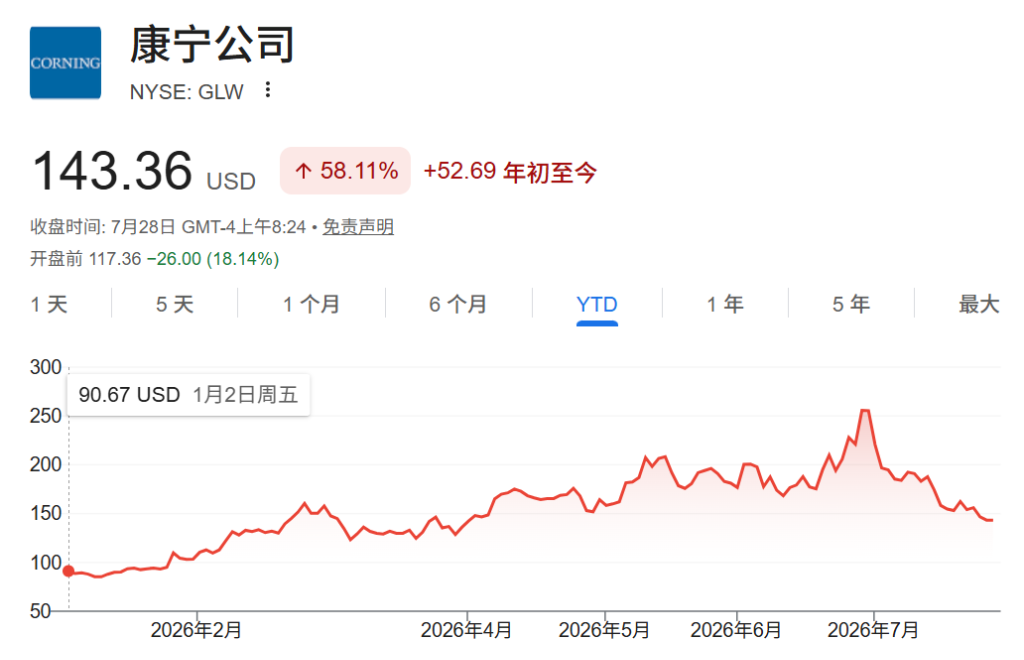
What does this mean? It means Corning’s earnings are no longer competing against “last year’s Corning,” but against a valuation framework that has already baked in the AI Capex supercycle.
Is 32% growth in optical communications enough? For a traditional materials company with a 40x P/E, it’s almost a luxury. But for a company now valued as an AI growth stock—and a consensus target price above $215—this quarter’s results are, at best, just “meeting expectations.”
This is exactly where the market is most conflicted. Sixteen Wall Street analysts currently cover Corning: nine rating it a buy, seven a hold, with an average target price of about $220. Even though, from current levels, there’s theoretically over 50% upside, the market clearly isn’t buying it—institutions have been trimming positions since the June peak, and the percentage of buy ratings has slipped from 76% at the start of the year to 70%.
The real market debate centers on one unavoidable question: Should Corning be treated as a cyclical materials company, or a structural AI growth story?
If it’s the former, a 44x P/E is a bubble. If it’s the latter, with AI Capex still accelerating, it might be justifiable. But current market pricing sends one message: we’re not fully convinced.
The financials do contain reassuring elements. Profit margin metrics are actually quite strong. Core gross margin hit 39.6%, up 120 basis points year-on-year. Core operating margin reached 20.9%, expanding by 190 basis points—the best operating leverage Corning has achieved in nine quarters. Core ROIC climbed to 14.9%, up 180 basis points. Adjusted free cash flow was $1.42 billion. Nine consecutive quarters of solid year-on-year growth—this consistency alone begins to answer many questions about whether this is a “cyclical or growth stock.”
The solar business remains something of an in-progress ticket.
Q2 revenue grew by 90% year-on-year, but due to extended maintenance shutdowns and equipment upgrades at the wafer plant this quarter—including switching to permanent power supply systems—profit was still negatively impacted. Management promised improved profitability for the solar segment in Q3, with an ultimate target of more than $3 billion in annual revenue, “with strong profits and cash flow.” But until we actually see margin improvement, this segment plays more the role of a call option in the valuation model than as realized value.
Back to the core dilemma: Corning’s AI narrative is legitimate, the customer mix and order quality of optical communications are solid, and the pace of margin improvement proves operating leverage is truly being released. But the market game at this stage is no longer about “whether the story is real.”
When a stock triples in six months, any earnings report that doesn’t crush expectations numerically—even if impressive—may still face a short-term re-rating. The report Corning released on Tuesday ultimately failed to do just that. It wasn’t a bad report—it just wasn’t good enough to make everyone forget how expensive it is.
Disclaimer: The content of this article solely reflects the author's opinion and does not represent the platform in any capacity. This article is not intended to serve as a reference for making investment decisions.
You may also like
3 Cooling Stocks to Watch as Europe’s Fourth Heatwave Hits
Spot gold trades at $4,029/oz after Consumer Confidence drops to 90.8 in July
DTCC says $1.2 trillion in daily US Treasury trades now centrally cleared
Euro: Pressured by softer ECB expectations – Scotiabank
Crypto prices
More


