The Federal Reserve is expected to keep interest rates unchanged as policymakers focus less on cooling CPI data and more on future inflation risks. Officials are closely watching AI driven capital spending, tariff expansion, and geopolitical energy shocks that could reignite price pressures and delay policy easing.
The Fed is widely expected to continue maintaining its benchmark federal funds rate in the target range of 3.50%-3.75% at the end of its July 28-29, 2026 meeting. This would mark the fifth consecutive meeting, as the effective federal funds rate is approximately 3.63%.
Notably, the current target range has been in place since the December 2025 meeting when the Fed had lowered the rates from higher levels earlier in the cycle. It has remained unchanged through the January, March, April, and June 2026 meetings.
Policymakers are looking beyond cooling June CPI data and focusing on three forward-looking risks that could reignite inflation. AI driven capital spending is becoming a key inflation risk, with hyperscalers projected to spend $720–750 billion this year on semiconductors, data centers and electricity.
Tariffs imposed in 2025 have passed through to prices, and estimates of their impact on core PCE inflation are peaking around early 2026. Continuing adjustments and potential new measures are still impacting goods prices, however the impacts have been gradual.
Additionally, geopolitical energy shocks, particularly those related to the Middle East tensions and disruptions in the Strait of Hormuz, contributed to oil prices exceeding $100 per barrel earlier in 2026. Although some of the most severe impacts might be short-term, the prospect of resurgences makes the Committee vigilant on preventing second-round impacts.
Market pricing remains in favor of a Fed hold, but the odds of a Fed hike have been increasing over the past few weeks. As of July 28, CME FedWatch showed 63%–65% odds of unchanged rates and 35%–37% odds of a 25 basis point increase to 3.75%–4.00%. The Kalshi markets, in turn, are pricing one hike this year, with cuts to come in 2027, with the broad expectation from FactSet economists being a no hike in July.
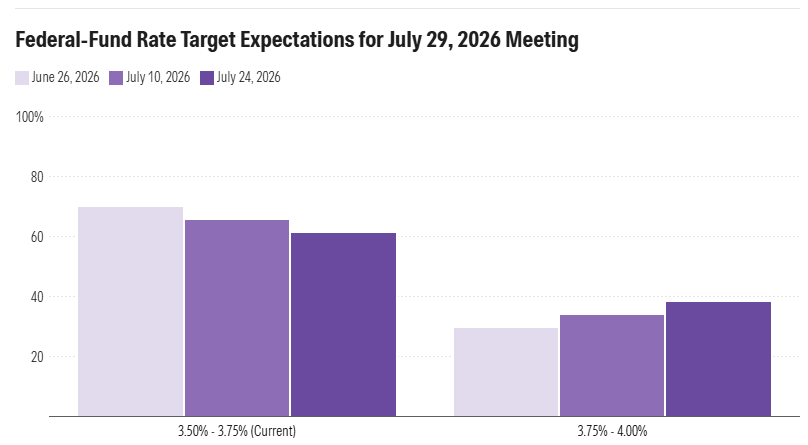 Source:
As a result, the most probable scenario is a prolonged hold in the policy rate through the next meeting in September, and the Fed leaning to hikes should inflation fail to sustainably reach the 2% target due to the impact of AI investments, energy costs, or tariff impacts. A rate cut in 2026 appears to be far from certain, with Chair Warsh stating future actions will be governed by inflation, employment, and geopolitical conditions.