
Federal Reserve's 40-Year Rule Loosens for the First Time: Wall Street's Most Familiar "Interest Rate Playbook" May No Longer Work

Conclusion first: If the Federal Reserve reduces the number of monetary policy meetings, the real reduction is not in the number of meetings, but in the market's opportunity to anticipate the direction of interest rates.
According to The New York Times, citing informed sources, Federal Reserve Chairman Kevin Warsh is considering reducing the number of regular FOMC policy meetings. He has introduced the relevant legal authority to officials at this week’s meeting and asked for direct feedback after the meeting.
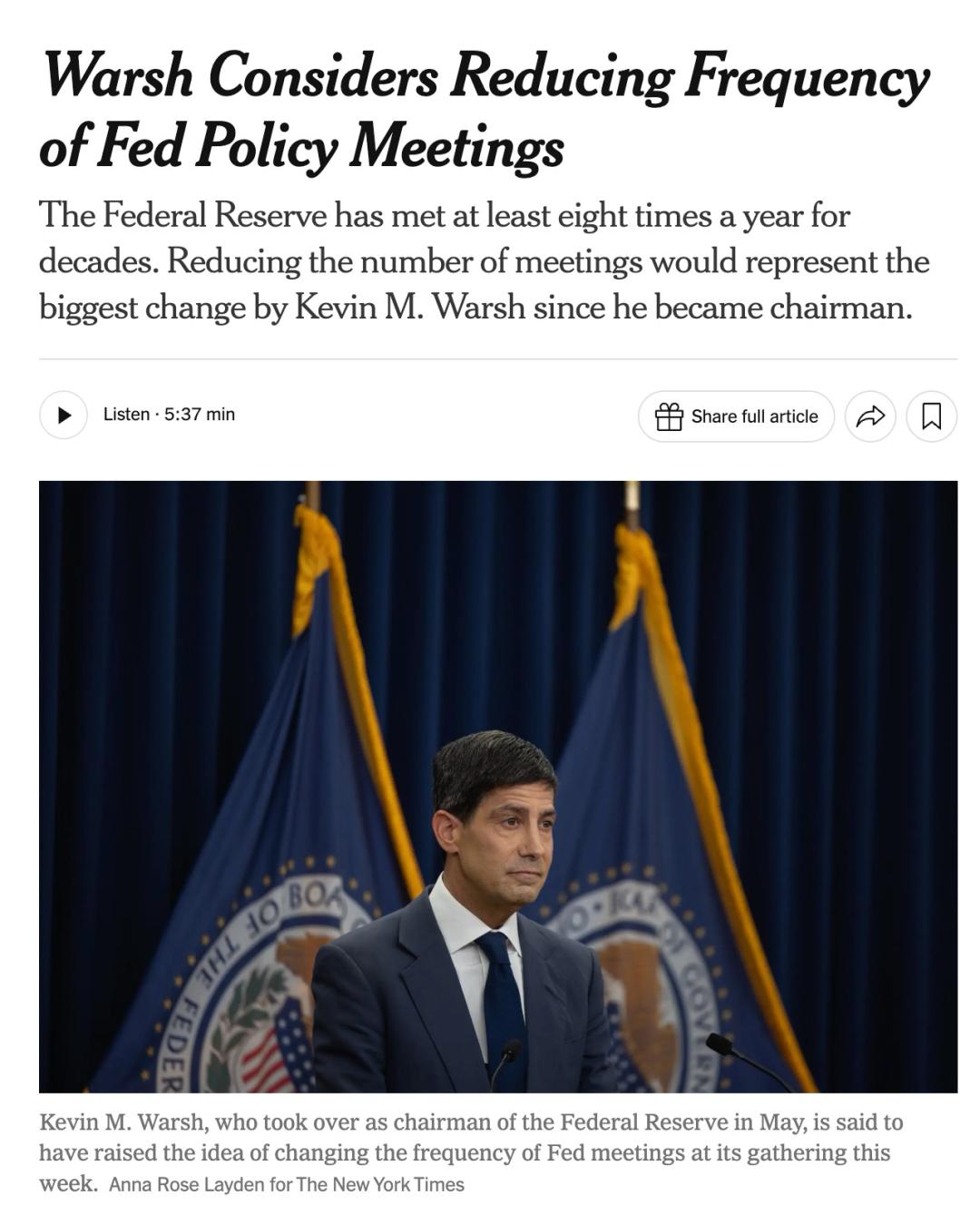
The plan has not yet been finalized, but a direction could be set as early as before the next rate decision. The next Federal Reserve meeting is scheduled for September 15–16, and the market is watching whether this reform will proceed further.
A 40-Year Fixed Rhythm May Change
Currently, the FOMC holds eight fixed meetings a year, about once every six weeks.
This arrangement has continued since 1981.
However, it should be noted that U.S. law does not require the Federal Reserve to meet eight times a year.
The legal requirement is:
The FOMC must meet at least four times a year.
In other words, if Warsh pushes for an adjustment, from a systemic perspective, the Federal Reserve indeed has room for change.
On the surface, this is just an adjustment to the frequency of meetings.
But in reality, FOMC meetings have already become one of the most important informational windows in the global financial markets.
For decades, investors have established a fixed pattern:
Release of economic data;
Markets predict whether the next FOMC will raise or cut rates;
Federal Reserve holds the meeting;
Signals are released via rate decisions, policy statements, economic forecasts, dot plots, and press conferences; markets then reprice assets.
This rhythm has become part of Wall Street’s trading system.
Market Trading Logic May Change
If FOMC meetings are reduced, the market will first lose several fixed policy confirmation windows.
At present:
After the monthly release of CPI, Nonfarm Payrolls, PCE and other data, investors quickly determine:
“Will this data change the outcome of the next Federal Reserve meeting?”
Then they wait for the Fed to give the answer.
In the future, if meetings are reduced, data will still be released monthly, but the frequency of public Fed responses may decrease.
Investors may have to rely more on:
Speeches by Fed officials;
Market interest rate movements;
Economic data models;
Wall Street institutional forecasts.
In simple terms:
In the past, the market waited for the Fed to confirm the answer.
In the future, they may have to make more of their own predictions.
Ordinary Investors May Face Three Changes
First, interest rate expectations may fluctuate more violently.
Previously, if the market made a wrong judgment, usually it would only take about six weeks to reach the next meeting and verify.
In the future, if there are fewer policy windows, wrong expectations may last longer.
When the Fed finally releases a clear signal, the bond, dollar, and stock markets may undergo a more concentrated round of repricing.
Second, the importance of every FOMC meeting will increase.
Fewer meetings do not mean less policy risk. On the contrary, as markets wait longer, each meeting may carry more information.
If the economic environment changes significantly, the market may accumulate more disagreements during the waiting period, which will eventually surface around the meeting dates.
Third, the importance of economic data will further increase.
When policy communications decrease, indicators such as CPI, employment data, and consumer demand will become the primary bases for the market to judge rate direction.
A significantly above-expectation inflation data could result in greater market volatility than before. However, reducing regular meetings does not mean the Fed loses its ability to act.
When major risks arise, the FOMC can still hold special meetings. What the Fed is really weakening is not its "ability to act quickly" but the frequency with which the market obtains policy information during normal times.
Supporters' Logic
Supporters of reducing the number of meetings believe that having eight meetings a year has caused the market to become overly dependent.
After every release of economic data, investors immediately look for answers:
“Will this data change the outcome of the next Federal Reserve meeting?”
Over time, monetary policy has gradually become the key variable for short-term trading.
Supporters believe that changes in interest rates themselves need time to affect the economy.
The cost of corporate financing, consumer loans, and the real estate market will not change immediately after a single rate cut.
If the Fed keeps adjusting market expectations based on one or two months of data volatility, it could instead add unnecessary fluctuations.
From this perspective, reducing the number of meetings doesn’t necessarily mean policy will be more aggressive. On the contrary, it may mean the Fed hopes to reduce market overreaction to short-term data and focus policy more on long-term trends.
The Real Controversy
The issue is not actually the eight meetings per year itself.
Rather, it is:
If meetings are reduced, and policy communication is also reduced, can the market still accurately understand the Fed's next steps?
The reform Warsh is pushing is not just about adjusting the number of meetings.
He also previously proposed:
Shortening the policy statement;
Reducing public explanation of the future rate path;
Adjusting arrangements for post-meeting press conferences.
If these changes advance together, the market's sources for Fed signals may be significantly reduced.
US Stock Investing Network believes that what investors really need to be alert to is:
A reduction in meetings + shorter policy statements + fewer press conferences—will this shift the Fed from decades of highly transparent communications toward a model that relies more on market interpretation?
Why Is Now Especially Sensitive Timing?
It’s worth noting that this reform is happening at a time when policy disagreements are notably increasing.
The current market environment is not an easy one.
On the one hand:
Tech giants like Microsoft and Amazon continue to expand AI capital investment, and the market is reassessing the potential for AI growth.
On the other hand, investors still worry about:
Whether inflation will rebound;
Whether tariffs will push up prices;
Whether the resilience of the U.S. economy can continue.
Meanwhile, there are also divisions within the Fed about the direction of interest rates. This week, three Fed officials said the current rate level should not be maintained, arguing for policy adjustments to prevent inflation from spreading again.
In this context, if the market receives less policy signaling, asset prices may become more prone to violent swings.
Which Assets Will Be Affected?
First, high-valuation tech stocks.
AI companies, cloud computing firms, and many growth companies rely heavily on future cash flows for their valuations. The harder it is for the market to predict future rate direction, the higher the volatility for high-valuation stocks.
Especially in the current AI investment cycle, investors both believe in long-term demand and worry that high rates will suppress valuations. Lower policy transparency could magnify this contradiction.
Second, US Treasuries and the dollar.
The US Treasury market relies most on the path of Federal Reserve rates.
If policy signals are reduced, two-year Treasury yields may rely even more closely on monthly inflation and jobs data. The dollar may also experience greater short-term swings around economic data releases.
Gold may benefit from policy uncertainty, but if this leads the market to raise rate expectations again, higher real yields may also put pressure on gold prices.
Finally, the options market.
If FOMC meetings are reduced, risk will not disappear but will be more concentrated at specific moments in time.
Before the remaining meetings, market pricing of volatility may increase. After the meetings, if direction becomes clear, volatility may drop more sharply. For options investors, the cost of betting on the wrong direction in a single meeting may rise considerably.
Disclaimer: The content of this article solely reflects the author's opinion and does not represent the platform in any capacity. This article is not intended to serve as a reference for making investment decisions.
You may also like
The "Black July" ends with two consecutive gains—has "AI trading" reached the bottom?
Most analysts believe that after significant corrections in momentum stocks and some valuation adjustments in AI leaders, the most intense phase of market rotation has passed. However, they also emphasize that this does not necessarily mean that a precise bottom has been confirmed. JPMorgan recommends increasing exposure to quality factors, while Goldman Sachs warns about long-term interest rate risks and suggests maintaining positions with high liquidity and low complexity.
Why is Unibase up? AI buzz, exchange outflows & more…
Utility Takes a Back Seat as Altseason 2026 Ignites: Are These Meme Coins Ready to Outperform?

Colombia launches $4B reserve program to cool its red-hot peso
Crypto prices
More


