
Lumentum FY2026 Q4 Earnings Highlights: Revenue Doubled YoY to $1.01 Billion, Non-GAAP EPS Up 267%, Q1 Guidance Significantly Above Expectations
 2026/08/12 02:51
Core View
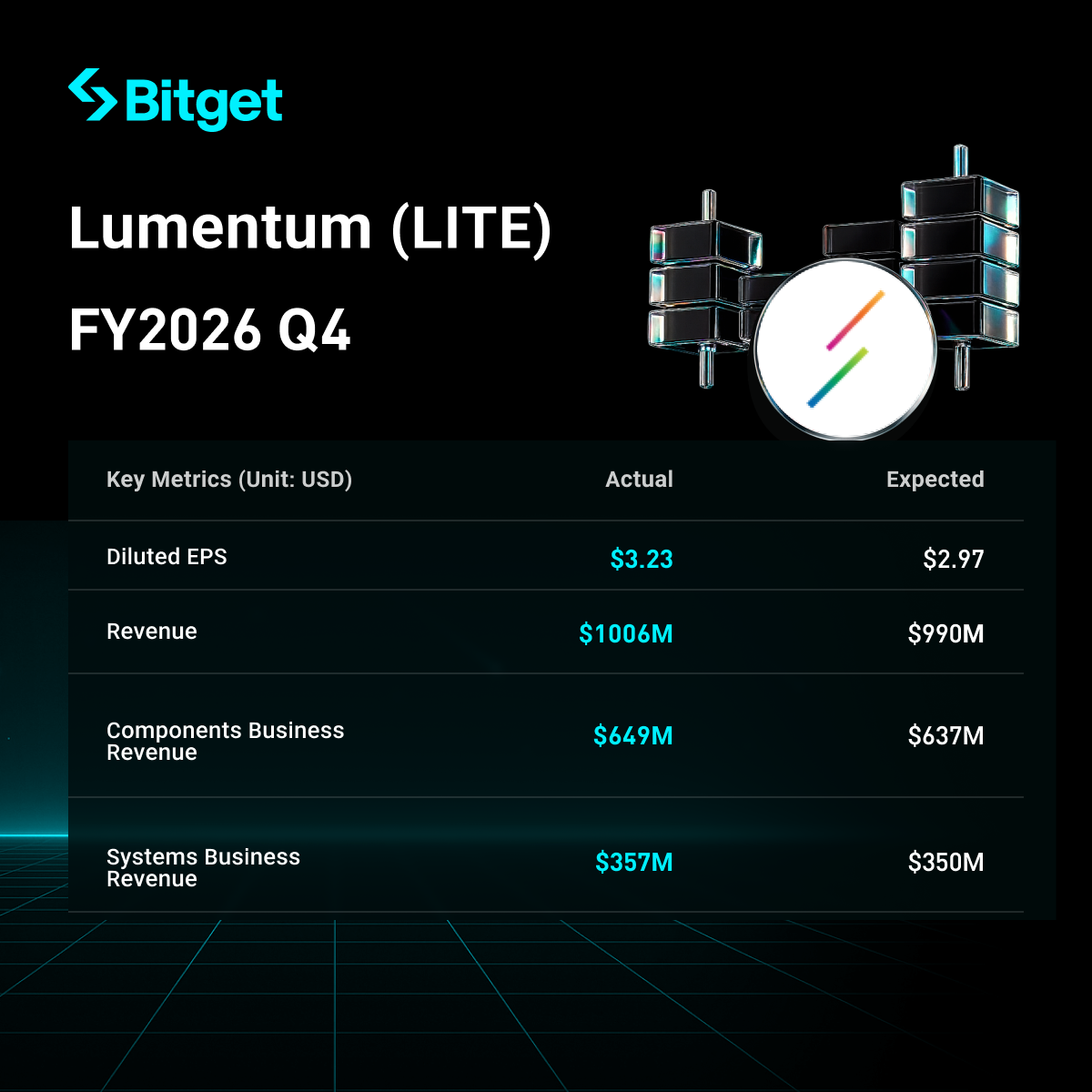
Lumentum (LITE.US) reported results for the fiscal fourth quarter ended June 27, 2026. Net revenue rose approximately 109% year-over-year to $1.01 billion, modestly above market expectations. Non-GAAP adjusted EPS surged 267% year-over-year to $3.23, significantly beating estimates. Non-GAAP gross margin broke through 50% to reach 50.4%, while operating margin hit 36.6%, demonstrating stronger profit leverage than revenue growth. On a GAAP basis, the company recorded a net loss of approximately $7.2 billion due to a one-time non-cash debt extinguishment charge. Guidance for the next fiscal quarter (FY2027 Q1) shows revenue midpoint growth of about 135% year-over-year and roughly 8% above consensus, with non-GAAP operating margin guided near 40%, underscoring continued strong demand from AI optical communications. After-hours trading saw the stock initially decline more than 5% before rebounding over 2%, reflecting the market’s tug-of-war between strong guidance and the GAAP loss plus valuation concerns.
Detailed Breakdown
- Overall Revenue and Profit Performance
- Net revenue: $1.01 billion (approximately $1.0063 billion), up about 109% year-over-year (from $480.7 million in the prior-year period), above market expectations of roughly $988 million (beat by ~2%).
- Non-GAAP adjusted EPS: $3.23, up 267% year-over-year, above the $2.97 consensus (beat by ~9%).
- Non-GAAP gross margin: 50.4%, up 1,260 basis points year-over-year.
- Non-GAAP operating margin: 36.6%, up 2,160 basis points year-over-year.
- Adjusted EBITDA: $406.4 million, corresponding to a margin of approximately 40%.
- Non-GAAP net income: $326.3 million, up 415% year-over-year.
- GAAP net loss: approximately $7.2 billion ($84.65 per share), primarily driven by a one-time non-cash loss on debt extinguishment of about $7.8 billion from the equitization of certain convertible notes.
- Full-year FY2026 net revenue: approximately $3.01 billion, up about 83% year-over-year.
- Components Business Performance
- Revenue: $649.4 million, up approximately 103% year-over-year (from $320.4 million), above the $636.9 million estimate.
- Accounted for more than 60% of total revenue and remained the primary revenue base.
- Key drivers: Strong AI data-center demand for scale-out and scale-across applications, including record 100G/200G EML shipments (200G EMLs exceeding 25% of total EML revenue), growing demand for ultra-high-power CPO lasers, continued sequential growth in narrow-linewidth lasers, and pump lasers up about 80% year-over-year.
- Other Business Segment Performance (Systems)
- Systems revenue: $356.9 million, up approximately 123% year-over-year (from $160.3 million), above the $350.4 million estimate.
- Growth rate exceeded that of the components business, indicating demand spillover from discrete devices to system-level solutions.
- Key drivers: Cloud module business (record 800G transceiver shipments and initial volume production of 1.6T modules) and optical circuit switch (OCS) solutions beginning to contribute incremental revenue.
- Future Plans and Growth Drivers
- CEO Michael Hurlston noted that OCS solutions and the cloud module business have started contributing incremental growth. Rising demand for ultra-high-power CPO lasers, an initial order for ELS modules, and broad NPO engagements signal that optics are beginning to penetrate in-rack connectivity, significantly expanding the optical technology total addressable market (TAM).
- The company stated it is reaching its target operating model more than a quarter ahead of schedule, driven by faster-than-expected revenue scale, product mix improvement, and operating leverage.
- Increasing AI compute workloads in both speed and bandwidth are prompting data-center architects to adopt optical links as a primary means of connectivity.
- Next-Quarter Guidance (FY2027 Q1)
- Revenue: $1.225 billion to $1.275 billion (midpoint approximately $1.25 billion), representing about 135% year-over-year growth and roughly 24% sequential growth, approximately 8% above the market consensus of about $1.16 billion.
- Non-GAAP adjusted EPS: $4.05 to $4.35 (midpoint approximately $4.20), up about 282% year-over-year and roughly 30% sequentially, about 16% above the $3.61 consensus.
- Non-GAAP operating margin: 39.5% to 40.5% (midpoint approximately 40%), an improvement of about 340 basis points from the 36.6% reported in Q4.
- Market Context and Investor Concerns
- Core tension: Robust AI optical communications demand (particularly data-center optical modules, lasers, and OCS) and significantly better-than-expected guidance support fundamental upside; however, the large GAAP non-cash loss, previously elevated expectations, and high valuation create near-term pressure and profit-taking risk.
- Stock reaction: The shares closed up nearly 0.9% before the report; after-hours trading initially declined more than 5% before recovering to a gain of over 2%, reflecting competing forces.
- Key items to watch going forward: Delivery against Q1 guidance, sustainability of operating margins near 40%, the pace at which CPO/ELS/NPO-related demand converts from early orders into scaled revenue, and whether supply constraints (especially in OCS and certain lasers) ease.
Stock Limited-time Offer:August new user gift: Buy U.S. stocks and get free NVIDIA stock.Trade Now for Better Deals
Disclaimer
This content is for reference only and does not constitute any investment advice.
Disclaimer: The content of this article solely reflects the author's opinion and does not represent the platform in any capacity. This article is not intended to serve as a reference for making investment decisions.
You may also like
What if you can't afford chips? Nvidia partners with Wall Street to turn AI computing power into financeable and securitizable assets
Nvidia has partnered with Apollo, BlackRock, Blackstone, and other Wall Street giants to build a $500 billion AI chip securitization financing system. By packaging GPUs into a new asset class similar to mortgage-backed loans through SPVs, the aim is to create capital channels for small and medium-sized AI enterprises struggling with financing. However, concerns remain over the "lettuce-short" shelf life of chips, potential circular financing arising from Nvidia's self-guaranteeing, and the reality of zero actual fundraising so far. These factors leave this financial innovation, likened to the MBS revolution of the 1970s, teetering between idealism and risk.
Bank of America: Tonight’s “downward surprise” in CPI will have a greater impact; if core CPI unexpectedly drops, a September rate hike may be off the table
Bank of America noted in its CPI preview report that the market's reaction to a "downside surprise" in inflation will be significantly greater than to an "upside surprise." If the core CPI month-on-month comes in at 0.1%, lower than expected, a September rate hike will basically be ruled out, putting double pressure on US Treasury yields and the dollar. Conversely, while a 0.3% upside surprise would put a September rate hike back on the table, the outcome remains uncertain due to doubts over Waller’s stance and the need to confirm August data.
Bitcoin Rally May Fade Without Spot Demand, CryptoQuant CEO Warns
Bitmine Adds $289.4M in ETH to Staking, Now Controls 4.2% of Ethereum Supply
Crypto prices
More


