
Not Competing in AI Nor Buying Back Shares, Can the "Stingy" JD.com Still Succeed?


Perhaps the currently “most recognized” domestic e-commerce platform—JD.com (JD.US) announced its Q2 2026 results on the evening of August 13. Overall, the performance could be described as “steady”, but also “lackluster”. From the perspective of expectations, revenue and total profit slightly outperformed Bloomberg expectations, but were about in line with or slightly below some major banks’ predictions.
In terms of trend, as overall domestic consumption weakened in Q2, total revenue turned negative this quarter. However, since the market had already braced for this with previous retail sales data, it was not a surprise. Although profits in the mall segment declined year-on-year, compared to last year—when profits were nearly wiped out by the food delivery battle—the group’s overall profit was actually showing clear recovery year-on-year.
Specifically:
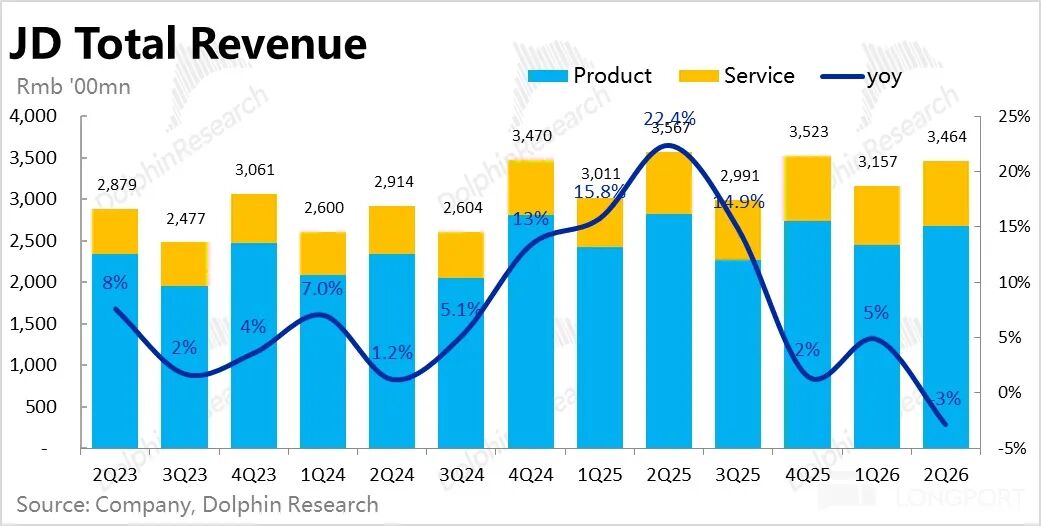
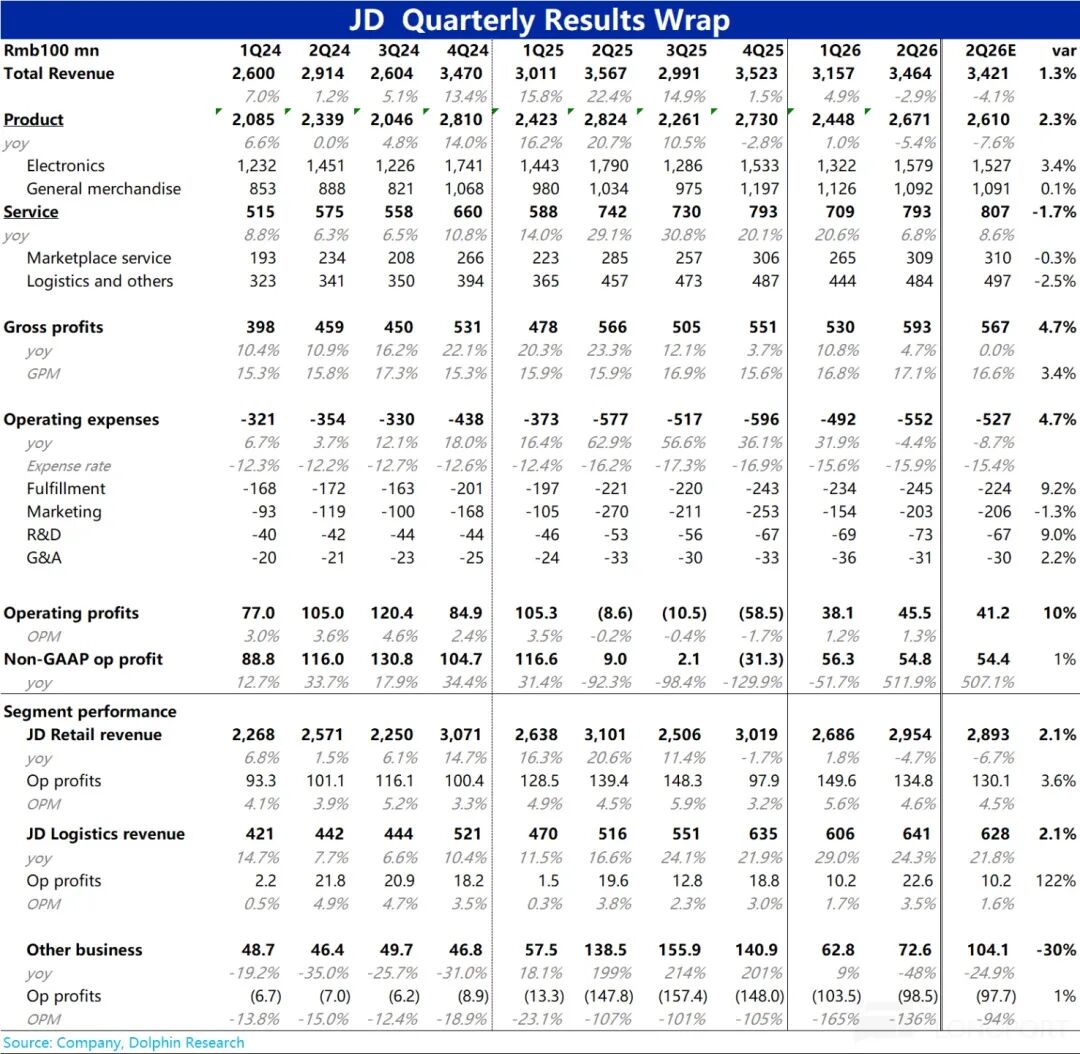
1. Both revenue and profit declined, but without shock: JD.com's total revenue this quarter was approximately 346.4 billion, a year-on-year decrease of 3%, down from last quarter’s 5%—a significant deceleration, but generally in line with market expectations and not a surprise, corresponding with the overall retail sales trend this quarter.
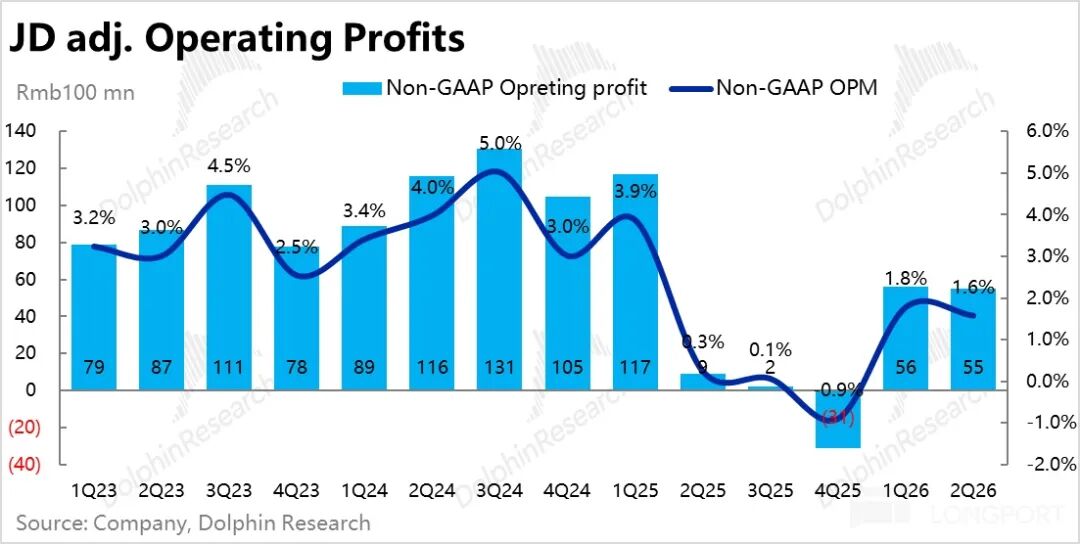
The group’s operating profit was 4.55 billion, with an adjusted figure of 5.48 billion. According to the adjusted data,it was slightly better than Bloomberg’s expectations, but below those of some major banks. Specifically,the primary drag was higher-than-expected losses in new businesses.
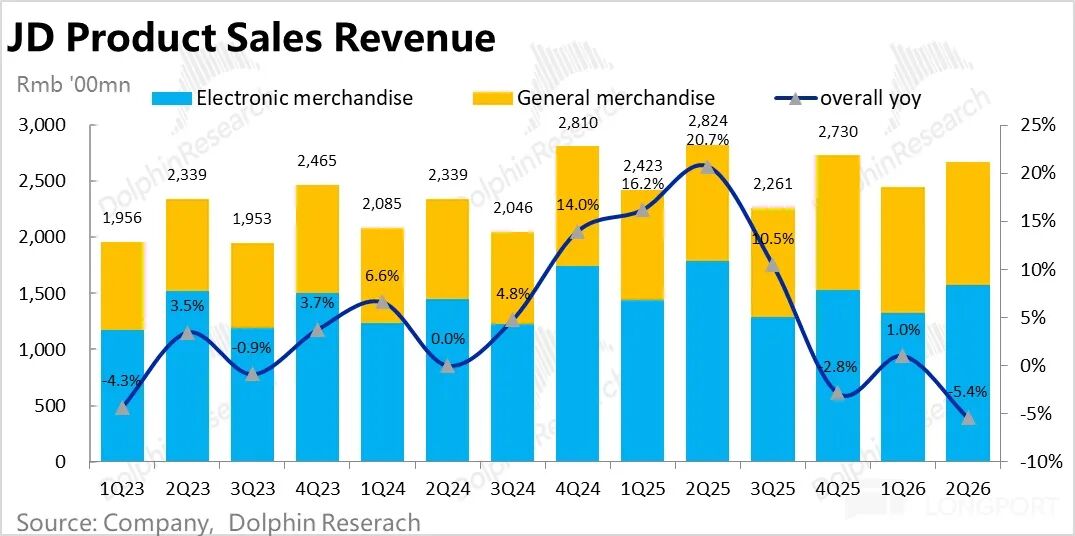
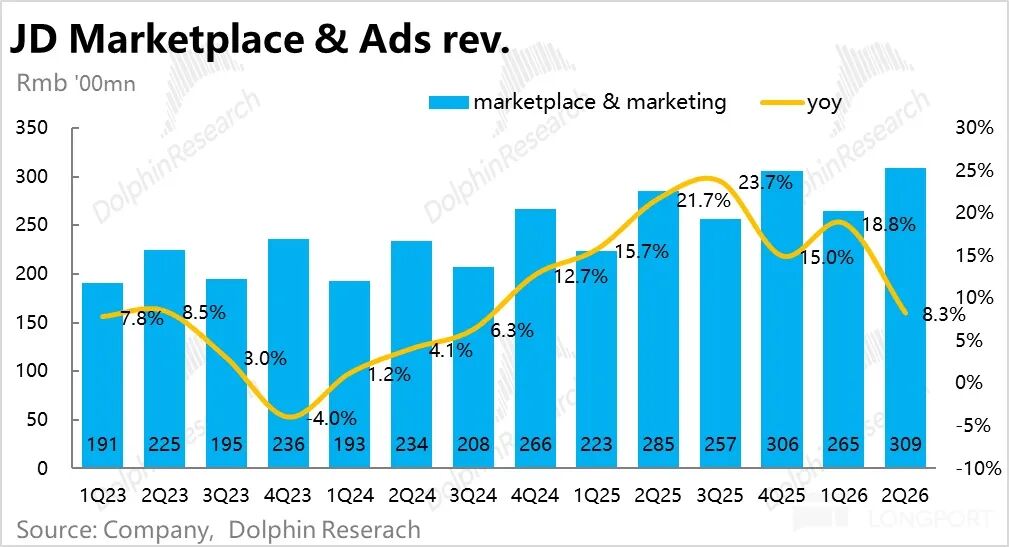
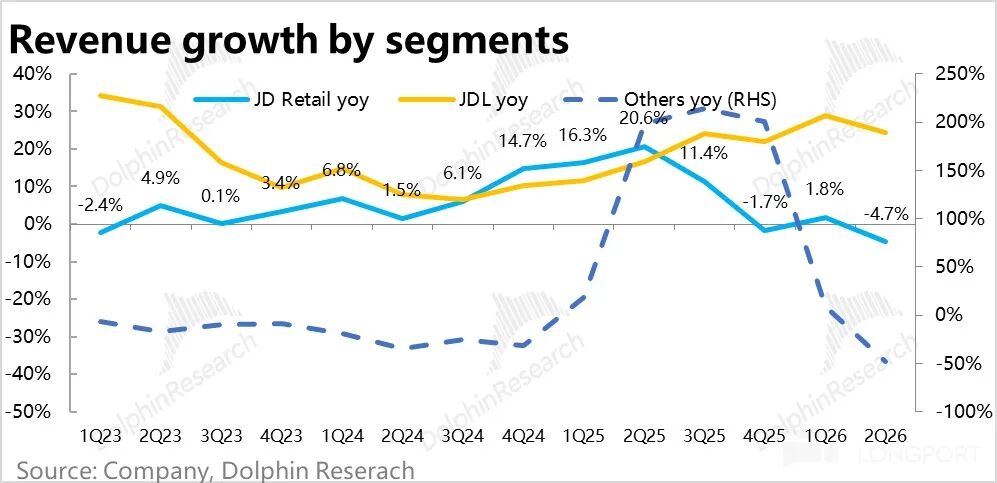
2. More severe plunge in daily goods and advertising growth: The most criticaldomestic mall segment revenue declined by approximately 4.7% YoY this quarter, with growth rate as anticipated continuing to worsen. The decline was less than market expectations, but was generally in line with leading banks’ forecasts.
Specifically, the most worryingdecline in electrical product sales was actually limited, this quarterwas under 12% YoY vs. 8.4% last quarter. This may be due to a marginal rebound from national subsidies, which were previously focused on offline sales and have recently begun returning to online platforms.
In contrast,sales of daily essentials and service ad revenue—businesses theoretically unaffected by the fading national subsidy—declined more significantly. Daily essentials sales growth dropped from 15% to 5.6%, while ad service growth slowed from nearly 19% to about 8%.Both fell by about 10 percentage points.
Though the market expected a slowdown (as the effect of electrical products and food delivery leading users to the platform wanes),these two businesses are the main growth drivers for JD.com’s mid-term results, raising market doubts—after the national subsidy effects fade, whether JD Mall’s core growth rate can re-accelerate (such as returning to above 10%).
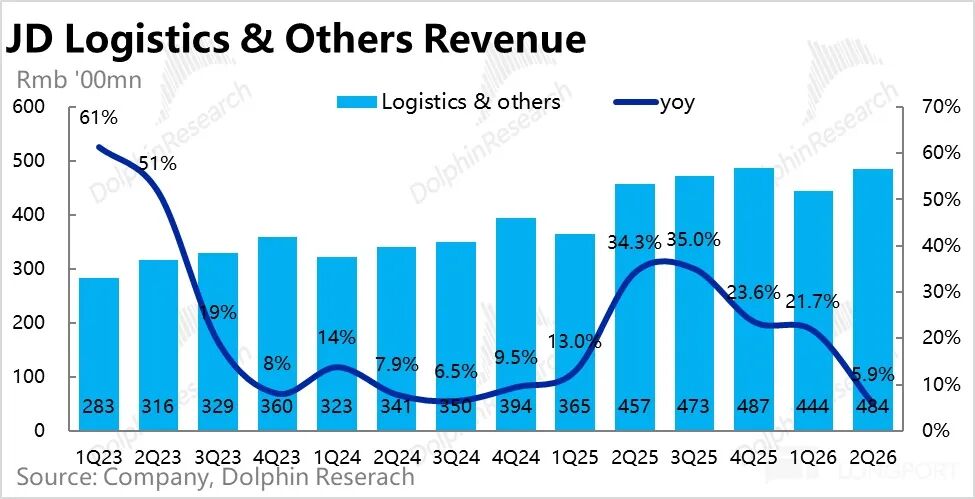
3. Food delivery war cooling down, logistics and new business growth also slowing: Having now entered the high base period caused by the food delivery war, and with food delivery orders not increasing this year but instead falling,this quarter’slogistics income and new business growth rates both declined.
Among them,logistics and other income growth slowed to 5.9%, and with the food delivery pull gone, it has basicallyreturned to the mid-to-high single-digit growth rates seen before 2025.
However, looking at revenue from its startup segment, it grew by about 15% quarter-on-quarter, suggesting an increase in overseas business contributions.
4. Mall profit margin can still improve; new business losses slightly higher: Overall, group profits this quarter largely met expectations.
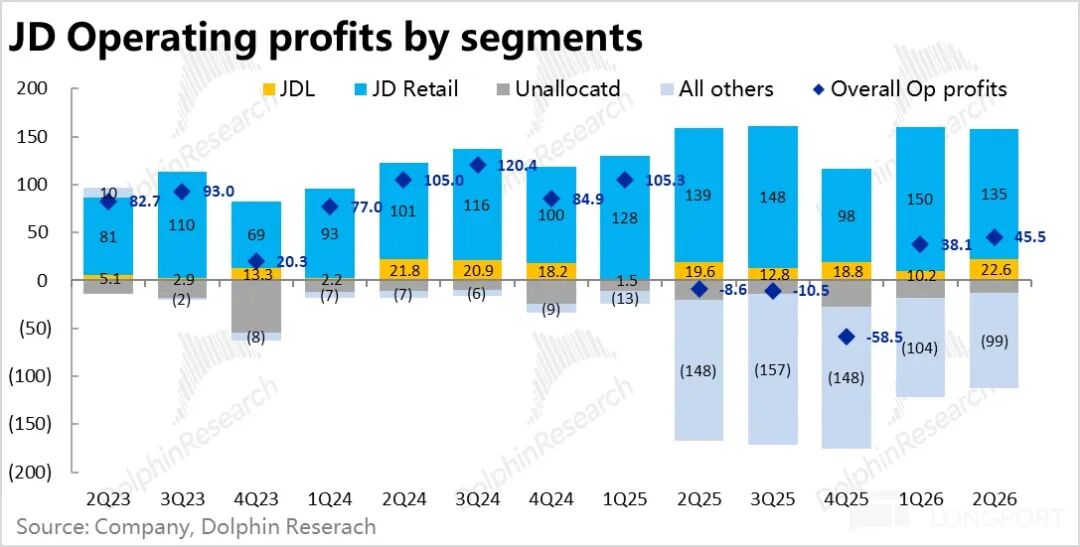
By segment,JD Mall’s operating profit this quarter was nearly 13.5 billion, slightly beating Bloomberg’s ~13.0. In terms of trend, it did not withstand the revenue contraction, with profit also dropping about 3% YoY,failing to deliver outperformance once again.
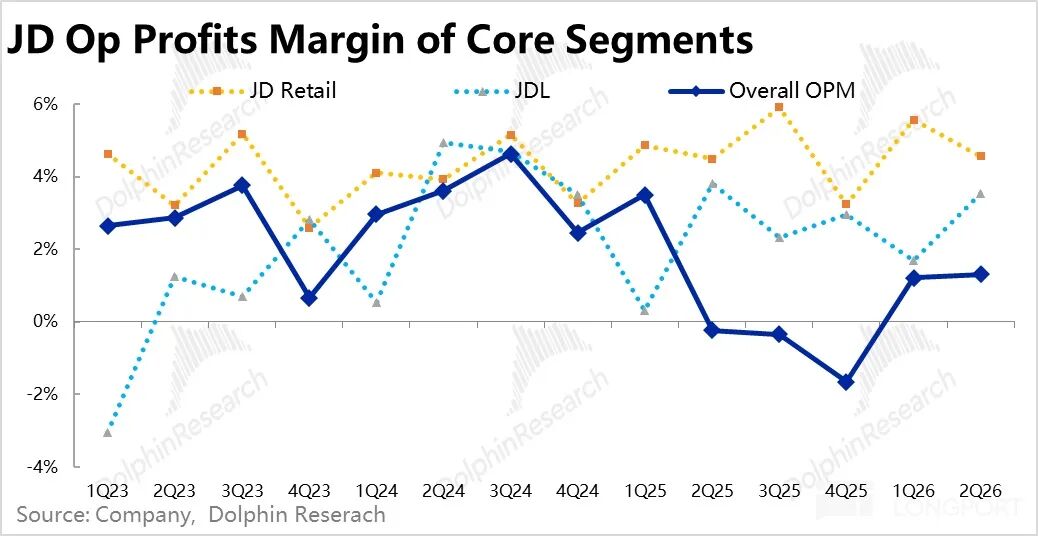
However,profit margin still rose slightly year-on-year, below 0.1 percentage point improvement. Optimists may say that JD.com is improving margins even as revenue shrinks; pessimists may say that margin improvement in the mall segment appears quite limited now.
According to the company, margin improvement is mainly due to revenue structure shifting towards higher-margin businesses, and optimization in the supply chain.
As for theinnovation segment that includes food delivery, this quarter’s loss was close to 9.9 billion, as Dolphin Research expected, the gap did not narrow significantly from the previous quarter, and was also slightly higher than Bloomberg’s consensus expectations.
According to general market consensus, JD Food Delivery’s losses this quarter should have dropped about 1 billion quarter-on-quarter. This suggestsoverseas and other business investments rose about 500 million QoQ (which doesn’t seem like much).
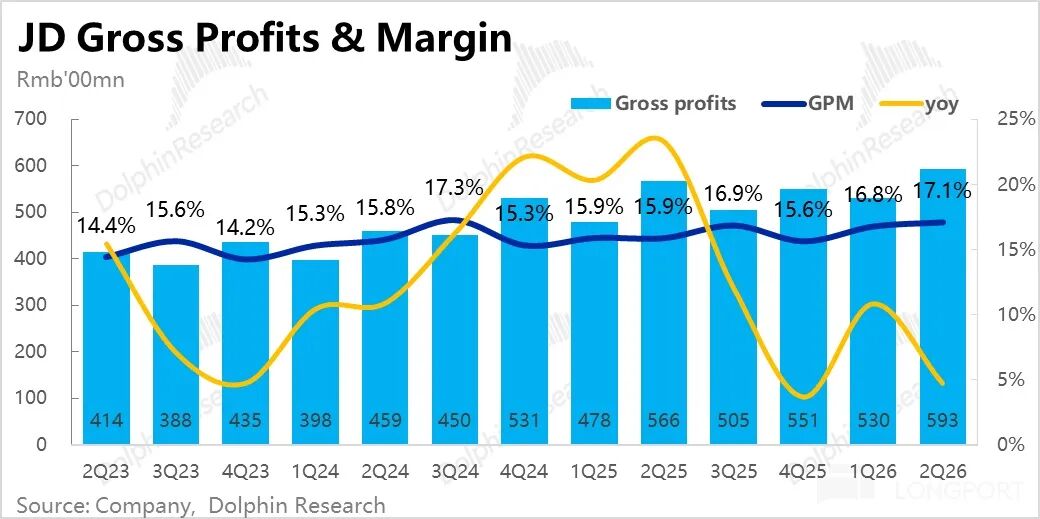
5. Cost and expense perspective: First,gross margin at group level continued to rise quarter-on-quarter this quarter, from 16.8% to 17.1%. Therefore, gross profit still achieved about 5% positive growth.
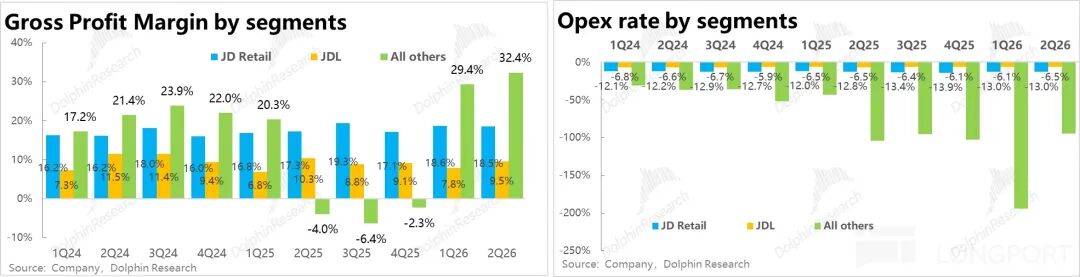
Specifically, this is mainly becauseafter food delivery subsidies decreased, innovation and logistics segments saw higher gross margins, with new businesses contributing more, lifting gross margin by 3 percentage points QoQ. In contrast,the mall segment gross margin fell slightly QoQ by around 0.1 point (though still up 1.2 points YoY).Thus, margin expansion from the upstream supply chain appears largely exhausted.
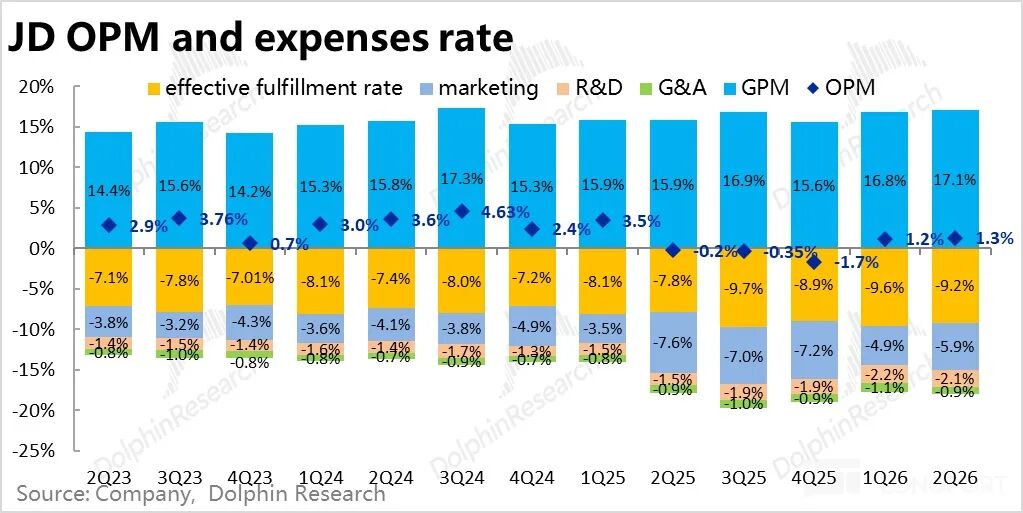
From an expense perspective,group-wide expenses fell 4.4% YoY this quarter, outpacing the revenue drop, supporting profit release. Specifically, marketing spend dropped 25% as expected. Of note, R&D expenses continued robust 38% YoY growth—though no massive AI model R&D outlay, JD.com has clearly been investing in internal AI applications.
By segment,Mall segment’s total expense ratio rose about 1 percentage point both YoY and QoQ, showing that with the national subsidy fading, the company is under more pressure to subsidize users itself—which is the main reason mall profit margin did not climb further.
The overall decrease in group expenses was primarily due to reduced investment in new business, falling by about 1.8 billion YoY.
6. Shareholder returns down; not investing in AI but overseas: Previously, a JD.com advantage was best-in-class shareholder returns among US-listed Chinese tech stocks. Yet inall of H1 2026, the company repurchased only about $1 billion, an annualized return yield of only about 5% relative to its current market cap, a clear decline.
And unlike Alibaba or Tencent,JD.com does not have massive AI Capex outlays, so cash flow pressure is not high. In this quarter's cash flow statement, about 29.5 billion was invested, but most of it was for short-term investments, cash management, and not truly substantial investments.The impression that the company would rather buy wealth management than return cash to shareholders is certainly not positive.
Dolphin Research’s view:
1. As seen above, JD.com’s results this time were average with no highlights. The trend is that macro factors are dragging down growth; while total profit seems to have improved due to lower food delivery losses, profit in the core mall segment actually declined. So overall, the results are not good.
In summary, the main deficiencies are: a. Mall revenue decline was expected, but previously, mall profit was much higher than expectations and guidance—now it’s bland; it seemsthe trend of profit improvement in the mall may have reached a bottleneck. b. Although food delivery losses narrowed,overall, new business losses did not significantly decline due to overseas investment; c. Daily essentials and ad revenue growth fell significantly, which—though reasonable—means reduced revenue growth outlook mid-term; d. Prefers to invest surplus cash rather than pay dividends.
2. Outlook & Logical Judgement
The current result is not good, so what about the outlook? Dolphin Research believes the decisive factors for future performance and stock price are generally twofold:
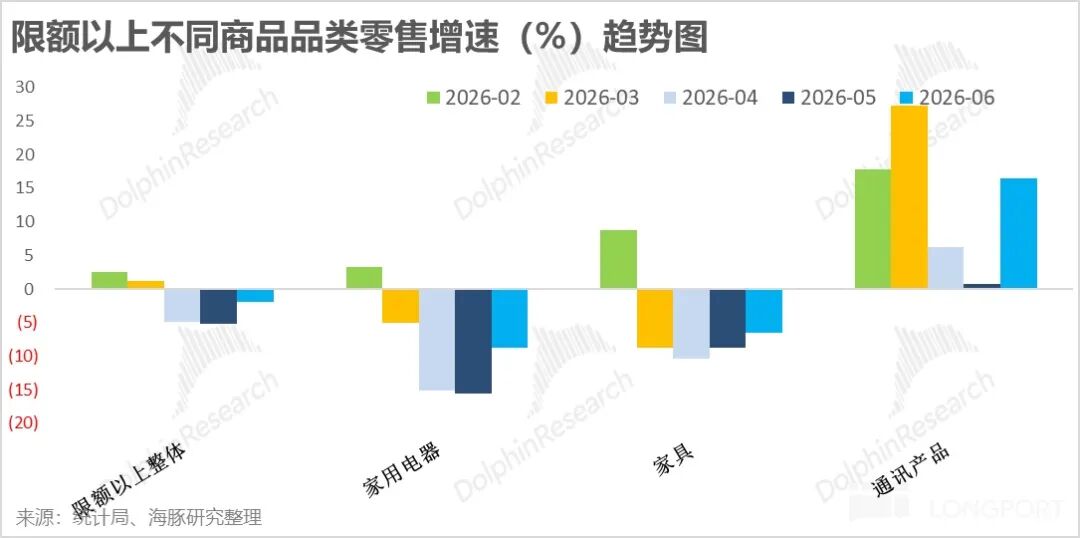
1) Whether there will be a clear inflection point in domestic e-commerce performance in H2. From macro retail data, Q2 was the worst in years for both online and overall consumption. However,June’s retail sales YoY growth had already started to recover compared to May,with overall growth from -0.6% to +1% and online physical goods from 2.6% to 3.9%.
For JD.com, especially in electrics, the Stats Bureau saidsales growth for home appliances, furniture, and communications all improved significantly in June (smaller declines). The degree of decline in electrical product sales this quarter was indeed modest.
According to a foreign bank’s research,the national subsidy allocation will shift from offline to online channels in the second half, and as the base keeps dropping, JD.com’s mid-term performance trend is likely to stabilize and recover.
2) The other key isthe attitude toward new business investment & how losses trend,and how much this drags on overall company profit.
Currently, as all food delivery war participants are narrowing investments and improving unit economics, JD Food Delivery’s losses are likely to keep narrowing. But since order volume has dropped below 20 million/day and cannot increase much without large-scale new subsidies,unless JD.com completely abandons the food delivery business, its loss will probably be perpetual, stabilizing at a “minimum loss” level and unlikely to shrink further.
But since the domestic business ceiling is evident, the company is unlikely to stop “diversifying everywhere”. One profit leverage is how much to invest in “Jingxi” and overseas expansion.In the short to medium term, overseas investment will likely not fall sharply, sinceJoyBuy is still early in its expansion, now reportedly operating in more than 30 cities across 7 countries.
So in the near future,overall losses in new businesses will likely only slowly decline, not rapidly, as was the case this quarter.
3) Over recent quarters, JD Mall’s continuous margin outperformance did not rise further. For investors hoping JD could rely on internal efficiency gains to hedge external macro pressure, this is disappointing.
Fortunately, JD.com did not get drawn into the “AI model arms race”;it will not see profit and cash flow hit by “crazy” AI Capex. Though this earnings report was mediocre, it was still in line with expectations. If domestic e-commerce sentiment warms in H2, with a focused domestic business,JD.com remains one of the e-commerce stocks with comparatively high earnings visibility and defensive value in China.
3. In terms of valuation, since this report was in line with expectations, our full-year forecast has not changed much. 2026 mall segment operating profit is still expected to be around 56 billion, a high single-digit growth YoY.
As for new business losses (including food delivery, Jingxi, and overseas), since much of the decrease is offset by ongoing overseas investment, we expect annual new business losses at 36.5 billion, with group-wide operating profit at nearly 19.5 billion (before extra taxes).
In the short and medium term,JD’s earnings volatility will likely remain moderate, characterized by stability. If shareholder returns are maintained, there is allocation value for safety- and certainty-seeking investors. However,the current attitude toward shareholder returns is discouraging, making it hard for Dolphin Research to find compelling reasons for aggressive allocation. While an H2 e-commerce upturn is possible, JD may not offer the greatest upside elasticity.
- END -

It's not easy to write this article, please tap “Share” to recharge me~
Disclaimer: The content of this article solely reflects the author's opinion and does not represent the platform in any capacity. This article is not intended to serve as a reference for making investment decisions.
You may also like
Optimal "AI Bubble Trading": Going Long Both "Arrogance" and "Prejudice"
Cardano Dijkstra hard fork on schedule, Amaru node targets November 2026
US stablecoin bill debate hones in on preventing 'race to the bottom'
Crypto still has many lessons to learn from traditional finance, TP ICAP says
Crypto prices
More


