
July Retail Sales Review: Is the Recovery a Fleeting Phenomenon? Will It Rebound in the Second Half of the Year?


Today (the 17th), the latest released July retail sales data does not look optimistic again. After a preliminary recovery in growth last month, this month’s growth has once again turned downward, making me less confident about a consumption rebound in the second half of the year.
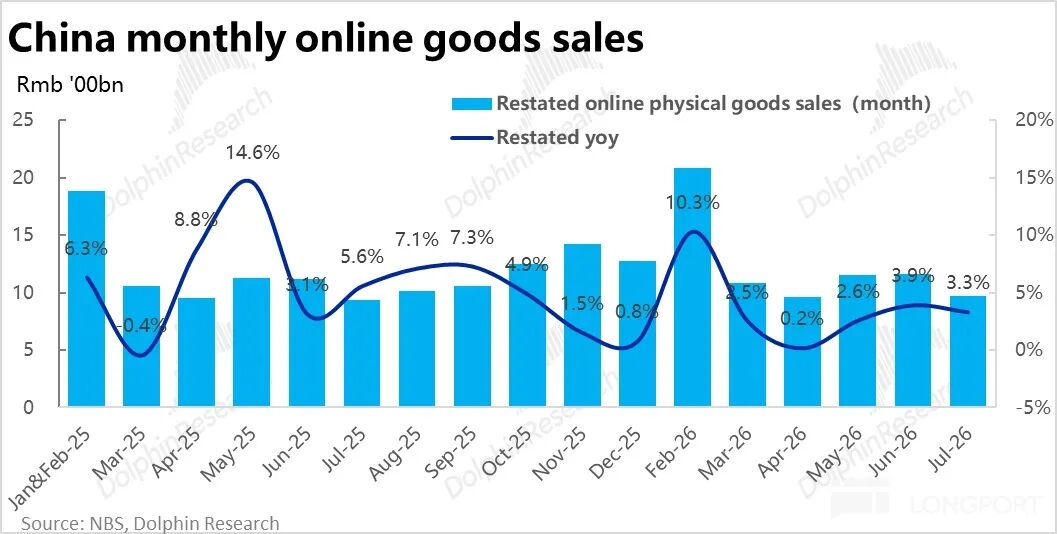
Fortunately,online retail remains more resilient. Even in the face of strong headwinds, online retail penetration continues to creep up. As a result, the growth rate of physical online retail is still above 3%, far outpacing the overall retail sales growth of 0.6%.
Istill maintain that Q2 marks the lowest point for e-commerce growth this year, but I expect a somewhat weaker rebound in Q3. Putting things in context with last year’s expectations, a more pronounced rebound may have to wait until Q4.
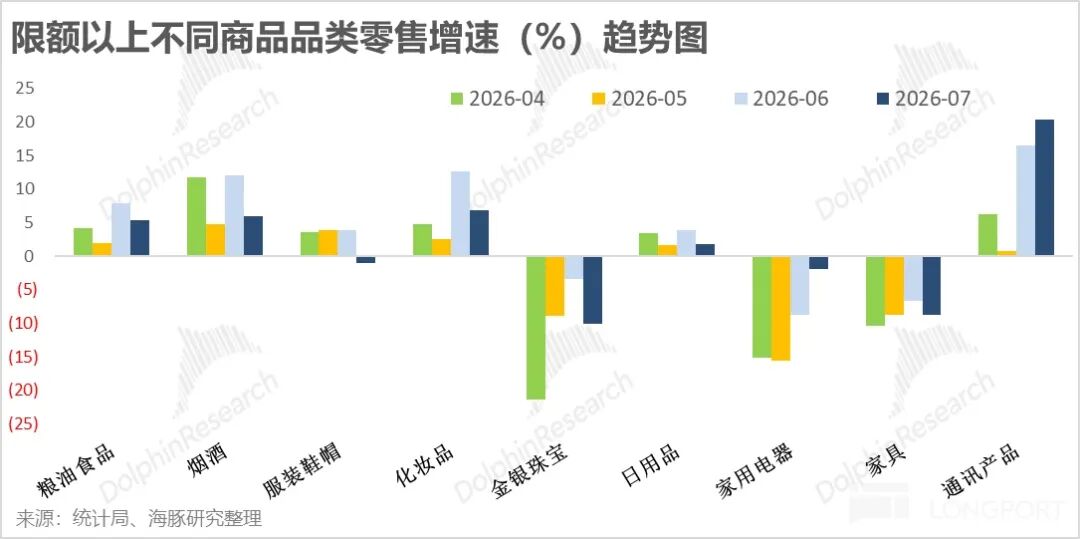
From the perspective of product categories, our previous prediction that weakening consumption is shifting from structural to overall is unfortunately coming true. The home appliances and communications products directly affected by state subsidies continued to show marked improvement in July, but growth in all other essential and discretionary categories is declining across the board.
1. Retail sales growth turns downward again
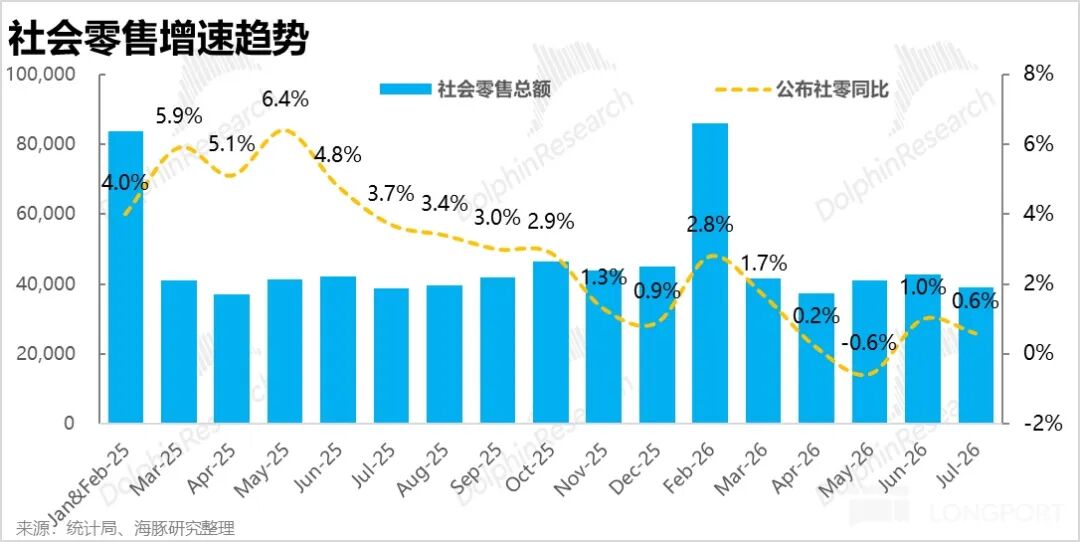
According to the National Bureau of Statistics,total domestic retail sales in July increased by 0.6% year-on-year. After a certain degree of recovery in June, this month’s growth weakened again.To some extent, thisdampens my confidence in a consumption bottoming out and recovery in the second half of the year.
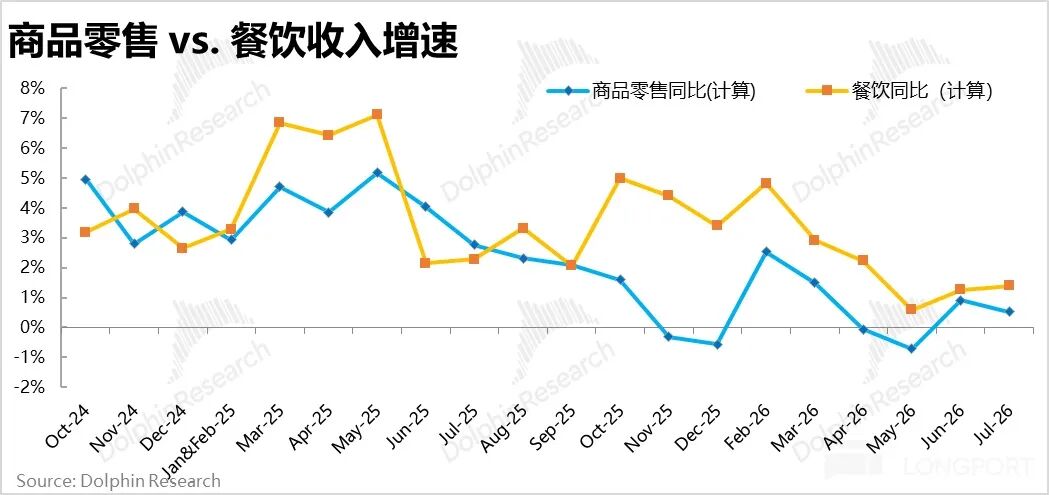
By consumption type,the decline in overall retail sales growth in July was mainly due to goods consumption, which grew 0.9% this month vs. 0.9% last quarter.In contrast,restaurant consumption stabilized at a low level, growing by 1.4% this month, picking up slightly month-on-month. I guess that the entry into the summer peak season may have supported service-based consumption like dining, alcohol, and tourism via “family with kids” spending.
2. Online sales also weaken, but display more resilience
With overall retail, especially goods consumption, softening,the growth of physical goods sales online also declined this month, from 3.9% last month to 3.3% this month.
From the pace of changes in the past two months,the June rebound was still driven to some extent by the 618 shopping festival. After the promotion season, shopping demand naturally dipped slightly. However, since the sequential drop was not dramatic, the sentiment did not “fall off a cliff.” Considering historical bases,online retail will likely remain under pressure in Q3, but will still perform better than Q2 in all probability.
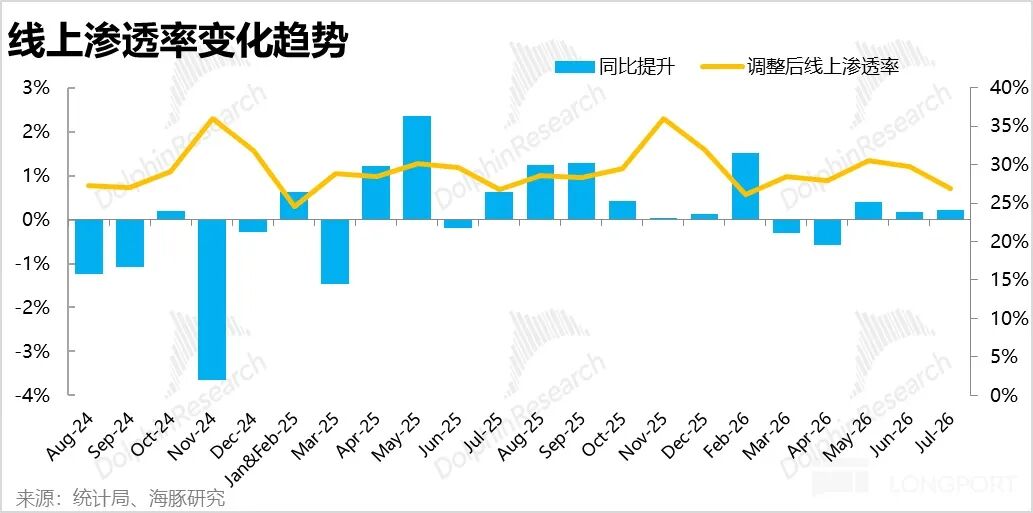
Additionally, this month’sonline retail penetration rate continued to edge up year-on-year (about 0.2 percentage points), with the y/y growth slightly higher than in June,showing that the relative condition of online retail to total retail really improved somewhat. In other words, online consumption is under less pressure than offline and total consumption.
(Note: After 2026,the National Bureau of Statistics adjusted the overall scope of online retail, changing the previous “online retail sales” to “online goods & services retail sales,” greatly expanding the statistics for online services retail. However, the scope for counting online physical goods retail remains basically unchanged, making it comparable with historical data.)
3. Is weak consumption confirmed as spreading from structural to broad-based?
As mentioned above, one of the biggest drags on consumption remains auto sales, down nearly 17% y/y this quarter. Excluding autos, retail sales grew 2.5%.
Anotherimportant observation is that the sales growth ofelectronics and appliance products, which had been impacted by the withdrawal of state subsidies, has clearly bottomed and rebounded, whilethe growth rates of other goods, whether discretionary or essential, have started to decline significantly. As already highlighted,the weakness in consumption is evolving from a structural change caused by the phasing out of subsidies into a widespread slowdown.
Specifically, the y/y drop in retail sales of large-scale home appliances has narrowed sharply to less than -2%, while sales of communications products have further accelerated, already over 20% this month. But according to sources like IDC, mobile phone sales and shipments were down y/y in domestic markets, meaning the big jump is driven by sharply rising memory prices, which have pushed up average phone prices significantly.
- END -
/// RepostOpen for approval

Writing isn’t easy, give me a “share” to charge me up~
Disclaimer: The content of this article solely reflects the author's opinion and does not represent the platform in any capacity. This article is not intended to serve as a reference for making investment decisions.
You may also like
Altcoins Under $1 That Could Deliver Explosive Growth Soon
Nvidia’s Madison Huang visits LG robot factory as training push ramps up
Ethereum validator queue hits highest level since September 2023
Bitcoin Price in INR Today: Why 1 Bitcoin Is Moving Differently for Indian Holders
Crypto prices
More


