
Nasdaq Surges, Ondo Stalls: The Diverging Paths of Asset Tokenization

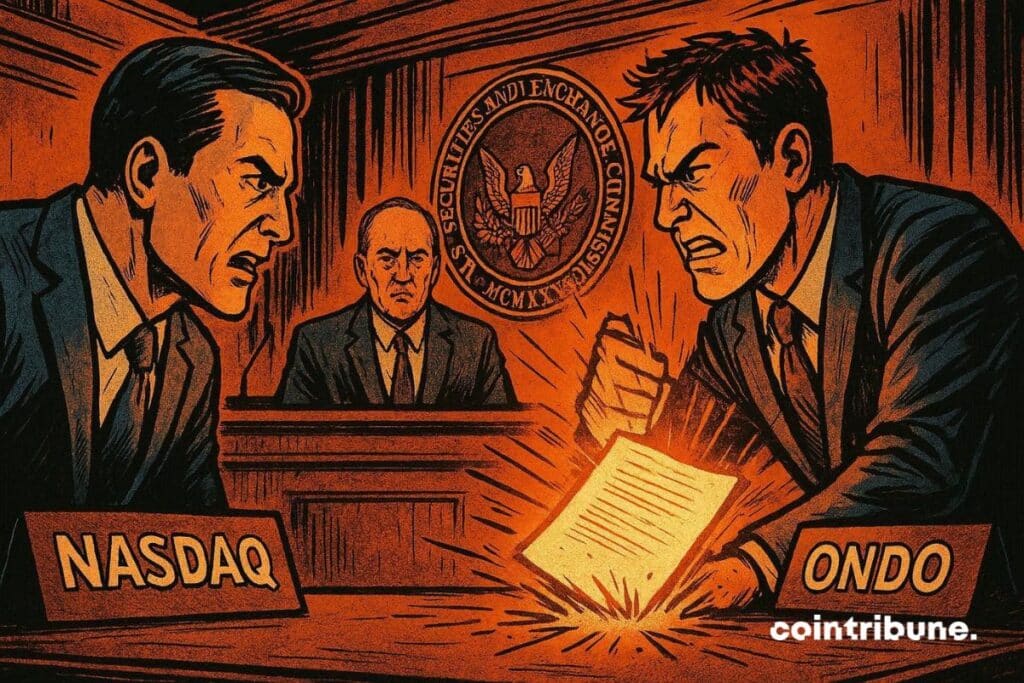
The tokenization of financial assets promises to disrupt traditional finance, but tensions between innovation and regulation are reaching a critical point. Nasdaq wants to accelerate the adoption of tokenized securities, while Ondo Finance, a giant in the sector, demands more transparency. Who is right in this fight for the future of crypto markets?
In brief
- Nasdaq proposes integrating tokenized securities to modernize markets, but its lack of details on the settlement process raises criticism.
- Ondo Finance demands more transparency from Nasdaq, denouncing an unfair competitive advantage and a risk of market centralization.
- The SEC’s decision could shape the future of tokenization, between accelerated adoption or stricter regulatory framework to protect investors.
Nasdaq’s Proposal for Tokenization of Securities
Nasdaq submitted a proposal to the SEC to integrate tokenized securities , a major step to modernize financial markets. The goal? Allow investors to trade stocks and ETFs in token form, reducing costs and speeding up transactions. According to Nasdaq, this innovation could democratize access to financial assets while maintaining traditional protections.
However, questions remain. The proposal relies on the Depository Trust Company (DTC) for transaction settlement, but technical details remain unclear. Some experts fear increased centralization, where a few players would dominate the market. In its letter to the SEC, Nasdaq assures that its approach complies with existing rules. But critics like Ondo Finance have doubts.
Ondo Finance Sounds the Alarm: Transparency and Fairness in Question
Ondo Finance, a leader in real asset tokenization, has sent a letter to the SEC to demand more clarity on Nasdaq’s proposal . According to Ondo, the lack of public details on DTC’s role creates an imbalance: only a few players would have access to crucial information, distorting competition. The company advocates for open collaboration and transparent standards before any approval.
 ONDO Finance writes to the SEC.
This opposition is not surprising. Ondo, which manages over 600 million dollars in tokenized assets, defends a decentralized and accessible ecosystem. For them, Nasdaq’s rush could harm the entire sector. Other players, like BlackRock and Fidelity, are watching closely, aware that this decision could influence their own tokenization projects.
Asset Tokenization: Toward a Stricter Regulatory Framework or a Financial Wild West?
The SEC plays a key role in this debate. Its approach will determine whether the tokenization of securities will be strictly regulated or left to private actors’ initiative. A too rapid approval could open the door to abuses, while a rejection would slow down innovation. While European regulators like the AMF in France adopt a cautious stance on tokenizing traditional assets by demanding strengthened guarantees, bitcoin reminds us that decentralization remains the only model resistant to any institutional interference.
Several scenarios are possible. If the SEC approves Nasdaq’s proposal, other exchanges could follow, accelerating global adoption. Conversely, a rejection or major modifications could slow the movement, favoring more decentralized solutions, like those promoted by Ondo Finance. Tokenization is inevitable, but its future will depend on the ability to find a balance between innovation and investor protection.
The confrontation between Ondo Finance and Nasdaq illustrates the challenges of tokenization: innovating without sacrificing transparency. However, one question remains: will tomorrow’s finance be more open or controlled by a handful of players? And you, would you be ready to invest in tokenized securities without clear guarantees?
Disclaimer: The content of this article solely reflects the author's opinion and does not represent the platform in any capacity. This article is not intended to serve as a reference for making investment decisions.
You may also like
New Prospects in Security Technology and Advancements in Cybersecurity
- Post-cyberwarfare era demands AI-integrated defense-grade security as cyber threats evolve, with AI cybersecurity market projected to grow from $22.4B (2023) to $136.18B by 2032 at 24.81% CAGR. - Key drivers include cloud/IoT expansion, regulatory mandates (e.g., U.S. NSF privacy research), and institutional innovation like federal talent programs and startup collaborations. - Real-world applications show AI mitigating ransomware (Darktrace) and zero-day attacks (Cylance), while military operations lever

COAI Experiences Significant Price Decline and the Enduring Insights for Investors Focused on the Long Term
- ChainOpera AI (COAI) collapsed from $44.90 to $0.52 in late 2025 due to market shifts, structural flaws, and regulatory uncertainty. - COAI's 88% supply concentration and 60 manipulative wallets exacerbated liquidity crises amid sector-wide AI token outflows to meme coins. - Regulatory pressures (GENIUS Act, FSB) and algorithmic stablecoin collapses (xUSD, deUSD) deepened distrust in DeFi, compounding COAI's decline. - Long-term investors may find opportunities in COAI's collapse by applying margin of sa
Assessing How the TGE of MMT Token Influences the Cryptocurrency Ecosystem
- Momentum Finance's MMT token TGE on Sui blockchain highlights innovative DeFi tokenomics with 42.72% community allocation and ve(3,3) governance model. - Post-TGE volatility (4,000% surge followed by 70% correction) reflects market dynamics, but technical indicators and buybacks suggest long-term resilience. - MMT's $250-350M FDV target and Sui integration demonstrate strategic benchmarks, offering lessons for balancing innovation, sustainability, and institutional trust in emerging blockchain projects.
Momentum (MMT) and the Rising Popularity Among Retail Investors: Insights from Behavioral Finance
- Momentum (MMT) price surges mirror 2021 GameStop dynamics, driven by social media sentiment and behavioral biases like overconfidence and herd behavior. - Retail-driven speculation distorts market efficiency, with 21% trading volume reflecting emotional decision-making over fundamentals, as shown by Bitget and academic studies. - Institutional investors exploit these anomalies through contrarian strategies, while regulators scrutinize social media's role in destabilizing traditional market models. - The

Trending news
MoreCrypto prices
More





