
Gold and Bitcoin Near Historic Valuation Relative to US Money Supply

Gold and Bitcoin near record valuation versus US M2 money supply as Fidelity’s Jurrien Timmer warns their inflation-fueled rally may be ending.
The combined value of gold and Bitcoin is approaching a historic level relative to the US M2 money supply.
A top market analyst now suggests the upside potential for using these assets as hedges against dollar devaluation and inflation may be nearing its limit. Jurrien Timmer, Director of Global Macro at Fidelity, shared his analysis on X (formerly Twitter) on Friday.
The End of the Easy Run?
Because of their limited supply, gold and Bitcoin are widely regarded as premier inflation hedges. Data from CoinGecko shows both assets have rallied strongly this year—gold is up 54.83%, while Bitcoin has gained 12.98%.
However, Timmer argues that this rally may be approaching its ceiling. He draws a comparison between current market conditions and those seen during the high-inflation peak of 1980.
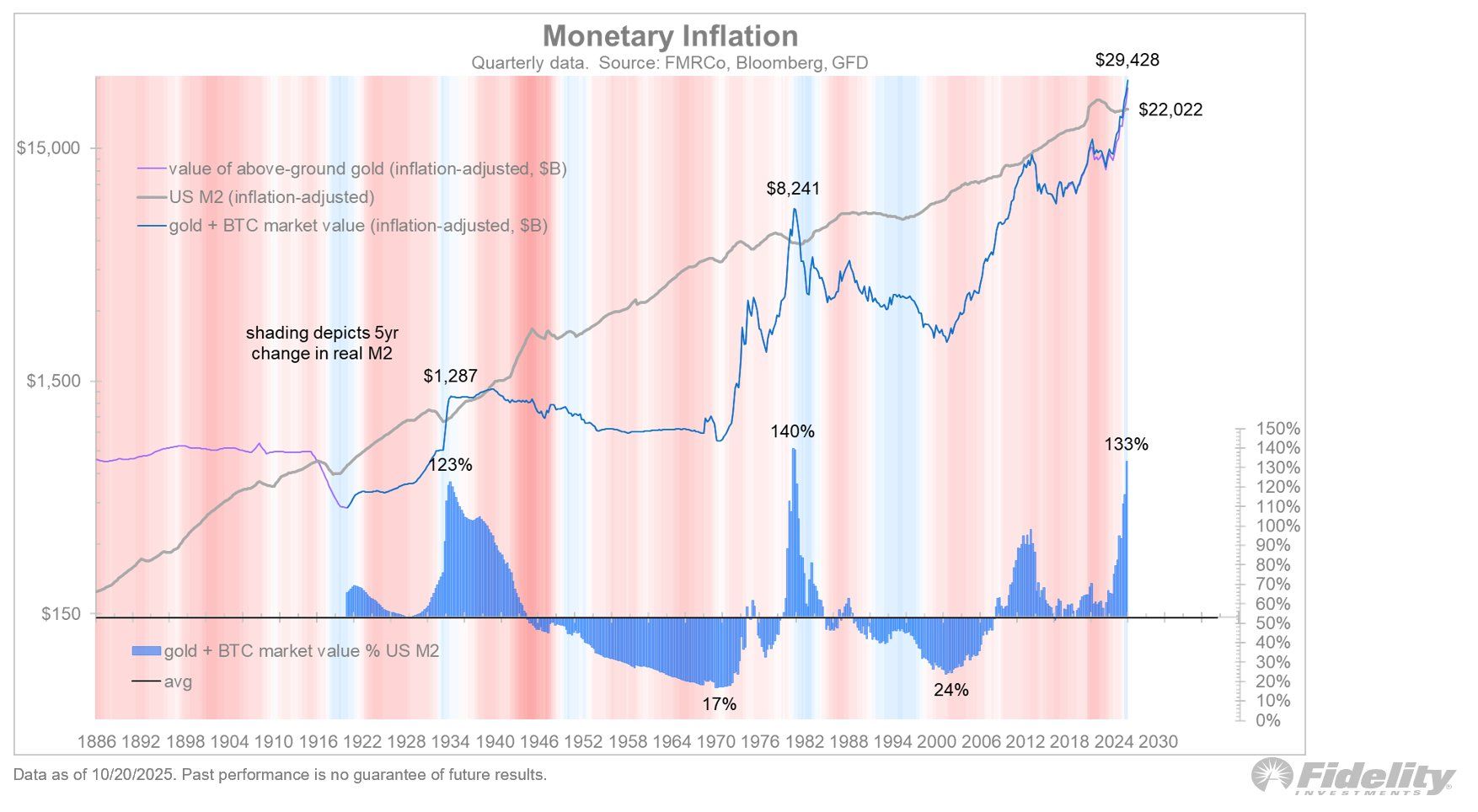 Monetary Inflation. Source:
Jurrien Timmer’s X
Monetary Inflation. Source:
Jurrien Timmer’s X
Comparing Value Against US M2
Timmer’s analysis aggregates the inflation-adjusted market value of gold and Bitcoin, then compares the total to the US M2 money supply—a broad measure of money in circulation.
Historically, sharp expansions in M2 (monetary inflation) have coincided with significant rises in the value of hard assets like gold. According to Timmer, both gold and Bitcoin act as key forms of “hard money,” offering protection against currency debasement.
The Historical Ceiling
Timmer highlights two notable moments in the past century when inflation caused gold’s value to surge—1933 and 1980. During those peaks, gold’s total market value reached 123% and 140% of the US M2 money supply, respectively.
Today, the combined value of gold and Bitcoin is about $29 trillion, equivalent to 133% of the M2 money supply. That figure surpasses the 1933 peak and sits just below the 1980 high.
Timmer called this valuation a “critical point” to consider following gold’s recent aggressive rally.
“One reason to contemplate ringing the golden bell is that if gold is a play on US fiscal dominance, one could argue that the run is now complete,” he concluded.
This suggests that the massive rallies in gold and Bitcoin—largely driven by concerns over monetary expansion—may be running out of steam. While both assets remain structurally sound as long-term hedges, Timmer warns that the “easy returns” fueled by inflation fears may already have been realized.
Disclaimer: The content of this article solely reflects the author's opinion and does not represent the platform in any capacity. This article is not intended to serve as a reference for making investment decisions.
You may also like
Stanford’s top journalist challenges Silicon Valley’s startup scene, calling out its obsession with wealth
PENGU Token Experiences Rapid Growth: Could This Signal the Onset of a Bullish Trend in Cryptocurrency?
- PENGU token's 25% surge since Nov 2025 sparks debate over altcoin revival vs speculative frenzy. - Technical indicators show mixed signals with bullish patterns but bearish RSI divergence and compressed Bollinger Bands. - Whale accumulation and $4.3M institutional inflows contrast with broader altcoin weakness (ETH -27%, SOL -31%). - Upcoming 41% supply unlock on Dec 17 poses $288M selling pressure risk amid fragile market conditions. - Token's future depends on sustaining institutional support, navigati

Clean Energy Market Fluidity: How REsurety's CleanTrade Platform is Transforming the Industry
- REsurety's CleanTrade platform, CFTC-approved as a SEF, standardizes trading of VPPAs, PPAs, and RECs to boost clean energy liquidity. - By aligning with ICE-like regulations and offering real-time pricing, it reduces counterparty risks and bridges traditional/renewable energy markets. - The platform achieved $16B in notional volume within two months, signaling maturing markets where clean assets gain institutional traction. - CleanTrade's analytics combat greenwashing while streamlining transactions, en

ChainOpera AI Token Experiences Steep Drop and Highlights Wider Dangers in AI-Based Cryptocurrency Initiatives
- ChainOpera AI's 2025 token collapse (99% loss) exposed systemic risks in AI-driven crypto projects through structural, governance, and technical vulnerabilities. - Extreme centralization (88% in ten wallets) worsened liquidity risks, while C3.ai's governance failures and regulatory pressures accelerated investor flight to stable assets. - Technical flaws in AI-integrated blockchains and lack of audits highlighted urgent need for decentralized governance, AI-powered compliance tools, and real-time vulnera
Trending news
MoreCrypto prices
More





