
SEC Clears DTCC for Tokenization Services: 3 Altcoins Stand to Benefit

The Depository Trust & Clearing Corporation (DTCC) has received clearance from the US Securities and Exchange Commission to pilot a regulated tokenization service. This is a significant step toward bridging the gap between traditional finance (TradFi) and decentralized finance (DeFi). Furthermore, the initiative can likely benefit several assets in the cryptocurrency market. DTCC Receives SEC
The Depository Trust & Clearing Corporation (DTCC) has received clearance from the US Securities and Exchange Commission to pilot a regulated tokenization service.
This is a significant step toward bridging the gap between traditional finance (TradFi) and decentralized finance (DeFi). Furthermore, the initiative can likely benefit several assets in the cryptocurrency market.
DTCC Receives SEC Nod for Asset Tokenization
In a recent announcement, DTCC stated that its subsidiary, The Depository Trust Company (DTC), has obtained a No-Action Letter from the SEC. This allows it to tokenize real-world assets held in DTC custody under existing federal securities laws. The service is expected to begin rolling out in the second half of 2026.
In an historic milestone, DTC received a No‑Action Letter from the SEC to tokenize certain DTC‑custodied assets. By leveraging blockchain, DTCC aims to bridge TradFi and DeFi, advancing a more resilient, inclusive and efficient global financial system.
— DTCC (@The_DTCC) December 11, 2025
The No-Action Letter permits DTC to offer the tokenization service for an initial period of three years. During this time, DTC will be able to issue blockchain-based representations of certain traditional securities, with the digital tokens carrying the same ownership rights, investor protections, and legal entitlements as their conventional counterparts.
According to DTCC, the authorization applies to a limited group of highly liquid assets. These include equities in the Russell 1000 index, exchange-traded funds tracking major benchmarks, and US Treasury bills, notes, and bonds.
“Tokenizing the US securities market has the potential to yield transformational benefits such as collateral mobility, new trading modalities, 24/7 access and programmable assets, but this will only be achievable if market infrastructure provides a robust foundation to usher in this new digital era,” Frank La Salla, President and CEO of the DTCC said.
Which Altcoins Could Gain From DTCC’s Tokenization Service?
DTCC emphasized that it is permitted to provide a “limited production environment tokenization service on selected blockchains.” Notably, no specific networks have been chosen for the service yet.
However, the initiative has sparked speculation across the digital asset sector about which ecosystems could ultimately stand to gain from DTCC’s move into tokenization. Below are three altcoins that may benefit:
1. Ethereum (ETH)
Ethereum is widely viewed as one of the leading candidates. According to Matthew Sigel, Head of Digital Assets Research at VanEck, there is a “99% chance” that DTCC could select Ethereum for its tokenization service.
On-chain data supports this view. As of December 12, the total distributed value of tokenized real-world assets stands at approximately $18.48 billion, with Ethereum accounting for around 66% of that market.
Data from RWA.xyz showed that the network currently hosts about $12.2 billion worth of tokenized RWAs, making it the dominant public blockchain in this segment.
Ethereum’s established role in tokenized asset issuance, combined with its security and extensive developer ecosystem, strengthens its positioning. DTCC has also previously used Ethereum for several of its initiatives.
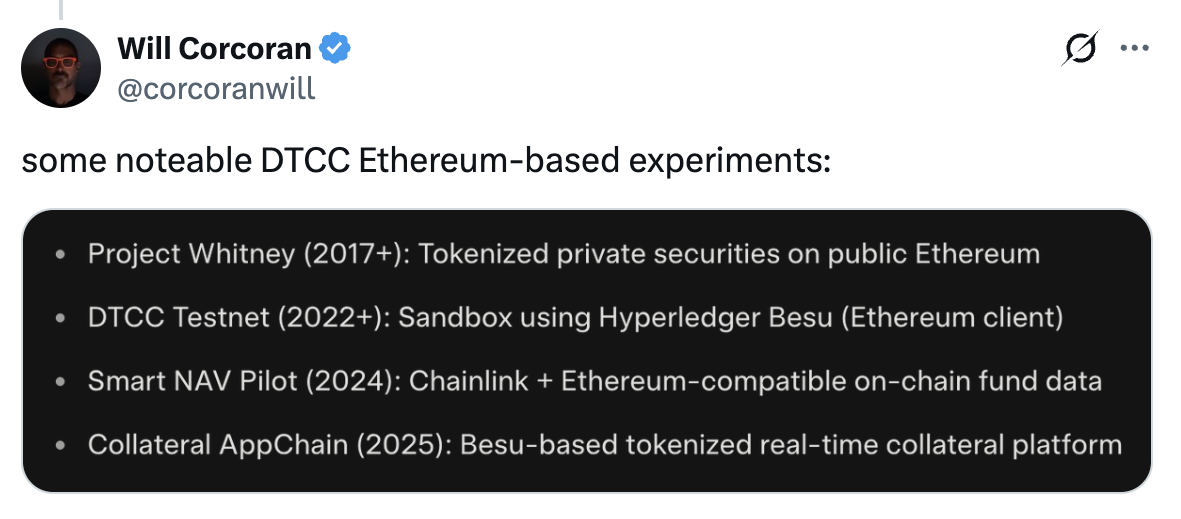 DTCC and Ethereum’s Initiatives. Source:
X/Will Corcoran
DTCC and Ethereum’s Initiatives. Source:
X/Will Corcoran
This positions Ethereum to capture transaction fees and liquidity from tokenized securities, potentially accelerating its transition to a foundational layer for global finance.
2. Chainlink (LINK)
The next leading contender is Chainlink. Chainlink is often cited as the connective layer between on-chain and off-chain systems, a role that closely aligns with DTCC’s emphasis on regulated tokenization, data integrity, and interoperability. Its oracle infrastructure, cross-chain capabilities, and proof-of-reserve solutions are particularly relevant for institutional use cases.
The two entities also have a track record of collaboration. In 2023, DTCC and Chainlink collaborated on SWIFT’s blockchain interoperability project.
“If you’re not able to make this movement freely between the chains, you’re really left with the same world we had before.”At SmartCon 2025, DTCC Digital Assets CTO Dan Doney emphasizes interoperability as critical to enabling instant settlement across blockchains, highlighting…
— Chainlink (@chainlink) November 8, 2025
In September 2025, Chainlink partnered with DTCC and 24 financial institutions to address inefficiencies in corporate actions processing. Taken together, this history of cooperation strengthens Chainlink’s case and has increased optimism among the community.
3. Ondo Finance (ONDO)
The last one is Ondo Finance. As the leader in tokenized stocks by total value, Ondo commands $361.2 million, representing 51.64% of the $699.51 million market for tokenized public equities.
Ondo’s recent clearance from a two-year SEC investigation further bolsters its expansion in US tokenization. With a 12.67% growth in market share over the past 30 days, Ondo could be well-equipped to handle increased institutional inflows.
Thus, as DTCC’s initiative progresses, potential inclusion could be beneficial for all three networks. It could enhance credibility, deepen liquidity, and reinforce real-world use cases across these ecosystems.
From a market perspective, sustained institutional adoption of tokenized securities may also have longer-term implications for price performance. Increased on-chain activity, higher transaction volumes, and deeper integration into regulated financial infrastructure could support structural demand for ETH, LINK, and ONDO over time.
Read the article at BeInCryptoDisclaimer: The content of this article solely reflects the author's opinion and does not represent the platform in any capacity. This article is not intended to serve as a reference for making investment decisions.
You may also like
Clean Energy Market Dynamics and Investment Prospects: The Role of CFTC-Approved Platforms in Facilitating Institutional Participation
- CFTC-approved platforms like CleanTrade are transforming clean energy markets by standardizing derivatives and centralizing trading infrastructure, boosting institutional liquidity and transparency. - CleanTrade’s SEF designation in September 2025 enabled $16B in notional trades within two months, converting illiquid assets like RECs into tradable commodities with ESG-aligned risk management tools. - Institutional demand surged as 70% of large asset owners integrated climate goals, with IRA-driven clean
The Growing Significance of Financial Well-Being in Planning for Lasting Wealth
- Financial wellness is redefining long-term wealth planning by integrating personal well-being with financial outcomes. - Intentional habits and AI-driven tools boost resilience, reducing behavioral underperformance by 2.5% annually. - Debt management via sustainable finance mitigates risks, especially in developing economies with robust policies. - Early financial education and four-quadrant frameworks balance objective metrics with subjective well-being. - Technology and financial therapy bridge gaps, e

The Rise of Liquid Clean Energy Markets and Their Impact on Investment Opportunities
- Global energy transition accelerates liquid clean energy markets, reshaping institutional investment strategies with ESG-aligned assets. - U.S. DOE and private firms advance infrastructure, including fusion and hydrogen projects, addressing scalability and reliability. - RESurety’s CFTC-approved CleanTrade platform boosts transparency and liquidity in clean energy derivatives, enabling $16B in trading. - Institutional investors diversify portfolios with clean energy derivatives, leveraging ESG compliance

Anthropology-Inspired Advancements in Higher Education: The Impact of Cross-Disciplinary Research on Student Success and Institutional Worth
- Farmingdale State College integrates anthropology with STEM/edtech to cultivate critical thinking and cross-disciplinary skills, aligning with evolving workforce demands. - Its Anthropology Minor (15 credits) and STS program emphasize cultural context, societal implications of technology, and data-driven problem-solving for STEM-aligned careers. - Partnerships like the $1.75M Estée Lauder collaboration and $75M Computer Sciences Center demonstrate how interdisciplinary approaches attract investment and a

Trending news
MoreCrypto prices
More





