
Air Products Falls 1.23% Despite Earnings Beat 430th in Trading Volume Amid Sector Headwinds

Market Snapshot
Air Products and Chemicals (APD) closed Tuesday’s trading session down 1.23% at $273.04, underperforming the broader market amid a 0.94% decline in the S&P 500 and a 0.83% drop in the Dow Jones Industrial Average. The stock’s trading volume fell to $0.33 billion, a 33.76% decrease from the previous day, ranking it 430th in trading activity. Despite the decline, APDAPD-1.23% remains 14.32% below its 52-week high of $318.66, achieved on March 7, 2025. The drop followed mixed performance relative to peers, with Linde PLC falling 1.50% and Dow Inc. rising 0.46%.
Key Drivers
APD’s Q1 2026 earnings report, released January 30, highlighted a 10.5% year-over-year increase in adjusted earnings per share (EPS) to $3.16, surpassing the $3.04 forecast. Revenue rose 5.8% to $3.1 billion, outpacing expectations of $3.05 billion. The company’s operating margin improved to 24.4%, driven by a 12% rise in adjusted operating income, though return on capital dipped slightly to 11%. Despite these positive results, the stock fell 1.23% on March 3, likely influenced by broader market volatility and concerns over macroeconomic pressures.
A key catalyst for long-term optimism is APD’s expansion in high-growth sectors. The company secured new NASA contracts for liquid hydrogen supply, positioning itself in the aerospace sector. CEO Eduardo Menezes emphasized resilience in refining, electronics, and aerospace, with the electronics segment identified as a “star segment” due to AI-driven demand. APD estimates a 40-50% market share in the U.S. space sector, underscoring its strategic focus on hydrogen and advanced materials.
However, challenges persist. Management acknowledged macroeconomic headwinds, European regulatory changes, and helium market instability. Institutional investors have shown mixed signals: Staley Capital Advisers increased its stake by 61.8% in Q3, while insider Ridge LP Mantle sold 70,175 shares in February, reducing their holdings by 42.87%. Analysts remain divided, with eight “Buy” ratings, seven “Hold” ratings, and one “Sell” rating, reflecting uncertainty about near-term execution risks.
The company’s dividend policy also drew attention. APD raised its quarterly dividend to $1.81 per share, translating to an annual yield of 2.6%. While this reinforces its appeal as a dividend grower, the payout ratio of -479.47% (negative due to declining net income) raises concerns about sustainability.
Finally, technical indicators suggest mixed momentum. APD has traded above its 200-day moving average since February but remains 12.6% below its 52-week high. The stock’s underperformance relative to the Materials Select Sector SPDR Fund (XLB) highlights sector-wide challenges, as XLB gained 20.5% over the past three months compared to APD’s 7.7%. Analysts project a 9.1% upside to $301.52, but near-term volatility is expected amid ongoing macroeconomic and sector-specific risks.
Disclaimer: The content of this article solely reflects the author's opinion and does not represent the platform in any capacity. This article is not intended to serve as a reference for making investment decisions.
You may also like
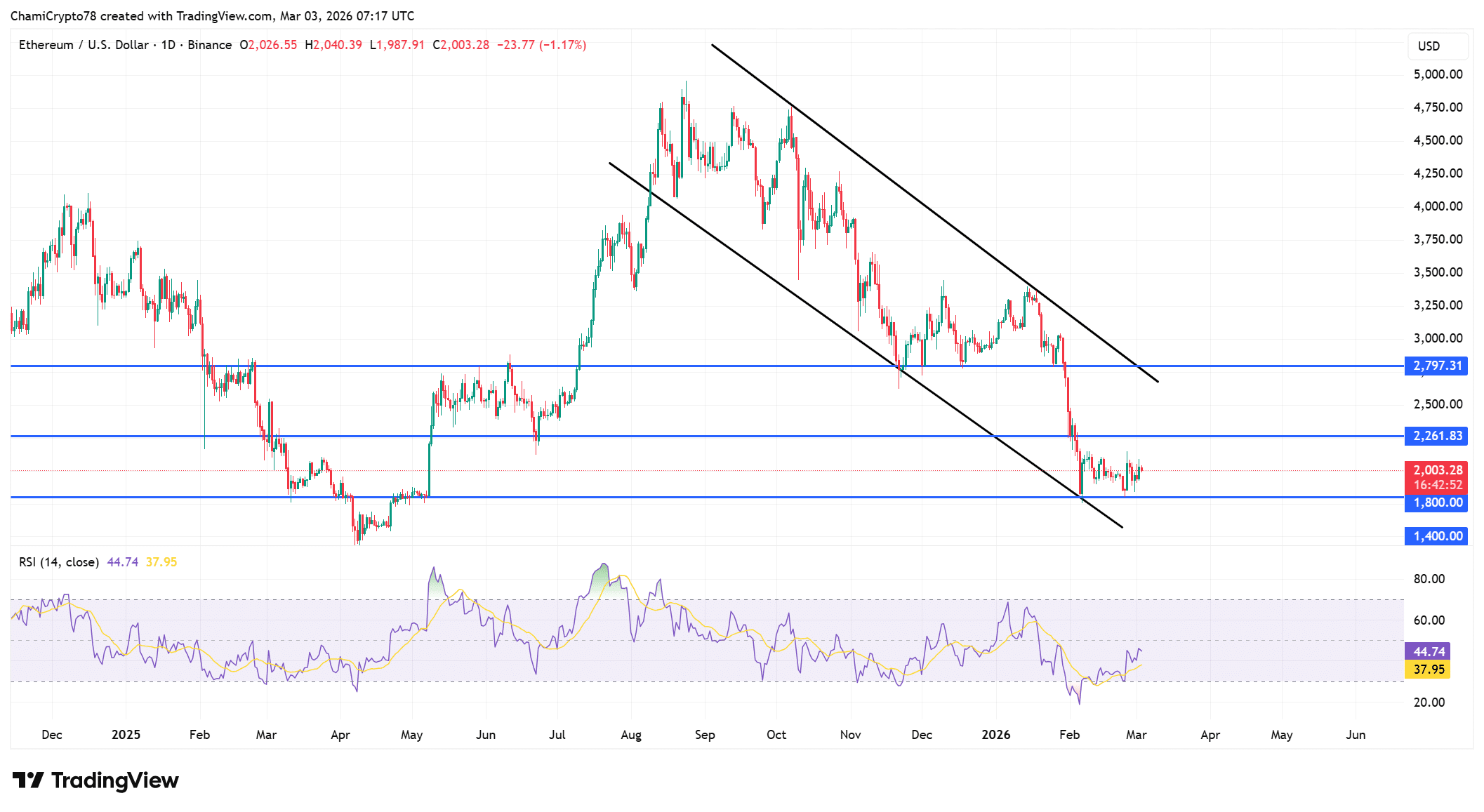
Ethereum whales accumulate $12.5mln – Is ETH’s $2,261 breakout next?
China’s RatingDog Manufacturing PMI climbs to 62.1 in February, Services PMI rises to 56.7
PayPal Names Enrique Lores CEO as $475B Volume Giant Eyes Fintech Reset
Trending news
MoreCrypto prices
More





