
MaxLinear's Rushmore DSP Set for OFC 2026 Clash: Will It Demonstrate 1.6T Power Advantage Against Marvell?

AI Infrastructure: A New Bandwidth Era
The foundation for artificial intelligence infrastructure is undergoing a major transformation, driven by surging demand for connectivity within data centers. As AI workloads multiply, the industry is rapidly moving away from legacy signaling technologies toward advanced solutions that enable dramatic increases in bandwidth. This is not a gradual change—it's a pivotal shift required to support exponential growth. The market for these enabling components is projected to reach $15 billion by 2030, highlighting the scale of the upcoming infrastructure expansion.
Signal Technology: The Leap to 1.6T
Central to this evolution is the adoption of new signaling methods. The transition from traditional non-return-to-zero (NRZ) transmission to PAM4 (Pulse Amplitude Modulation 4) is what makes 1.6T speeds achievable. PAM4 effectively doubles the data rate per channel, providing the bandwidth necessary for architectures that interconnect thousands of GPUs. This is more than a simple upgrade—it's a fundamental change that supports the entire AI computing ecosystem, enabling fast, low-latency communication for large-scale parallel processing.
DSP Competition: Engineering at Scale
Within this technological curve, companies are competing to deliver the essential Digital Signal Processor (DSP) chips that handle these advanced signals. Industry leaders are setting high standards. Marvell has introduced the first 1.6T ZR/ZR+ pluggable solution and its Electra coherent DSP, the first 2nm 1.6T ZR/ZR+ coherent DSP in the market. This integrated, next-generation offering showcases the engineering prowess and manufacturing scale required to compete, setting benchmarks for performance, efficiency, and production volume.
MaxLinear's Role: Building the AI Backbone
Amid this competitive landscape, MaxLinear's Rushmore DSP stands out as a crucial player. Designed to deliver the sophisticated algorithms necessary for reliable 1.6T transmission, Rushmore is laying the groundwork for the AI revolution. MaxLinear is not merely pursuing market share; it is investing in the technological curve where bandwidth needs are growing exponentially.
Strategy Backtest: RSI Oversold Long-only
Trading Strategy Overview:
- Buy MXL when RSI(14) falls below 30
- Sell when RSI(14) exceeds 70, after 10 trading days, upon a 15% profit, or at a 7% loss
- Backtest period: March 12, 2024 to March 12, 2026
Backtest Conditions
- Open Signal: RSI(14) < 30
- Close Signal: RSI(14) > 70, 10 trading days, take-profit +15%, stop-loss −7%
- Object: MXL
- Risk Controls: Take-Profit: 15%, Stop-Loss: 7%, Hold Days: 10
Backtest Results
- Strategy Return: 20.12%
- Annualized Return: 14.63%
- Maximum Drawdown: 34.09%
- Profit-Loss Ratio: 0.9
Trade Metrics
- Total Trades: 13
- Winning Trades: 8
- Losing Trades: 5
- Win Rate: 61.54%
- Average Hold Days: 6.23
- Max Consecutive Losses: 3
- Average Win Return: 9.16%
- Average Loss Return: 9.57%
- Max Single Return: 18.8%
- Max Single Loss Return: 14.05%
The challenge for MaxLinear is to keep pace with innovation and match the scale of industry giants like Marvell. However, the opportunity lies in becoming a core supplier in a market defined by rapid, exponential growth.
Financial Outlook: Supporting the 1.6T Vision
MaxLinear's short-term financial performance demonstrates the momentum needed to support its ambitious 1.6T DSP initiative. The company anticipates a 15% quarter-over-quarter increase in revenue to $125 million, indicating strong adoption of the Keystone PAM4 DSP platform. This growth is reinforced by rising profitability, with gross margins expected to improve by 30 basis points to 59.5%, thanks to a favorable product mix and enhanced sales efficiency. Projections suggest revenue could reach $130 million in the December quarter.
This financial stability is vital for a company investing heavily in next-generation infrastructure. The expected revenue and margin gains provide the resources to ramp up production, fund research and development for Rushmore DSP, and compete in a market dominated by large players. The Industrial segment, which includes high-growth communications and data center markets, is the main driver of this positive outlook.
Nevertheless, the overall picture is mixed. The Connectivity segment is facing challenges that are weighing on performance. This creates a dynamic where MaxLinear generates cash flow to pursue growth in one area while contending with obstacles in another. The uncertain adoption rate of its PAM4 solutions introduces additional risk, as highlighted by cautious analysts. For MaxLinear, financial strength is sufficient to support its strategic shift, but the company must successfully manage these segment-specific pressures to turn projected revenue into sustained earnings.
Valuation: Assessing S-Curve Potential
MaxLinear's stock currently trades at $16.90, amid considerable uncertainty about its long-term prospects. Analyst consensus, based on eight ratings, is a "Hold" with an average price target of $19.57, suggesting a moderate 17% upside over the next year. This neutral view indicates the market recognizes near-term growth from the Keystone PAM4 platform but remains skeptical about the exponential payoff from the 1.6T Rushmore DSP.
Forecasts are highly variable. The average price target for 2026 is $12.74, with estimates ranging from $2.09 to $23.39. This wide spread reflects the market's difficulty in predicting the adoption rate of next-generation DSPs. The upper end points to a successful 1.6T rollout, while the lower end suggests doubts about the critical mass needed for MaxLinear's PAM4 solutions to drive the stock higher.
Ultimately, valuation is a wager on the S-curve. The stock's moderate upside implies the market is discounting the long-term infrastructure opportunity. Investors must decide if the current price accurately reflects MaxLinear's potential to become a foundational supplier in the 1.6T bandwidth expansion. The broad forecast range means the stock is poised for a binary outcome: either the company captures significant market share, or it falls behind.
Key Catalysts and Metrics to Monitor
The next major milestone for MaxLinear's 1.6T initiative is imminent. The company will demonstrate its Rushmore DSP live at OFC 2026, the leading optics conference from March 17 to 19. This event is a crucial catalyst—a successful showcase will shift the narrative from potential to proven performance, confirming the chip's advantages.
Technical benchmarks to watch include BER performance and power consumption. Rushmore DSP is designed for optical modules under 25W, a key target for data centers facing rising energy costs. Any failure to meet this low-power goal would undermine its competitive position. The OFC demonstration is the first real-world test of these metrics.
The competitive environment is evolving quickly. Marvell's integrated solution could gain market share before MaxLinear's Rushmore/Washington combination achieves volume production. Marvell has already launched the industry's first 1.6T ZR/ZR+ pluggable powered by its 2nm Electra coherent DSP, setting a high standard for performance and manufacturing scale. MaxLinear must not only validate its technology but also accelerate production and customer adoption to avoid being overshadowed.
For investors, the critical factor is how this technology race translates into financial results. Watch for revenue contributions from the Keystone/Keystone MM DSP platform, which is already shipping in volume. Any change in the Connectivity segment's performance will indicate whether MaxLinear's near-term growth is holding up or being challenged by segment-specific issues. The path to exponential returns depends on MaxLinear's ability to execute in the short term while its 1.6T DSP faces real-world scrutiny.
Disclaimer: The content of this article solely reflects the author's opinion and does not represent the platform in any capacity. This article is not intended to serve as a reference for making investment decisions.
You may also like
Top Stocks to Consider Purchasing With $1,000 Today

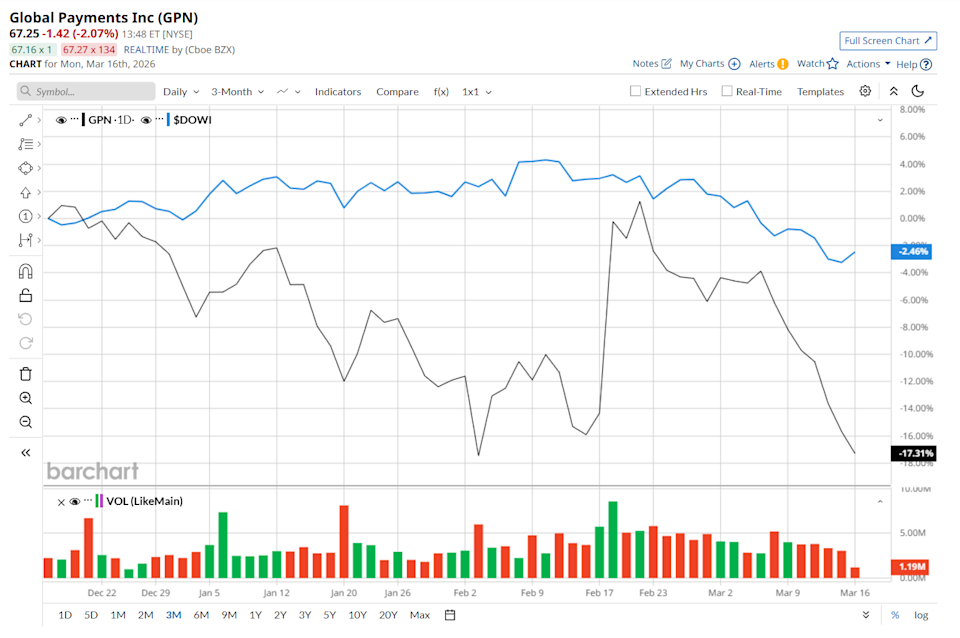
Is Global Payments Shares Lagging Behind the Dow?
Trending news
MoreFRED shows the OVX crude oil volatility index above 120, its highest since April 2020. Here is why the spike matters for Bitcoin and crypto risk sentiment.
Bitcoin Magazine's 'We're so early. #Bitcoin' headline reflects long-term conviction, early adoption narratives, and growing mainstream interest in Bitcoin.
Crypto prices
More





