
Why Darknet Crypto Transactions May Signal More Than Just Criminal Activity

Quick Breakdown
- Darknet-related crypto transactions are increasing. This trend points not only to criminal activity but also to wider economic stress, capital flight, and changing trust in alternative financial systems.
- Changes in transaction volume, frequency, and asset use show shifting patterns. However, blockchain surveillance has limits; wallet labelling is not always accurate, intent is hard to judge, and privacy tools can hide flows. This makes it hard to measure activity exactly.
- Narratives around darknet activity influence investor sentiment, exchange compliance, and how privacy tools are perceived. Even a small amount of illegal activity can have a big impact on markets and rules

Darknet-related crypto transactions are rising again, and the trend is drawing renewed attention across the crypto market. While these transactions are often linked to illegal activity, recent data shows there may be more going on beneath the surface than just crime alone.
This analysis looks at darknet crypto transactions as possible signals, not just crime statistics. Changes in darknet activity might show economic pressure, capital flight, or less trust in regular financial systems. That makes them important to watch in the bigger market picture.
Overview of Transaction Data Trends
In 2025, darknet markets and related services kept up steady crypto activity. Blockchain analytics firms say darknet markets processed almost
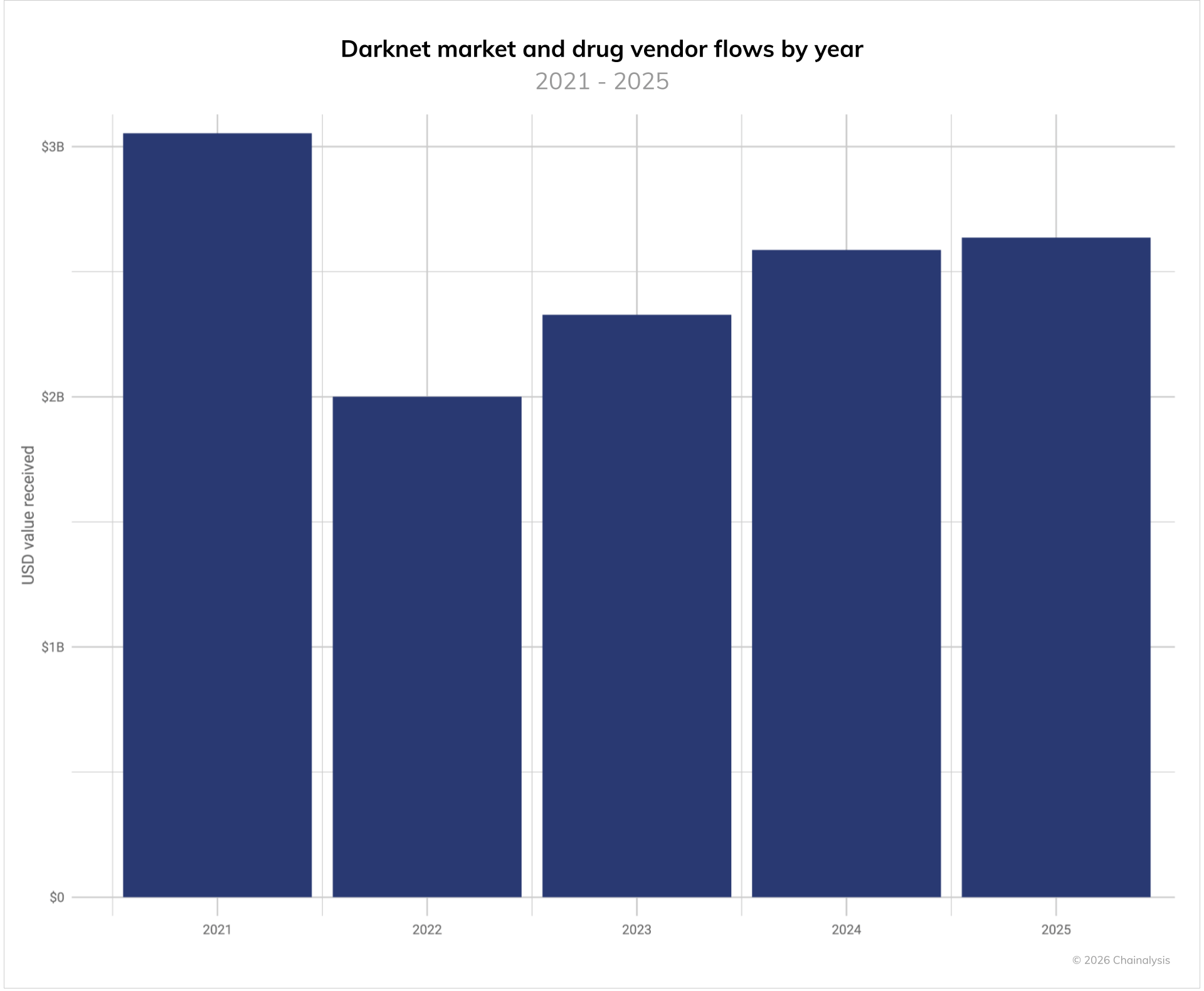 Darknet Market and drug vendor flows 2021-2025. Source:
Chainalysis
Darknet Market and drug vendor flows 2021-2025. Source:
Chainalysis
While enforcement actions have disrupted some platforms, overall transaction volume has not collapsed but rather adapted and shifted locations, proving the durability of these illicit activity networks.
When analyzing darknet data, it’s important to separate how often transactions happen from how much value they move. The sheer number of individual transactions (transaction count) may rise or fall independently of volume because large payments can make up a disproportionate share of value flows.
For example, many small transfers under $500 don’t strongly correlate with broader trends, while larger, high-value transactions often signal major purchasing or supply activity on darknet markets, making volume a more telling metric for market impact.
Correlation With Real-World Indicators
When people or businesses face tough economic times or cannot use regular banks, they may look for other ways to move money, including using crypto on darknet markets. In countries with high inflation, weak currencies, or strict controls, crypto use can go up as people try to protect their money or move it out of the system.
shows that crypto activity tends to increase in regions with tighter capital controls and corruption, suggesting a link between economic stress and greater adoption of digital assets for unconventional financial needs.
Links to sanctions, capital flight, and restrictions
Darknet crypto flows are also influenced by geopolitical pressures like sanctions and financial isolation. For example, in Iran, crypto activity surged as citizens and state-linked entities sought to evade international sanctions and access stable value outside the traditional banking system.
Similarly, large volumes of crypto transactions tied to sanctioned countries and illicit activity, including those associated with nation-state strategies to bypass financial blockades, show how broader policy pressures can drive upticks in crypto movement.
Why darknet transaction behaviour reflects broader pressure points
Instead of seeing darknet crypto solely as a measure of illegal activity, patterns in these transactions can signal wider economic and financial stress. When legal financial routes become unreliable or restricted, whether due to inflation, unemployment, sanctions, or capital controls, people seek alternatives.
Darknet transactions, due to their anonymity and borderless nature, can thus act as an early indicator of underlying societal pressures and shifting demand for financial alternatives.
Limitations of Blockchain Surveillance
While blockchain data is transparent, interpreting darknet-related activity is far from exact, and analysts must be careful not to overstate what on-chain signals really mean.
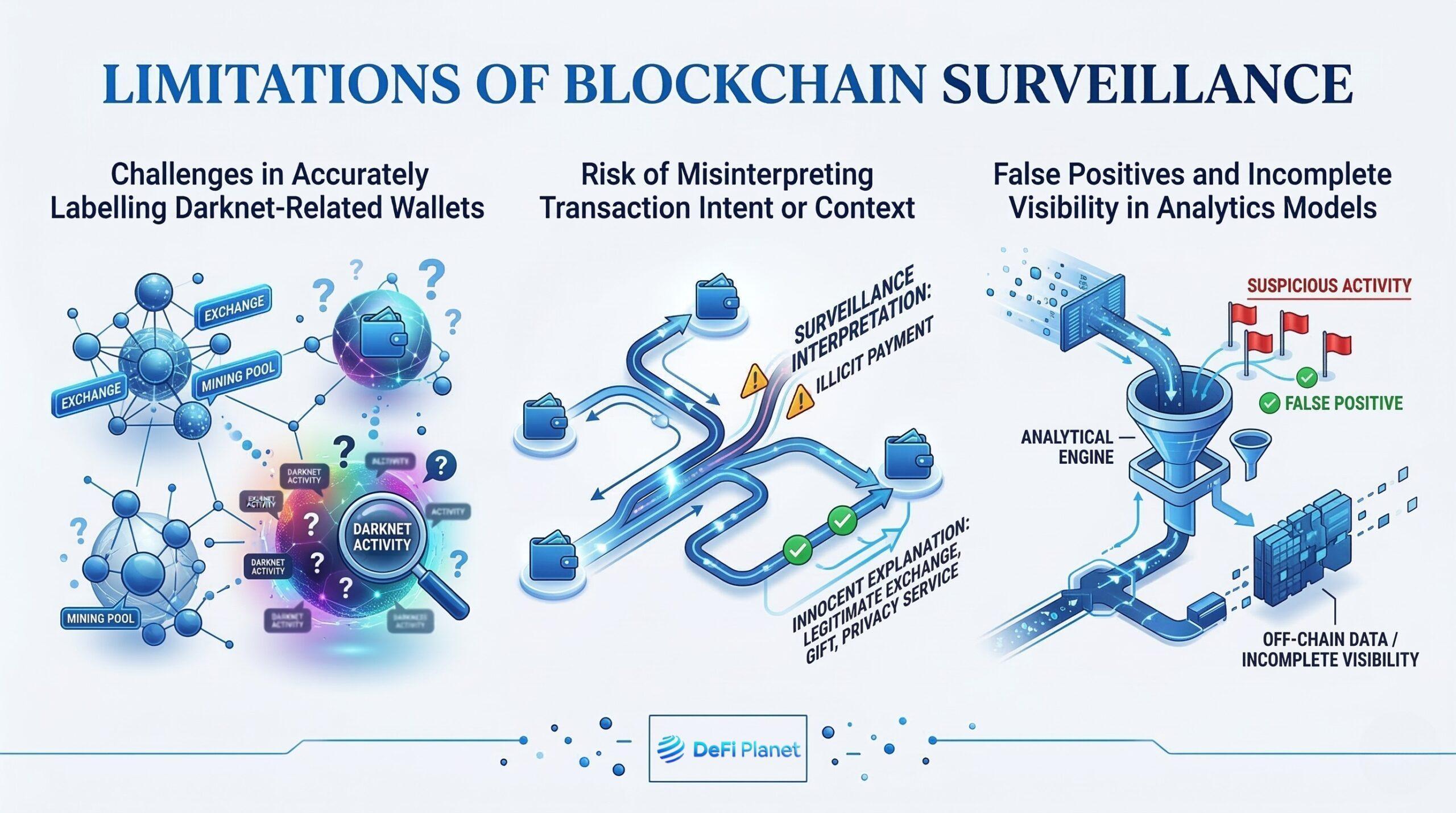
Challenges in accurately labelling darknet-related wallets
Blockchain surveillance relies heavily on address labelling, but these labels are often probabilistic rather than definitive. Darknet markets frequently rotate wallets, use intermediaries, or rely on shared infrastructure, making it difficult to clearly distinguish between a “darknet” wallet and a regular user address.
As a result, some wallets flagged as darknet-linked may only have indirect or historical connections, rather than active involvement.
Risk of misinterpreting transaction intent or context
A crypto transaction shows that value moved, but not why it moved. Payments associated with darknet-linked addresses could represent many things beyond criminal trade, such as refunds, escrow returns, personal fund transfers, or even research and law-enforcement monitoring activity. Without off-chain context, it’s easy to misread intent and draw conclusions that don’t fully reflect real-world behaviour.
False positives and incomplete visibility in analytics models
Blockchain analytics tools are powerful, but they are not perfect. False positives can occur when clustering algorithms incorrectly group addresses together or when privacy tools obscure transaction paths.
At the same time, some activity remains invisible due to the use of privacy coins, mixers, or cross-chain bridges. This means reported darknet transaction figures should be viewed as directional indicators, not precise measurements, reinforcing the need for cautious interpretation.
Market and Reputational Implications
Darknet-linked crypto activities narrative itself can influence markets, regulation, and how certain tools are perceived, sometimes more than the data actually warrants.
When headlines focus on increased darknet-related crypto flows, it can reinforce the idea that crypto is primarily used for illicit activity, even if those transactions represent a small share of total usage.
This perception can weigh on investor sentiment, especially during periods of market stress, and may trigger short-term volatility as traders react to regulatory or reputational fears rather than fundamentals.
Impact on exchange compliance and asset listings
Exchanges tend to respond quickly to reputational risk. If a blockchain or asset becomes associated, fairly or not, with darknet activity, exchanges may tighten compliance checks, restrict withdrawals, or even delist certain tokens to avoid regulatory scrutiny.
This can reduce liquidity and accessibility for legitimate users, amplifying the market impact beyond the actual level of illicit use.
Reputational risks for privacy-focused tools and protocols
Privacy tools often face the most reputational pressure. Even if they are made for legal uses like financial privacy or avoiding censorship, they are often seen as criminal tools when darknet activity goes up.
This can lead to reduced adoption, increased regulatory targeting, or loss of partnerships, forcing developers and users to balance privacy needs against growing compliance and reputational challenges.
Final Take: Interpreting Darknet Crypto Flows
Darknet transaction data can give useful insights, but it is important to tell the difference between real signals and background noise. Patterns in these flows may help predict trends when combined with real-world data like inflation, capital controls, or sudden changes in market liquidity.
To make better conclusions, darknet data should be used with other sources, like blockchain analytics, economic data, and exchange compliance reports. Context matters, since raw transaction numbers do not show intent, legality, or deeper economic issues.
Knowing why these transactions happen helps investors, regulators, and researchers see darknet crypto flows as early signs of bigger market and social trends, not just as a measure of illicit activity.
Disclaimer: The content of this article solely reflects the author's opinion and does not represent the platform in any capacity. This article is not intended to serve as a reference for making investment decisions.
You may also like
Dogecoin (DOGE) Prints Abnormal $0 as Short Sellers Disappear
15 stocks within the S&P 500 have experienced increases of over 10% since the onset of the conflict with Iran
Invest in These 3 Altcoins Before the Next Bull Cycle
Trending news
MoreCrypto prices
More





