
How an extended conflict in the Middle East might impact consumer spending in the US

Rising Oil Prices Threaten to Squeeze American Consumers
Industry experts warn that Americans are on the verge of facing an effective "oil tax" as turmoil in the Middle East drives up energy costs, potentially curbing consumer spending.
The recent conflict has disrupted shipping through the vital Strait of Hormuz, a passage responsible for transporting about 20% of the world's oil. This disruption has sent crude oil prices soaring, which in turn has led to higher prices at the gas pump.
As fuel becomes more expensive, both businesses and financial analysts caution that shoppers—especially those with lower incomes—may start tightening their budgets and cutting back on purchases.
According to Tavis McCourt, a strategist at Raymond James, "A general guideline is that a $20 per barrel increase in oil prices acts like a $150 billion tax on annual consumer spending."
Nationally, the average price of gasoline has climbed over $0.60 in just a month. Many experts believe these elevated prices may persist, with crude oil futures hovering near $100 per barrel. Analysts estimate that every $10 rise in crude oil adds about $0.25 per gallon at the pump.
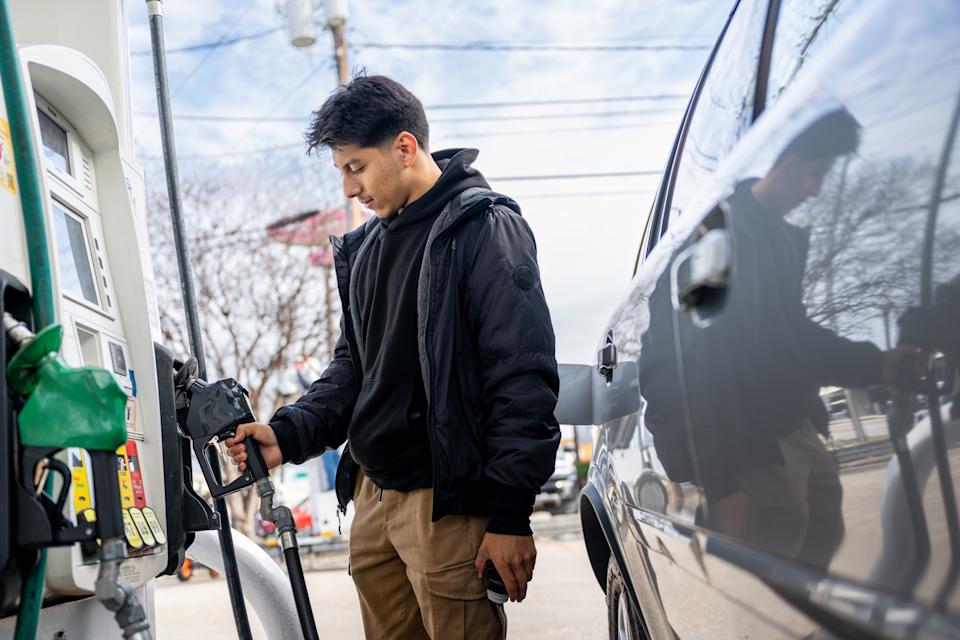
A customer fills up at a Chevron station in Austin, Texas, on February 13, 2025. (Brandon Bell/Getty Images)
Economic Sentiment and Consumer Behavior
The uncertainty surrounding energy prices has already dampened Americans' outlook on the economy. The University of Michigan's latest consumer sentiment survey, released Friday, showed confidence at its lowest point so far this year.
Forrester Research retail analyst Sucharita Kodali explained, "Whenever gas prices rise, consumers feel the pinch and are likely to cut back on discretionary spending, which impacts both supply and demand."
While all households are affected by higher energy costs, strategists point out that those with lower incomes are hit hardest, as they have less flexibility to absorb the added expenses.
Krishna Guha, vice chairman at Evercore ISI, noted that persistently high oil prices could worsen the "K-shaped" divide in the economy, widening the gap between the financial well-being of the lowest and highest earners.
According to the Bank of America Institute, the gap in wage growth between high- and low-income households is now at its widest in a decade. In February, wages for higher earners increased by 4.2% year-over-year, while those for lower earners rose only 0.6%.
Looking ahead to 2026, economists had hoped that larger tax refunds from President Trump's One Big Beautiful Bill Act (OBBBA) would help boost consumer spending and narrow the income gap.
Oil Price Surge Offsets Tax Refund Gains
That optimism may be fading. Raymond James' McCourt suggests that the recent $25 jump in oil prices has effectively negated the fiscal benefits of the OBBBA for many households.
Bloomberg economists estimate that oil prices would need to average around $83 per barrel to erase the impact of tax refunds. As of Friday, Brent crude was trading at about $102 per barrel, while West Texas Intermediate stood at $97 per barrel.
Broader Economic Impact
Diesel prices are also on the rise, increasing transportation costs across the board. Since trucks move about 70% of all freight in the US, these higher costs could push inflation further above the Federal Reserve's 2% target. If the oil shock persists for more than six months, the Fed may be forced to reconsider its policy stance.
Michael Zdinak, economics director at S&P Global Market Intelligence, notes that it typically takes at least six to nine months for higher energy costs to fully impact prices of goods like food and clothing.
Earlier this week, Dollar General issued cautious financial guidance, citing ongoing uncertainty in consumer behavior. CFO Donny Lau pointed to factors such as shifting tariffs and the potential for continued increases in gas prices as key challenges.
Meanwhile, leaders at wholesale retailers BJ's and Costco report that higher fuel prices are prompting shoppers to hunt for bargains. At a recent retail conference, AutoZone CEO Philip Daniele observed that consumers may delay big-ticket purchases like new vehicles and instead invest in maintaining their current cars.
Disclaimer: The content of this article solely reflects the author's opinion and does not represent the platform in any capacity. This article is not intended to serve as a reference for making investment decisions.
You may also like
Gold Encounters Crucial Challenge: Rising Dollar and Real Yields May Undermine 73% Surge
Pi Network Crashes Big on Pi Day as Investors Panic Sell
Global Market Capitalization Exceeds $4 Trillion Amid Growth in Crypto and Stablecoin Sectors
Bill Morgan and Zach Rynes Clash in Fresh XRP Value Debate
Trending news
MoreCrypto prices
More





