
Iran’s Covert Oil Export System Poses Risks to Global Commodity Market Stability

Long-Term Trends in Oil Markets: The Role of Interest Rates and the U.S. Dollar
Oil prices, like those of other commodities, are influenced by extended cycles. Currently, two major factors—real interest rates and the strength of the U.S. dollar—are shaping the boundaries for oil prices. These elements set the upper and lower limits for price movements. When global economic expansion is strong and inflation is rising, the dollar typically weakens and real yields decrease, which supports higher oil prices. In contrast, a stronger dollar and higher real rates make holding oil less attractive, leading to downward pressure on prices.
Iran’s Geopolitical Impact: Risks and Market Response
Amid this macroeconomic environment, developments in Iran have introduced a measurable risk to oil price stability. Protests and new U.S. sanctions have increased geopolitical uncertainty, but the market has only factored in a modest risk premium—about $4 per barrel. The real challenge would arise if Iranian oil exports were completely halted. According to BloombergNEF, a full cutoff of Iran’s 3.3 million barrels per day could push Brent crude to an average of $71 per barrel in Q2 2026, and potentially up to $91 per barrel by the end of the year if the disruption continues. Such a scenario would force a reassessment of the current price range dictated by macroeconomic factors.
U.S. Policy Dilemma: Enforcement Versus Revenue Flow
The United States faces a strategic crossroads. Recent sanctions targeting 14 shadow fleet vessels and 15 entities involved in Iranian oil transport aim to cut off vital funding. Despite these efforts, Iran continues to generate revenue, maintaining exports to major buyers like China. This ongoing cash flow supports Iran’s activities abroad. If enforcement is relaxed, the revenue stream persists. The market’s current stance—that speculation outweighs actual supply concerns—reflects the tension between policy objectives and practical outcomes. While fundamentals drive the macro cycle, geopolitical events can temporarily push prices outside their usual range.
Iran’s Adaptability: Navigating Supply Shocks
Initial market reactions to Operation Epic Fury have evolved into a clearer understanding of Iran’s operational resilience. Despite conflict and threats to the Strait of Hormuz, Iran has sustained high crude exports, averaging 2.17 million barrels per day in February 2026. Over 2 million barrels daily are shipped to China, which has stepped in to replace other suppliers.
This steady flow is enabled by an intricate evasion network. Although the U.S. has sanctioned numerous vessels and entities, export volumes remain robust. Iran has combined pre-war stockpiling with agile responses, clearing onshore tanks and moving about 20 million barrels to floating storage near Singapore and Malaysia. This decentralized offshore inventory is transferred via ship-to-ship operations, often in concealed locations such as the East Outer Port Limits anchorage off Malaysia.
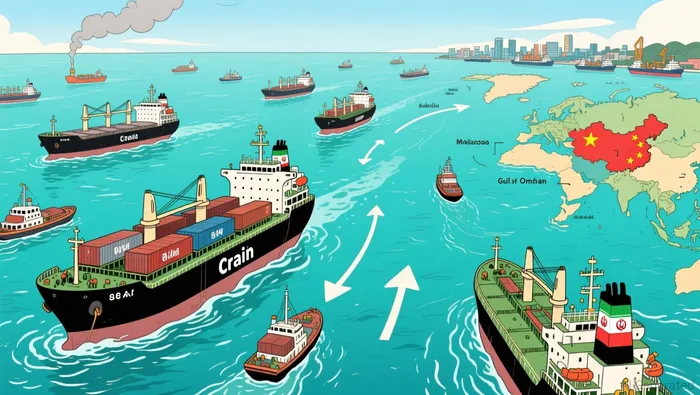
The network’s flexibility is crucial. With the Strait of Hormuz under threat, Iran has resumed loading at the Jask terminal on the Gulf of Oman. Many vessels now operate covertly, disabling tracking systems after Iran warned of attacks on ships passing through the strait. Satellite data shows Iran has sent at least 11.7 million barrels through the Strait since the conflict began, all bound for China. This demonstrates Iran’s determination to maintain its financial lifeline, even under intense pressure.
Ultimately, the supply shock is not simply a matter of exports stopping or continuing. It is a dynamic, evolving flow that adapts to conflict conditions. This resilience challenges the macro cycle by keeping a steady, though risky, supply of crude in the market. The possibility of a dramatic price spike from a total export halt remains theoretical for now, as the market adjusts to a new baseline where geopolitical risk is managed through evasion rather than eliminated.
Market Dynamics: Price Floors and Speculation
The current price floor for oil is shaped by a balance between a modest war premium and strong speculative activity. BloombergNEF estimates that only a small war premium—about $4 per barrel—is included in crude prices. This indicates the market is not anticipating an imminent supply crisis. However, Brent crude has traded above $66 since the protests, reaching its highest point since October 2025, suggesting speculation is a key driver.
Many experts believe recent price increases are more a result of market sentiment than actual shortages. As one industry figure observed, "The Iranians are managing to bring in money almost as usual," and the rise in energy prices is fueled by futures market speculation. Evidence supports this, with crude oil options showing increased upside risk and traders seeking protection against further price hikes. The premium is rooted in financial markets, not physical supply fundamentals.
China’s strategic motivation is also significant. Its increased imports from Iran serve as a safeguard against supply disruptions from other sources like Venezuela, whose output has been severely impacted by U.S. sanctions. By purchasing discounted Iranian crude, China strengthens its energy security and helps Iran maintain steady revenue. This creates a feedback loop: China’s demand supports Iran’s evasion tactics, which in turn stabilizes physical supply and limits speculative premiums.
In summary, the current price floor is shaped by a combination of low war premium, speculative activity, and strategic trade. While the macro cycle determines long-term equilibrium, this environment introduces ongoing volatility. The market is pricing in the risk of future disruptions rather than current shortages. As long as Iran continues to export and China remains a buyer, speculation may stay contained. A significant interruption in this flow could trigger a decisive shift in prices.
Key Triggers and Broader Implications
Iran’s ability to sustain oil exports has established a new, more complicated baseline for the market. However, the system remains susceptible to specific events that could quickly disrupt supply and challenge the prevailing commodity cycle. The main threat is a direct attack on the Kharg Island terminal, which handles 90% of Iran’s crude exports. Although a recent strike caused minimal damage, the terminal’s location and infrastructure make it a prime target for escalation. As one analyst suggested, "an American operation to ensure oil flows through the Strait of Hormuz, or a ground offensive to seize Kharg Island" could significantly increase pressure on Iran and create a real supply shock.
An extended blockade of the Strait of Hormuz would be an even more disruptive event. This critical passage is already under threat, prompting Iran to use the Jask terminal as an alternative. A prolonged naval blockade could cut off Iran’s main export route, forcing costly rerouting or halting shipments altogether. The current speculative premium would likely disappear in the face of such a tangible disruption, causing prices to surge and challenging the macro-driven equilibrium.
For now, a sustained drop in Iran’s export volumes is the key indicator to watch. The February peak of 2.17 million barrels per day marked a high point for Iran’s evasion network. If exports fall below 2 million barrels per day, it would signal that sanctions or operational setbacks are impacting Iran’s ability to move oil, marking a shift from speculative risk to actual scarcity.
Policy changes are equally important. Any reduction in China’s imports would weaken Iran’s financial position. A major escalation in U.S. enforcement, beyond targeting shadow fleet vessels, could further test Iran’s adaptability. In essence, the current environment introduces persistent volatility. The macro cycle sets the long-term direction, but sudden, high-impact events remain a real risk. Investors should closely monitor these catalysts, as they could quickly override the current speculative calm and reshape the market landscape.
Disclaimer: The content of this article solely reflects the author's opinion and does not represent the platform in any capacity. This article is not intended to serve as a reference for making investment decisions.
You may also like


Trending news
MoreEnhanced Capital Named to the ImpactAssets 50 2026, the Definitive Guide to Impact Investing Fund Managers
Acumen Pharmaceuticals Presents Studies on Enhanced Brain Delivery, Biomarker Research, and Novel Antibodies at Advances in Alzheimer's Treatment at International Conference on Alzheimer's and Parkinson's Diseases 2026
Crypto prices
More





