
Cosan Faces 35% Equity Haircut as Banks Demand R$25B Raízen Rescue

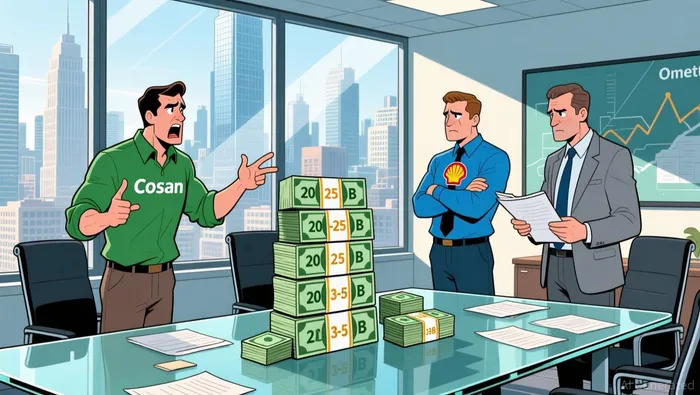
The core of the restructuring battle is a staggering capital gap. Creditors, led by major banks, have demanded a capital injection of 20 billion reais to 25 billion reais to stabilize Raízen. This figure, cited by UBS BB Investment Bank, represents the scale of the financial hole left by years of costly investments, poor harvests, and rising debt. In stark contrast, the owners' proposed rescue plan is a fraction of that size. The current shareholders-Cosan, ShellSHEL-1.43%, and billionaire Rubens Ometto-are negotiating a capital increase of 3 billion to 5 billion reais. Shell has committed to contributing between 1.5 billion reais and 3.5 billion reais, while CosanCSAN-1.74% is expected to provide 1 billion reais and Ometto an additional 500 million reais. This creates a shortfall of over R$20 billion.
| Total Trade | 174 |
| Winning Trades | 2 |
| Losing Trades | 2 |
| Win Rate | 1.15% |
| Average Hold Days | 0.18 |
| Max Consecutive Losses | 1 |
| Profit Loss Ratio | 1.55 |
| Avg Win Return | 1.93% |
| Avg Loss Return | 1.23% |
| Max Single Return | 2.47% |
| Max Single Loss Return | 1.46% |
The proposed mechanism to bridge this gap is a 35% debt-for-equity conversion. The plan includes converting about 35% of Raízen's debt to equity as a key element. This would directly address the banks' demand by writing down a portion of the debt, effectively converting a liability into ownership stakes. However, the scale of this conversion is critical. A 35% write-down may be insufficient to meet the banks' R$25 billion demand, which implies a much deeper capitalization or a more severe haircut. The owners' proposal, therefore, is a targeted, partial solution that aims to restructure the balance sheet without a full-scale default, but it falls far short of the banks' stated requirements.
This divergence sets up a classic institutional standoff. The banks, as senior creditors, are pushing for a capital injection large enough to protect their principal and maintain the company's investment-grade status. The owners, particularly Cosan, are resisting a dilutive rescue that would require them to contribute a disproportionate share of the R$25 billion gap. The collapse of recent talks highlights the deep disagreement over who bears the cost. For institutional investors, this conflict is the central risk: the deal may fail, forcing a disorderly default that would trigger a fire sale of assets and likely wipe out equity holders. The owners' proposal, while a step toward a solution, must now be re-evaluated against the banks' ultimatum to see if a viable, capital-light compromise can be found.
Cosan's Constraints: Balance Sheet Impact and Credit Quality
For Cosan, the Raízen crisis is not a distant risk-it is a direct, material hit to its financial health. The company's 44% stake in Raízen is now severely impaired, with Raízen's shares down 70.7% over the past year. This collapse in market value has dramatically reduced the carrying value of Cosan's investment, translating directly into a writedown on its balance sheet. The impairment is a stark reminder that Cosan's equity portfolio is no longer a source of stable returns but a significant drag on its capital.
This financial strain is compounded by the strategic diversion of capital. Resources that could have been deployed elsewhere have been tied up in the failed Raízen venture. The company's broader portfolio initiatives, like the Oxxo convenience store chain, have not yielded returns and have further strained its capital allocation. In essence, Cosan is being forced to choose between bailing out a struggling joint venture or funding its own growth, a trade-off that weakens its overall quality factor.
The most immediate liquidity pressure comes from Raízen's debt schedule. The company has estimated it will need to disburse approximately R$ 13 billion in the next 24 months, just for amortization of bank debt. This creates a massive near-term cash outflow event for its owners. For Cosan, this means a potential obligation to contribute to a capital increase that could be as large as R$ 5 billion, a sum that would be a significant portion of its own market cap. The owners' proposal to inject 1 billion reais is a fraction of this looming liability, highlighting the extreme pressure on Cosan's balance sheet.
The bottom line is a clear deterioration in credit quality. Cosan's exposure to a deeply distressed asset, combined with the need to potentially fund a rescue, increases its financial leverage and operational risk. This shifts the company from a position of financial strength to one of vulnerability, where its own credit profile is now inextricably linked to the outcome of the Raízen restructuring. For institutional investors, this means the stock carries a higher risk premium, as its cash flow stability and capital allocation discipline are now under direct assault.
Institutional Pressure Dynamics and Portfolio Implications
The restructuring is now a battle of creditor power. Raízen has secured backing from more than 40% of its creditors, a critical thresholdT-2.69% that has allowed it to file for an out-of-court reorganization. This support signals a pivotal shift: senior lenders are prioritizing the protection of their secured claims over the equity value of the venture. Their leverage is clear. As the company's largest shareholders, Cosan and Shell, are now being pressured to contribute more than their initial R$4 billion capital injection, the banks are effectively dictating the terms of the rescue. This dynamic sets a precedent for Latin American distressed deals, where creditor coalitions can force dilutive capital calls on equity holders, even when those holders are strategic partners.
The proposed 35% debt-for-equity conversion is the centerpiece of this new order. It establishes a concrete mechanism for writing down liabilities, but it also sets a benchmark for future risk assessment. For institutional investors, this precedent is a double-edged sword. On one hand, it provides a potential path to recovery for some bondholders. On the other, it signals that the risk premium for similar agribusiness ventures in the region may need to be recalibrated. The market will now price in a higher likelihood of severe debt restructurings, where equity is sacrificed to protect senior claims. This could depress valuations across the sector, as the perceived safety of a company's capital structure is diminished.
For portfolio managers, the Raízen case represents a high-conviction, high-risk bet. The institutional flow is clear: the deal is being structured to attract private equity, with a BTG Pactual fund poised to acquire a significant stake in the fuel distribution arm. This signals that the "smart money" sees a potential value trap in the distressed asset, but only if they can control the capital allocation and asset separation. The required risk premium is substantial. Investors must weigh the potential upside of a successful carve-out and reorganization against the high probability of further dilution and a prolonged, uncertain process. The bottom line is that this is not a passive investment; it demands active management and a significant tolerance for volatility, making it a niche allocation rather than a core holding.
Catalysts and Watchpoints for the Restructuring
The path to a resolution is now defined by a series of near-term milestones that will determine the final capital structure and inform portfolio positioning. The first critical event is the progress of the extrajudicial reorganization. Raízen has filed with the support of 47% of its creditors, but a binding plan requires approval from a 66% threshold. The coming weeks will test whether the initial creditor coalition can be expanded to meet this higher bar. Any failure to gain sufficient traction would likely force a more complex, court-supervised process, increasing costs and uncertainty for all parties.
Simultaneously, the market will watch for the evolution of the capital injection proposals. The current owners' plan for a 3 billion to 5 billion reais capital increase is a starting point, not a final offer. The key variable is the potential involvement of private equity. A BTG Pactual fund is poised to acquire a significant stake in the fuel distribution arm for about 5.5 billion reais, which would provide a major portion of the required capital. This third-party participation is a crucial catalyst; its finalization would alleviate direct pressure on Cosan and Shell, but its terms will dictate the equity split and control dynamics post-reorganization.
Finally, the company's ability to secure a Chapter 15 recognition in the United States is a key logistical watchpoint. Raízen has planned to request recognition of the Brazilian proceeding in the US under this cross-border bankruptcy framework. Success here would facilitate a coordinated restructuring across its international footprint, including its Argentine operations, and provide a more stable platform for negotiations with global bondholders. A delay or denial would complicate the process and could be viewed as a negative signal by the market.
For institutional investors, these are the concrete events that will move the needle. The outcome hinges on whether the 66% creditor threshold is met, whether the BTG deal closes, and whether the Chapter 15 application is granted. Each development will clarify the final capital burden on the owners and the potential recovery for bondholders, allowing for a more precise reassessment of risk and opportunity.
Disclaimer: The content of this article solely reflects the author's opinion and does not represent the platform in any capacity. This article is not intended to serve as a reference for making investment decisions.
You may also like
RCM Technologies, Inc. (RCMT) Experiences a Steeper Decline Compared to the Market: Key Points to Consider
Silicon Motion (SIMO) Rises Despite Market Downturn: Key Information to Note
Here's the Reason Oscar Health, Inc. (OSCR) Declined More Sharply Than the Overall Market
Strategy (MSTR) Experiences a Steeper Decline Compared to the Overall Market: Important Takeaways
Trending news
MoreCrypto prices
More





