
Oklo Drops by Half: An In-Depth Look at the Decline

Stock Performance and Market Sentiment
Over the last six months, the stock has plummeted by 53%, currently trading around $64—a sharp drop of 67% from its 52-week peak of $193.84. Despite this significant decline, trading activity remains robust, with an average of 18.6 million shares changing hands daily. This sustained volume suggests that both traders and investors are still highly engaged. Technically, the stock is entrenched in a downward trend, with indicators signaling continued selling pressure.
While the one-month trend appears neutral, indicating a temporary pause in momentum, the broader trajectory remains negative. The stock is trading well below major moving averages and has breached important support levels, setting the stage for further declines. The combination of heavy selling and high volume indicates that the market is still processing recent developments, with little evidence of stabilization at this point.
In summary, the stock is experiencing a pronounced outflow of capital. The scale of the drop is considerable, and the persistent trading volume confirms that this is not a neglected or overlooked equity. Although technical signals suggest a possible short-term consolidation, the prevailing downtrend and broken supports imply that further weakness is likely unless there is a significant change in market dynamics.
Financial Dynamics: Cash Usage and Fundraising
The company’s rate of cash consumption represents a major near-term concern. Oklo spent $82.2 million in operating cash last year, and management anticipates a similar outlay—between $80 million and $100 million—for 2026. Coupled with planned investments of $350 million to $450 million, this underscores the capital-intensive nature of its current expansion phase. Investors remain focused on the company’s long-term prospects, with analysts projecting annual revenue growth of 50% and assigning a valuation exceeding 100 times initial-year earnings.
To support its growth, Oklo completed a substantial capital raise in early 2026, securing $1.182 billion through a $1.5 billion at-the-market offering. Combined with $1.4 billion in cash and marketable securities at the close of 2025, this provides the company with several years of financial runway. This capital injection directly addresses concerns about solvency and mitigates immediate dilution risks for shareholders.
In essence, Oklo is moving from a development-focused phase to large-scale deployment, which demands significant expenditure but is now backed by ample funding. The high cash burn is an expected part of scaling operations, and the recent fundraising effort has bought the company valuable time. The current market valuation reflects optimism about future revenue, largely overlooking present cash outflows. While the financial position supports a long-term growth narrative, the stock’s performance will remain closely tied to the company’s ability to meet operational targets and manage its cash effectively.
Key Catalysts and Areas to Monitor
The company’s future trajectory depends on three main factors: successful project execution, prudent financial management, and the evolving narrative around AI-driven energy demand.
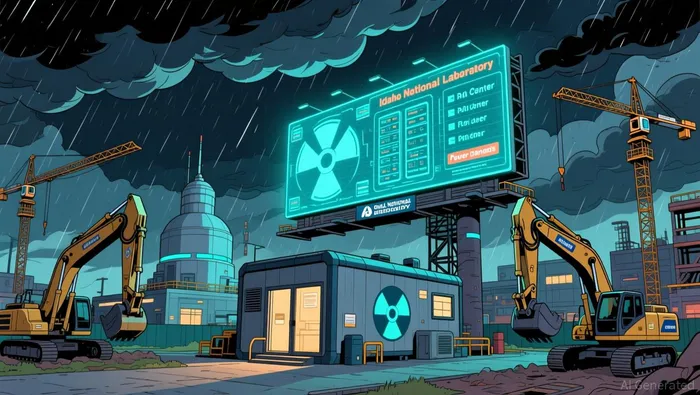
- Project Progress: Investors should look for concrete advancements on the first commercial reactor. Construction began on the Aurora powerhouse at Idaho National Laboratory in 2025, but the timeline has shifted. The main catalyst is the anticipated surge in electricity demand from AI, which could boost the stock if major data center power purchase agreements are secured. Notably, Oklo has a prepayment deal with Meta for a 1.2 gigawatt power campus, though the reactor is not expected to be operational until 2030. Delays or cost overruns in this project would pose significant risks to the company’s deployment strategy.
- Financial Oversight: It is crucial to track how the company manages its cash burn relative to the capital raised. The guidance for 2026 projects operating cash usage between $80 million and $100 million. Any significant deviation could signal operational inefficiencies. The recent $1.182 billion capital raise provides a multi-year buffer, but investors will be watching how effectively these funds are allocated, especially given the $350 million to $450 million earmarked for investments.
- Market Sensitivity: The stock’s valuation is heavily dependent on achieving future milestones. While the recent decline may present a buying opportunity, this is contingent on the company successfully navigating the next stage of project development without financial missteps. Any setbacks with the initial reactor or unexpected increases in cash burn could exacerbate the decline, whereas positive progress could renew investor enthusiasm, particularly around the AI-driven demand story.
In conclusion, while the stock’s current price reflects high expectations for future achievements, its path forward will be shaped by execution on key projects, disciplined financial management, and the realization of anticipated demand from emerging technologies.
Disclaimer: The content of this article solely reflects the author's opinion and does not represent the platform in any capacity. This article is not intended to serve as a reference for making investment decisions.
You may also like
Australia’s Nickel Industries halts Indonesia mine after worker death
High-Stakes Volatility – Hyperliquid Whale Suffers $125K Liquidation Amid $5.59M ETH Long Position
ECB: Market pricing challenges Lagarde stance – ING
Trending news
MoreCrypto prices
More





