
Macarthur Minerals clears dilution risk but faces fragile runway as Lake Giles waits for iron ore rebound

The recent expiry of Macarthur Minerals' quoted options marks a deliberate step to clean up its capital structure. The 2023 options, with a 3-cent strike price and a two-year horizon, have now lapsed. This removes a potential source of future share issuance and dilution for existing shareholders.
For a company navigating a challenging iron ore cycle, this lapse is a tactical simplification. It reduces a layer of contingent equity that could have pressured the share price if exercised during periods of weakness. With the options gone, the capital structure is clearer, and the risk of unexpected dilution is temporarily off the table.
Yet the move also highlights the ongoing need for capital. Just months before this expiry, the company executed an A$1.996 million capital raise via a renounceable entitlement offer. That raise was structured with a free option to incentivize participation, a clear signal that securing funds remains a priority. The company is using this capital to fund general expenses while it awaits the first royalty payments from its joint venture partner, Gold Valley Yilgarn, at Lake Giles. The options lapse, therefore, is not a sign of financial stability but a necessary reset to improve clarity as the company works through its next capital needs.
Lake Giles: Project Development Against a Cyclical Headwind
The Lake Giles project is the core of Macarthur Minerals' strategy, a magnetite resource base with over 1.2 billion tonnes of contained iron. For now, the company's primary focus is on preserving the project's value and integrity, navigating a path through development while its capital structure is being reset. This is not a project poised for immediate expansion; it is a long-term asset held in reserve.
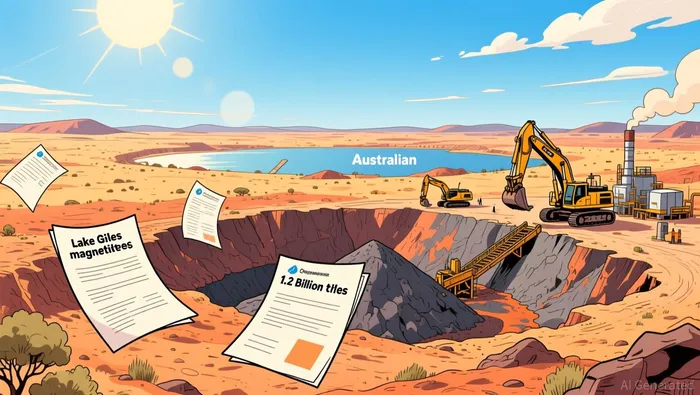
The ultimate commercial viability of Lake Giles is intrinsically tied to the iron ore price cycle, a cycle driven by global growth trends, China's massive demand for steel, and the broader real interest rate environment. A soft cycle, where prices are pressured, directly challenges the economics of new magnetite projects. In such a backdrop, development timelines can stretch, and the capital required for a mine build-out becomes a more significant hurdle. The project's fate is not determined by internal management alone but by these macroeconomic tides.
A key potential catalyst for Macarthur is a future royalty payment from its joint venture partner, Gold Valley Yilgarn. The agreement grants Macarthur a $1 per tonne royalty for all additional tonnes of hematite mined from the Ularring deposit, following milestone payments. This could provide a new, recurring revenue stream that would dramatically improve the company's financial profile. However, it is not a near-term cash flow driver. The royalty payments are contingent on Gold Valley's successful mining operations, which themselves depend on favorable market conditions. For now, the company is using its recent capital raise to fund general expenses until that day arrives.
The bottom line is that Lake Giles represents a bet on a future cycle. The company is using its current capital to hold the fort, awaiting the macro environment to turn in its favor and the royalty payments to materialize. In the meantime, the project's development pathway remains on a cautious, value-preserving footing.
Catalysts, Risks, and the Macro Backdrop
The path forward for Macarthur Minerals is defined by a handful of high-stakes catalysts and persistent risks, all set against the slow-moving but powerful current of the iron ore cycle. The primary catalyst is a sustained recovery in iron ore prices. A shift from a soft cycle to a more supportive one would directly improve the economics of magnetite projects like Lake Giles, making them more attractive to potential joint venture partners and contractors. This could accelerate development timelines and, more immediately, validate the commercial case for Gold Valley Yilgarn to move forward with mining the Ularring hematite deposit. A price recovery would also make the company's own capital raise more effective, as it would extend the runway for the project while the company waits for royalty payments.
The key risk, however, is the project's continued dependence on external funding and partnerships. The recent A$1.996 million capital raise is a necessary short-term solution to fund general expenses until the first royalty payments begin. This reliance on a rights issue, even with underwriting support from Gold Valley, underscores the company's limited financial buffer. The capital structure remains fragile, and any further delays in the royalty stream or a prolonged period of weak prices could force another round of fundraising, testing shareholder patience and potentially diluting ownership further.
In response, Macarthur is executing an operational shift to manage through this period of low commodity prices. The company has announced a strategic move to refocus on tighter cost controls and a stronger alignment with its predominantly Australian shareholder base. This includes consolidating its listings to the ASX, a step that simplifies governance and communication. This focus on cost discipline and shareholder alignment is a pragmatic adaptation to the macro backdrop, allowing the company to preserve value and maintain project integrity while waiting for the cycle to turn. The bottom line is that Macarthur's fortunes are now inextricably linked to the iron ore market's trajectory, with its own financial and operational choices serving as a buffer against the volatility of that cycle.
Disclaimer: The content of this article solely reflects the author's opinion and does not represent the platform in any capacity. This article is not intended to serve as a reference for making investment decisions.
You may also like
Fed's Barr: Iran oil price shock could shift inflation expectations and delay rate cuts
How to Value Early-Stage Mining Projects: Navigating the Price Sensitivity Gap
Top 5 European Neobanks Bringing Crypto Mainstream
Trending news
MoreCrypto prices
More





