
2 Top Oil Companies to Consider Now as Iran Tensions Drive Crude Prices Near $100

Oil Markets Face New Pressures Amid Middle East Conflict
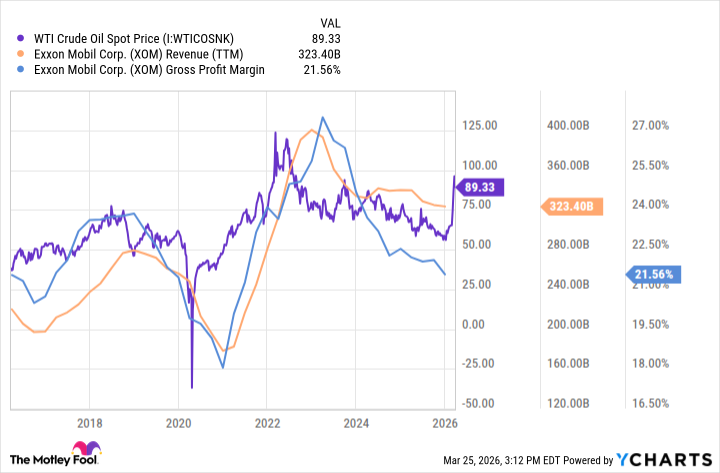
With the ongoing conflict in Iran now entering its second month, the Strait of Hormuz has become a vital bottleneck for global oil shipments. This disruption has pushed WTI crude oil prices close to the $100 per barrel mark.
In times like these, it's common to see energy sector stocks climb. However, only a select group of companies are structured to fully capitalize on the volatility and opportunities that arise during such unpredictable energy cycles.
ExxonMobil (NYSE: XOM, +0.28%) and Chevron (NYSE: CVX, -0.24%) stand out as more than just beneficiaries of the current market surge. Their business models are designed to harness long-term industry trends more effectively than many of their peers.
Source: Getty Images.
ExxonMobil: A Fully Integrated Energy Powerhouse
ExxonMobil's expansive global operations give it significant cost advantages. When oil prices soar, the company is able to convert those gains directly into profits, avoiding the margin pressures that often impact traditional exploration and production firms due to royalties or hedging losses.
Many upstream-focused companies are forced to sell their oil at market rates because they lack dedicated pipelines or have too many midstream contracts. This often leaves them struggling to secure transportation, which limits their ability to benefit from higher prices.
ExxonMobil’s vertical integration means it manages every stage of the process—from extraction and pipeline transport to refining and distributing finished products. This structure allows Exxon to deliver higher-value products to markets where demand remains steady, even when prices fluctuate.
ExxonMobil (NYSE: XOM) Snapshot
- Market Cap: $714B
- Day's Range: $171.05 – $176.41
- 52-Week Range: $97.80 – $176.41
- Volume: 30M
- Average Volume: 22M
- Gross Margin: 21.56%
- Dividend Yield: 2.36%
While independent drillers often see their costs rise alongside energy prices, ExxonMobil’s downstream and chemical divisions can actually benefit from expensive crude, expanding their profit margins. This demonstrates that Exxon’s integrated approach is a strategic advantage, acting as a built-in hedge that many competitors lack.
ExxonMobil’s strong financial position enables it to continue rewarding shareholders through stock buybacks and dividend increases, even in turbulent market conditions.
Chevron: Driving Growth Through Integration and Efficiency
Chevron also benefits from a vertically integrated business model. One of its key strengths is its low-cost operations in the Permian Basin, complemented by its Hess Guyana assets, which are expected to boost the company’s oil and gas reserves in the coming years.
By operating specialized refineries that process its own crude, Chevron can better manage price swings in the commodities market, unlike competitors who must purchase expensive feedstock.
Other midstream companies may need to issue new shares to fund infrastructure projects, and downstream-only firms can be squeezed by rising crude prices. Renewable energy developers, meanwhile, often face lengthy permitting processes and are sensitive to higher interest rates.
Chevron’s ability to fund infrastructure investments from its strong operating cash flow allows it to consistently return value to shareholders through dividends and share repurchases.
Chevron (NYSE: CVX) Snapshot
- Market Cap: $420B
- Day's Range: $210.32 – $214.71
- 52-Week Range: $132.04 – $214.71
- Volume: 501K
- Average Volume: 13M
- Gross Margin: 14.66%
- Dividend Yield: 3.28%
Why ExxonMobil and Chevron Excel in Volatile Oil Markets
By combining upstream production strength with downstream stability, ExxonMobil and Chevron offer a comprehensive approach to the oil business. Their integrated strategies provide a competitive edge, especially when geopolitical tensions disrupt supply. This makes both companies not only resilient choices for investors seeking exposure to oil, but also among the most strategically positioned in the industry.
Disclaimer: The content of this article solely reflects the author's opinion and does not represent the platform in any capacity. This article is not intended to serve as a reference for making investment decisions.
You may also like
Lagarde indicates that April remains an active possibility
XRP Sees Sharp Drop Amid Market Volatility But Demand May Be Rising
Bitcoin struggles to sustain gains as institutional demand wanes and U.S. yields climb
Malaysia's M2 Expansion Climbs to 4.3% — Liquidity Improves, Yet Will It Trigger Inflation?

Trending news
MoreCrypto prices
More





