
Bitget UEX Daily | Iran Negotiation Foundation Destroyed, Hormuz Strait Closed; Intel Surges on Terafab Project Participation (2026-04-09)
 Bitget2026/04/09 01:30
I. Hot News
Fed Dynamics
Fed March Meeting Minutes: Iran Conflict Amplifies Two-Way Economic Risks
- The minutes reveal clear divisions among policymakers due to the Iran conflict: prolonged warfare could damage the labor market and necessitate rate cuts, while rising inflationary pressures could force rate hikes; the vast majority of officials believe restoring inflation to the 2% target will take longer.
- Some officials support including a “two-way description” of future interest-rate decisions in the post-meeting statement.
- San Francisco Fed President Mary Daly noted that U.S. economic fundamentals remain solid, but the conflict’s impact on oil, gas, and related chains still requires more time to assess—any judgment now would be premature. Market Impact: This heightens uncertainty around the Fed’s policy path, potentially suppressing near-term rate-cut expectations, though signs of de-escalation could help ease overall inflationary pressure.
International Commodities
Iran Claims Three Key Points of “Ten-Point Plan” Violated, Hormuz Strait Closed Again
- Iran’s Islamic Consultative Assembly Speaker Qalibaf stated on social media that the U.S. has violated three critical clauses of Iran’s proposed ceasefire “Ten-Point Plan,” declaring the “negotiation foundation has been destroyed” and reiterating long-term distrust of U.S. commitments.
- On the 8th local time, the Hormuz Strait was closed once more; the oil tanker “AUROURA” suddenly turned around and returned to the Persian Gulf.
- White House Press Secretary Leavitt confirmed that the first face-to-face U.S.-Iran talks will be held on the morning of the 11th in Islamabad, Pakistan, led by Vice President Vance. Iran’s revised streamlined proposal has been accepted as the negotiation basis and will be aligned with the U.S. “15-point plan”; the U.S. core red lines remain unchanged, especially “Iran must not enrich uranium domestically.” Market Impact: Although de-escalation signals exist, the situation remains volatile; oil prices have seen sharp short-term pullbacks while risk assets have been supported.
Macroeconomic Policy
White House Clarifies Ceasefire Details; U.S. Government Considers Adjusting NATO Military Deployments
- Vice President Vance, speaking in Hungary, stated that the U.S. never promised the ceasefire agreement would include Lebanon and that Israel has agreed to exercise restraint to support the talks.
- Government officials disclosed that the Trump administration is considering withdrawing U.S. troops from certain NATO countries that failed to substantively assist in actions against Iran as a “punitive” measure; the plan is still in its early stages. Market Impact: This highlights the Trump administration’s tough stance toward allies and could further influence global geopolitical dynamics and energy security expectations.
II. Market Review
Commodities & Forex Performance
- Spot Gold: Around $4,720/oz, down 0.2% in 24H; safe-haven buying has eased slightly amid de-escalation but remains at elevated levels.
- Spot Silver: $74.5/oz, down 0.3% in 24H; moving in sync with gold and risk sentiment adjustments.
- WTI Crude: Up 2.3%, at $97/barrel; technical rebound after ceasefire implementation.
- Brent Crude: Up 2.1%, at $97/barrel; same drivers as WTI.
- Dollar Index: Down 0.8%, at 99.05; improved risk appetite has suppressed safe-haven demand.
Cryptocurrency Performance
- BTC: Down 1.2% in 24H, currently around $70,900; profit-taking pressure has increased after short-term geopolitical de-escalation, shifting the trend to consolidation.
- ETH: Down 2.2% in 24H, currently around $2,190; slightly underperforming the broader market.
- Total Crypto Market Cap: Down 1.4% in 24H, approximately $2.41 trillion; dragged by major coin pullbacks.
- Market Liquidations: $2.63 billion total in 24H, with $1.6 billion in long liquidations.
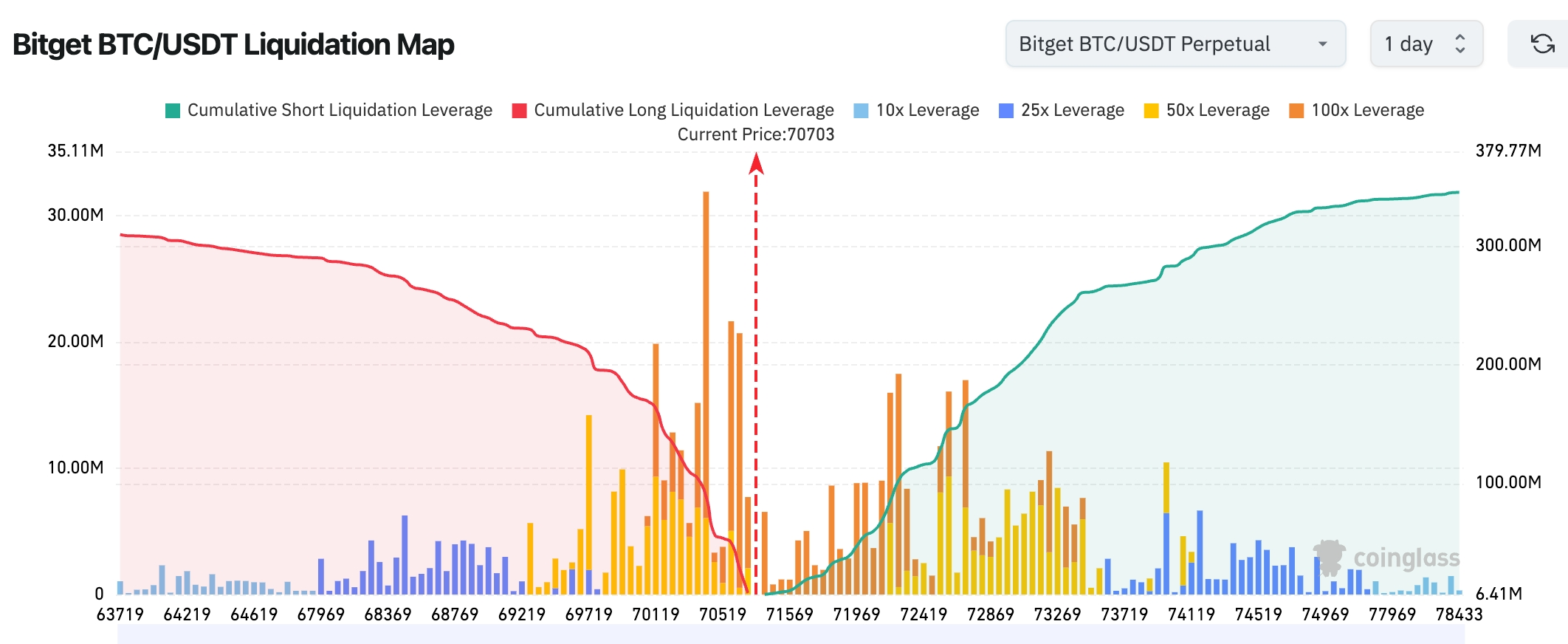
- Bitget BTC/USDT Liquidation Heatmap: Current price near $70,703 sits at a dense long-short liquidation boundary. A break below $70,000 could trigger rapid cascading long liquidations. The $72,400–$73,300 zone has significantly thicker short liquidation pools; a break above $71,500 is more likely to first trigger an upward squeeze.
- Spot ETF Net Flows: BTC spot ETFs saw net outflows of approximately $85 million yesterday; ETH spot ETFs recorded modest net outflows of $9.8 million.
- BTC Spot Inflows/Outflows: Inflows of $2.592 billion, outflows of $2.607 billion, net outflow of $15.32 million yesterday.
Summary: Yesterday’s Bitcoin rebound was primarily driven by the stage-one easing of geopolitical risks, but the Hormuz Strait cryptocurrency toll news served as an important secondary catalyst, significantly boosting market confidence in BTC’s long-term value. The event underscores Bitcoin’s unique role in high-risk international trade and provides a fresh dimension for monitoring future price action. Investors should continue tracking progress at the 11th talks and actual payment case implementations.
U.S. Stock Index Performance

- Dow Jones: +2.85% at 47,909.92 points; ceasefire news drove a strong open-to-close rally.
- S&P 500: +2.51% at 6,782.81 points; notable for six consecutive gains.
- Nasdaq: +2.80% at 22,635 points; led by technology and storage/optical communication sectors.
Tech Giants Performance
- Intel (INTC): +11.42%, $58.95; standout leader driven by recovering storage chip demand and stable semiconductor supply-chain expectations.
- NVIDIA (NVDA): +2.23%, $182.08; supported by sustained long-term AI computing demand.
- Google (GOOG): +3.56%, $317.32; AI search and application progress on track.
- Apple (AAPL): +2.13%, $258.90; seasonal consumer electronics demand rebound.
- Amazon (AMZN): +3.50%, $221.25; cloud computing growth expectations solid.
- Broadcom (AVGO): +4.99%, $350.63; strong demand for custom AI chips.
- Meta (META): +6.50%, $612.42; continued advertising business recovery momentum.
- Tesla (TSLA): -0.98%, $343.25; modest pullback amid overall risk appetite improvement.
Core Reason Summary: Stage-one easing of geopolitical tensions has fueled a broad risk-asset rebound. The storage/optical communication sector has erupted as the leading theme, with Intel—as a key supplier—showing the strongest performance in resonance with AI supply-chain demand.
Sector Rotation Highlights
Energy Sector down roughly 4-10%
- Representative stocks: Chevron (CVX) -4.4%, Exxon Mobil (XOM) -4.7%, APA Corp. (APA) -10%.
- Driving factor: Sharp oil-price drop triggered broad energy-stock sell-off.
Storage/Optical Communication Sector across-the-board surge
- Representative stocks: Related semiconductor and communications names led gains.
- Driving factor: Improved market expectations for supply-chain stability.
III. In-Depth Stock Analysis
1. Intel (INTC) – Tech Sector Leader
Event Overview: Intel shares surged 11.42% on Wednesday to $58.95, becoming the Nasdaq tech sector leader with single-day volume up more than 40%. Key catalysts include a clear recovery in storage-chip demand and optimistic market expectations for the company’s AI packaging project (Terafab), which involves deep cooperation with Elon Musk’s xAI to provide high-density advanced packaging solutions for next-generation AI training clusters. The stage-one geopolitical de-escalation (U.S.-Iran ceasefire) has further boosted semiconductor supply-chain stability expectations. Intel, as a global key supplier, has directly benefited; the broader tech-giant rally created strong resonance. The company has posted three consecutive quarters of sequential memory-business revenue growth, with AI-related orders now accounting for nearly 25%. Market Interpretation: Goldman Sachs and Morgan Stanley analysts have jointly upgraded ratings, arguing that reduced global semiconductor supply-chain disruption risk in the de-escalation environment will accelerate order landings for Intel’s HBM and advanced packaging capacity. Institutions estimate that if AI capex remains elevated, 2026 EPS could be revised upward 15%-20%. Investment Insight: In the short term, watch the positive pass-through from falling oil prices to inflation and greater Fed policy flexibility. Over the medium to long term, closely track AI server capex trends and capacity ramp-up progress; consider accumulating in the $55–60 range.
2. Meta Platforms (META) – Social Media Leader Strong
Event Overview: Meta shares rose 6.5% to $612.42, extending a six-session winning streak with cumulative gains exceeding 18%. Advertising business recovery momentum is robust; Q1 ARPU rose 8.2% sequentially thanks to AI-powered precision targeting upgrades and higher Reels monetization rates. Geopolitical de-escalation has lifted global consumer and corporate advertising spending confidence, while Meta Reality Labs VR/AR hardware shipments exceeded expectations and the open-source Llama AI content-generation tools have further expanded ecosystem influence—creating clear resonance with Nasdaq tech heavyweights. Market Interpretation: JPMorgan and Bernstein note that improved risk appetite combined with lower macro inflation expectations will drive overall digital-ad market expansion. Meta still has valuation repair room (current dynamic price-to-sales ratio of only 7.8x, 15% below historical average); with advertising + AI dual engines, 2026 revenue growth is expected to remain double-digit. Investment Insight: De-escalation favors consumption and advertising spend; focus on Q2 earnings guidance for AI product commercialization progress. The $330–650 range offers an attractive entry window.
3. Anthropic – AI Managed Agents Breakthrough (AI Ecosystem Milestone)
Event Overview: Anthropic officially launched Claude Managed Agents—a new product combining composable APIs and hosted environments that upgrades AI from simple conversational tools to sustainable production systems. Deployment speed is increased more than 10-fold, supporting complex multi-step decision-making, real-time auto-correction, and cross-system integration. The product directly connects to Google Cloud and AWS infrastructure; over 150 enterprise clients have completed internal testing, marking a key node in AI’s shift from “generative tools” to “enterprise-grade autonomous agents.” The breakthrough synergizes with supply-chain stability expectations from geopolitical de-escalation, further lifting demand for AI hardware and cloud services. Market Interpretation: Analysts with OpenAI alumni backgrounds view this as a milestone in AI’s transition from tools to productivity systems, poised to reshape enterprise IT spending structures. Goldman Sachs forecasts the global AI agent market to expand from $15 billion currently to $120 billion by 2026–2027; as a first mover, Anthropic will significantly drive upstream chip and cloud vendor performance. Investment Insight: Focus on AI infrastructure-related listed companies (Intel, Broadcom, etc.). Technological iteration is expected to accelerate industry-wide capex; treat this event as a key signal for AI thematic allocation.
4. Micron Technology (MU) – Storage Chip Demand Explosion
Event Overview: Micron shares advanced with the broader storage sector on strong AI data-center demand for high-bandwidth memory (HBM) and DRAM. The company has already sold out its entire 2026 HBM capacity; spot memory chip prices have risen 28% since the start of the year, with AI memory shortages persisting. Geopolitical de-escalation has eased supply-chain bottlenecks. As the world’s second-largest DRAM supplier, Micron directly benefits from order ramps by downstream clients such as Intel and NVIDIA. Recent earnings show data-center revenue share has climbed to 58%, with year-over-year growth of 112%. Market Interpretation: Citi and UBS joint reports emphasize that AI-driven memory supply-demand imbalances will persist into the second half of 2027; Micron’s gross margin is expected to rise from the current 42% to above 55%. Institutions broadly assign “Buy” ratings with target prices in the $110–130 range. Investment Insight: Medium- to long-term structural AI server memory shortages remain favorable. Continue to hold while HBM prices stay elevated and monitor quarterly capacity utilization as a forward indicator.
5. Broadcom (AVGO) – AI Custom Chip Order Landed
Event Overview: Broadcom announced expanded long-term cooperation agreements with Google and Anthropic to supply Google with next-generation Tensor Processing Unit (TPU) custom chips and provide Anthropic with multi-gigawatt AI computing capacity. The order is valued at over $4.5 billion—the largest single custom AI semiconductor deal in Broadcom’s history. Supply-chain stability from geopolitical de-escalation has further secured delivery timelines; AI-related revenue now accounts for 41% of total revenue, up 65% year-over-year. Market Interpretation: Jefferies and Barclays analysts state that the deal markedly raises visibility for Broadcom’s AI business revenue and solidifies its absolute leadership in custom ASIC chips. 2026 AI revenue guidance could be raised 18%-22%, driving overall valuation re-rating. Investment Insight: Sustained high growth in AI infrastructure capex makes Broadcom’s long-term outlook bright. Prioritize allocation within AI thematic rotations and monitor follow-through on subsequent cloud-giant cooperation milestones.
IV. Cryptocurrency Project Updates
- Bernstein: The quantum threat to Bitcoin is real but manageable; the industry has a three-to-five-year window for anti-quantum upgrades. Strategy founder and executive chairman Michael Saylor believes the risk is overstated and remains theoretical, potentially decades away, with solutions available by then.
- Strategy founder and executive chairman Michael Saylor, speaking at a Mizuho event, stated that Bitcoin likely bottomed near $60,000 in early February. The bottom was determined more by exhausted selling pressure than valuation. He sees limited current selling pressure, with ETF inflows absorbing daily supply and corporate treasury allocations providing sustained demand. Saylor predicts the next bull market catalyst will be the formation of bank credit and digital credit systems built on Bitcoin, transforming it from a non-yielding asset into a capital-markets engine.
- Morgan Stanley’s spot Bitcoin ETF (MSBT) recorded approximately $34 million in inflows on its April 8 listing debut, with trading volume exceeding 1.6 million shares.
- On-chain analyst Ember monitored that the Ethereum Foundation has now sold 3,750 of the planned 5,000 ETH (worth $8.3 million) at an average price of $2,214.
- Chainalysis report forecasts stablecoin transaction volume could reach as high as $15 quadrillion by 2035. Even baseline growth would push adjusted stablecoin volume to $7.19 quadrillion by 2035; adding demographic shifts and merchant adoption could raise the ceiling substantially. In 2025, stablecoins handled about $28 trillion in “real economic activity” (excluding noise and focusing on payments, remittances, and settlements). Two major drivers: an estimated $100 trillion wealth transfer from older generations to digital-native Millennials and Gen Z between 2028 and 2048, plus deeper integration of stablecoins into merchant checkout and backend payment systems where users no longer perceive the underlying crypto technology. Chainalysis expects stablecoin payment volumes to match Visa and Mastercard between 2031 and 2039.
- The Block reports that Canary Capital has submitted an S-1 filing to the SEC on Wednesday for a spot ETF tracking the PEPE token. Canary noted PEPE launched in April 2023 with a total supply exceeding 420 trillion tokens and has no utility. Last year, Canary also filed for ETFs tracking MOG and Pengu.
V. Today’s Market Calendar
Data Release Schedule
| 8:30 | United States | Personal Income (Feb) | ⭐⭐⭐ |
| 8:30 | United States | PCE Price Index (Feb) | ⭐⭐⭐⭐ |
| 8:30 | United States | GDP (Q4 Final) | ⭐⭐⭐⭐ |
| 8:30 | United States | Initial Jobless Claims (week of Apr 4) | ⭐⭐⭐ |
Key Event Preview
April 9 (Thursday)
- U.S. February core PCE price index, Q4 real GDP annualized final value, and initial jobless claims for the week ending April 4.
April 10 (Friday)
- U.S. March CPI YoY and MoM ★★★★★; University of Michigan April consumer confidence preliminary reading + 1-year inflation expectations preliminary reading.
Institutional Views
Leading investment bank analysts generally believe the strong rebound in U.S. equities and crypto assets on April 8 stemmed mainly from the risk-appetite boost following the U.S.-Iran two-week ceasefire agreement. The sharp oil-price decline has further eased inflation concerns and helped the Fed maintain policy flexibility. Morgan Stanley and others note that markets will focus on the outcome of the 11th Pakistan talks in the near term; substantive progress would leave further upside for risk assets, but the Iranian parliament statement shows divisions persist and Hormuz Strait volatility remains a source of uncertainty—investors should maintain position discipline. Goldman Sachs analysts emphasize that the weaker dollar and rebounds in gold and silver reflect a temporary release of safe-haven demand, while crypto market cap has surpassed $2.5 trillion and ETF inflows remain steady, signaling strong institutional allocation demand. Overall, de-escalation provides the market a breathing window, yet the Fed’s March minutes highlight bidirectional risks, reminding investors that the macro policy path still carries uncertainty. Focus on today’s PCE data for validation of inflation expectations.
Disclaimer: The above content has been compiled by AI search and is only manually verified and published; it does not constitute any investment advice.
Disclaimer: The content of this article solely reflects the author's opinion and does not represent the platform in any capacity. This article is not intended to serve as a reference for making investment decisions.
You may also like
Morgan Stanley Jumps 4.51% on 3-Day Rally to $176.02

Why Copper Is Outperforming Gold And Silver In 2026

Live Nation Jumps 3.33% to 163.56 as Bullish Signals Converge
Zaif's $60 Million Breach: Examining Liquidity and Reserve Movements

Trending news
MoreCrypto prices
More





