
Oil Price Movement: How Funds Shifted Following the Pipeline Attack

Major Disruption: Iranian Strike Hits Saudi Oil Pipeline
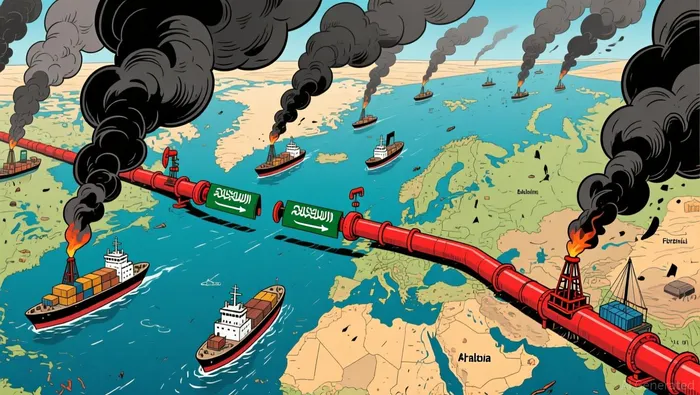
An Iranian assault has struck Saudi Arabia's East-West pipeline, the kingdom's only remaining export route after Iran's effective blockade of the Strait of Hormuz. This attack has halted the transfer of oil from Saudi Arabia's eastern reserves to the Red Sea, triggering a sudden and dramatic supply crisis. The oil market responded with unprecedented volatility, as International Brent crude prices soared by 60% in March, marking the largest monthly jump on record due to fears of extended supply interruptions.
Although prices have since retreated from their highs, Brent crude was still trading at $109.94 per barrel as of Tuesday—well above pre-crisis figures. This partial correction reflects a market coming to terms with ongoing uncertainty: while the pipeline attack is significant, the unresolved closure of the Strait of Hormuz remains the central issue threatening global oil shipments.
The economic fallout is already apparent. The price spike has benefited oil producers with alternative export routes, such as Saudi Arabia and Iran, while countries like Iraq and Kuwait, which lack such options, have experienced sharp declines in revenue. The situation remains tense, with U.S. President Donald Trump issuing an ultimatum to Iran to reopen the strait, warning of severe repercussions if it does not comply.
Winners and Losers in the Oil Market Shakeup
The surge in oil prices has created a clear divide among regional producers. Iran, Oman, and Saudi Arabia have seen their oil income rise, whereas Iraq and Kuwait, unable to reroute exports, have suffered steep losses. Both Iraq and Kuwait’s oil export earnings dropped by approximately 75% year-over-year. In contrast, Iran’s oil revenues climbed by 37%, and Oman’s by 26%.
Saudi Arabia managed to shield itself from the worst effects. Despite damage to its East-West pipeline, the kingdom had already increased shipments through its alternative route. In February, Saudi Arabia exported around 7 million barrels per day to the Red Sea, helping to stabilize its income even after the attack. The state oil company, Aramco, also stands to gain from higher prices through increased royalties and taxes, bolstering government finances.
The broader Gulf region has not been immune to the shock. Even the UAE, with its own pipeline infrastructure, saw oil revenues fall by 2.6%, as higher prices were offset by reduced export volumes. This underscores that while some countries are better positioned, the magnitude of the supply disruption is affecting all major producers in the region.
Ceasefire Uncertainty and the Road Ahead
The recent rally in oil prices is underpinned by a fragile truce. A temporary ceasefire has been established, contingent upon Iran’s “COMPLETE, IMMEDIATE, and SAFE OPENING of the Strait of Hormuz” by a U.S.-imposed deadline. While President Trump has declared this a “total and complete victory,” analysts caution that the agreement is unstable and unlikely to quickly resolve the underlying issues.
Financial markets reflect the tension between optimism and ongoing risk. Oil prices initially dropped on news of the ceasefire, with Brent crude falling to $94 per barrel from a high near $120. Nevertheless, prices remain far above the pre-crisis level of $70, as investors anticipate lasting economic consequences, including increased shipping costs and persistent structural changes in oil pricing—even if the strait is reopened.
OPEC+ has formally announced a planned increase in May production quotas by 206,000 barrels per day. However, with the Strait of Hormuz still blocked, the ability to physically deliver this oil to global markets is severely limited. The bottleneck is not just about price, but about the actual movement of oil.
Brent Crude Oil Price Trends

Disclaimer: The content of this article solely reflects the author's opinion and does not represent the platform in any capacity. This article is not intended to serve as a reference for making investment decisions.
You may also like
SEB's Deep Value Opportunity: An Undervalued Recovery Story Facing Wary Doubts

HEMITRY Surges Then Collapses — Overbought or Overdone?

QXO's Kodiak Buyout: Earnings Accretion or Dilution Trap in 2026?


Trending news
MoreCrypto prices
More





