
Australia's Urea Crisis Sparks Barley Shift: A Geopolitical Catalyst Forcing Farmers to Reroute Crop Mix

The core macro shock arrived with the U.S.-Israeli conflict with Iran, triggering a severe, multi-month supply disruption for Australia's nitrogen fertilizer market. The effective closure of the Strait of Hormuz, a critical chokepoint for global trade, cut off the nation's main urea suppliers in the Gulf region. This created an immediate and profound vulnerability, as Australia sources nearly two-thirds of its annual urea imports from the Middle East Gulf nations.
The transmission mechanism was swift and brutal. With the primary maritime route blocked, the flow of fertilizers to Australia stalled. The last vessel carrying fertilizer through the strait departed on February 23 and was not expected to arrive until late March. With typical transit times of three weeks or more, this meant no new Gulf shipments would reach Australia in April. The result was an immediate price surge. Urea prices in Australia jumped about 60% to around A$1,350 per ton this week, while Australian diesel prices are up 88% over the same period.
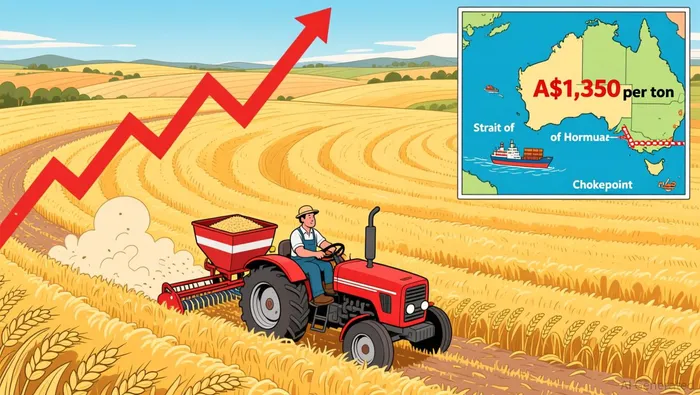
This dual cost shock landed directly on farmers, pressuring their most fundamental decisions. The economic pressure is concrete: a farmer like Geoff Cosgrove faces doubled diesel costs and a critical need for 40,000 liters to plant through June. With urea prices soaring and supply uncertain, the math for nitrogen-intensive crops like wheat and canola has turned sharply negative. As a result, planting decisions are being forced to adapt. Analysts note farmers are trying to reduce fertiliser application and switching planting from nitrogen hungry crops like wheat and canola into feed barley. This shift is already shaping the crop mix for the upcoming season, with wheat planting potentially dropping by 10% to 12%.
Structural Vulnerability and the Topdressing Risk
The immediate price spike is a symptom of a deeper, structural flaw. Australia's urea market is built on a single-point-of-failure. The nation imports 64pc of its urea from the Gulf nations of Saudi Arabia, Qatar, the UAE, Bahrain and Oman. This extreme concentration creates a systemic vulnerability that turns a geopolitical event into a national agricultural crisis. When the primary maritime route is severed, the entire supply chain grinds to a halt.
| Total Trade | 12 |
| Winning Trades | 7 |
| Losing Trades | 5 |
| Win Rate | 58.33% |
| Average Hold Days | 16.92 |
| Max Consecutive Losses | 3 |
| Profit Loss Ratio | 0.92 |
| Avg Win Return | 2.59% |
| Avg Loss Return | 2.68% |
| Max Single Return | 3.91% |
| Max Single Loss Return | 4.46% |
This vulnerability is compounded by the failure of a key alternative. China, a major supplier of ammonium sulphate (amsul), halted its exports to Australia as of March 13. While amsul is being sought as a substitute, it is less efficient, providing only half the nitrogen of urea. This limits its ability to fully offset a urea shortfall. The combined effect is a supply chain with high concentration and low resilience, leaving farmers exposed to a perfect storm of price and availability risk during the crop's most sensitive growth stages.
The bottom line is that the current shock is testing the entire system. The pre-seeding buffer provides a short-term reprieve, but the longer-term outlook for yield and protein quality depends entirely on imports that are now blocked. This structural dependency defines the risk profile for the coming season.
Government Actions and Strategic Response Options
The immediate pressure is on the Australian government to act. With the primary supply route blocked and the topdressing window closing, authorities face a clear choice: activate strategic reserves or expedite alternative import approvals. The problem is that current storage infrastructure is limited. The nation's buffer of urea is sufficient for pre-seeding applications, but it does not extend to the critical June-July topdressing period. This creates a policy vacuum where the government must decide how to manage a known, imminent shortfall.
This crisis is a stark spotlight on a systemic vulnerability. The evidence shows Australia's fertiliser import profile demonstrates extreme geographical concentration, with roughly two-thirds of urea coming from a single region. This single-point-of-failure model is now exposed, turning a geopolitical event into a national agricultural risk. The shock is likely to spark renewed debate on strategic reserve policies, which have long been discussed but not implemented at scale. More broadly, it could accelerate discussions about investing in domestic capacity, such as the Perdaman Project, to reduce reliance on volatile international supply chains.
For now, the watchpoints are clear. The government's first move will likely be to coordinate emergency supply efforts, perhaps by fast-tracking shipments from alternative sources like the U.S. or India. More consequential will be any policy announcements on import diversification or subsidy programs for critical inputs like urea and diesel. The goal would be to stabilize costs and ensure farmers can apply the nitrogen needed to protect yields and protein quality. The bottom line is that this event is testing not just agricultural resilience, but the entire framework for securing essential supply chains against macro-level shocks.
Farm-Level Adaptation and Long-Term Yield Trade-Offs
The shock is now translating directly to the farm gate, where economic pressure is forcing a fundamental shift in planting strategy. With urea prices soaring and diesel costs surging, farmers are making immediate trade-offs. As agricultural analyst Dennis Voznesenski noted, farmers are trying to reduce fertiliser application and switching planting from nitrogen hungry crops like wheat and canola into feed barley. This is a direct, cost-driven response to the new arithmetic of production.
The result is a clear crop mix shift. Barley plantings are expected to rise at wheat's expense, with analysts projecting Australia's wheat planting could drop by 10% to 12% from last year's levels. This isn't a minor adjustment; it's a strategic pivot away from Australia's core export staples. The move is driven by barley's lower nitrogen requirements and its strong market prices, offering a more viable path under the new cost constraints. Some growers are also exploring pulses as a lower-input alternative, while others may leave land fallow in already dry regions.
The long-term consequence of this adaptation is a potential yield and quality trade-off. The immediate pre-seeding application of urea is covered, but the real risk is to the crucial topdressing period in June and July. If farmers curtail these later applications due to price or availability, the impact will be felt in the field. As one report warns, crop volumes and, importantly, protein levels in wheat could be reduced if supplies are tight and high fertilizer prices cause farmers to pull back from their typical topdressing. This could undermine the quality of Australia's wheat exports, a key product for global markets.
Viewed through a macro lens, this is a textbook example of how a geopolitical shock cascades through a supply chain. The closure of the Strait of Hormuz disrupted a single trade route, but the impact has rippled through to the farm, altering planting decisions, shifting crop production, and threatening the final output. It turns a trade disruption into a direct threat to food production, highlighting the vulnerability of a system built on concentrated, just-in-time imports. The adaptation is pragmatic, but it comes at the cost of potential yield and quality, a tangible cost of the current geopolitical cycle.
Catalysts and Watchpoints for the Cycle
The path to normalization for Australia's urea market hinges on a few key macro and geopolitical factors. The primary catalyst remains the reopening and normalization of shipping through the Strait of Hormuz. While a ceasefire has been announced, the evidence shows Australia's urea supplies are a long way from secure. The timeline for a full return to pre-disruption flows is uncertain, and the market is already pricing in this extended uncertainty. Until vessels can transit the strait reliably again, the supply gap for the critical topdressing period will persist.
A secondary watchpoint is the resolution of China's export ban on ammonium sulphate (amsul). This ban has removed a potential substitute, forcing farmers to rely more heavily on urea or switch to lower-nitrogen alternatives like barley. Any easing of this restriction could provide a partial offset to the urea shortage, though the efficiency of amsul is limited, providing only half the nitrogen of urea. The flow of alternative imports from sources like the U.S. or India will also be critical in the near term, as these shipments may be expedited to fill the gap left by the blocked Gulf route.
The longer-term risk, however, is structural. This event has laid bare a systemic vulnerability in Australia's agricultural input security. The concentration of urea imports from the Gulf creates a single-point-of-failure that turns a regional conflict into a national production threat. The shock is likely to accelerate discussions on strategic reserve policies and investment in domestic capacity, such as the Perdaman Project. For now, the watchpoints are clear: monitor the strait's reopening, track any changes to China's export controls, and watch for government announcements on import diversification or subsidy programs. The cycle of disruption and adaptation will continue until the underlying supply chain is made more resilient.
Disclaimer: The content of this article solely reflects the author's opinion and does not represent the platform in any capacity. This article is not intended to serve as a reference for making investment decisions.
You may also like
Decentraland (MANA) Price Prediction 2026, 2027 and 2030: Will MANA Stage a Comeback?
Maji Ends 13-Trade Streak With $192K Bitcoin Loss
Crypto prices tumble after US-Iran talks collapse; Bitcoin drops 2%
Vance to Return to U.S. After Breakdown of Talks
Trending news
MoreCrypto prices
More





