
La-Z-Boy Valuation Check: Tariff Relief Sentiment Meets Earnings Beat

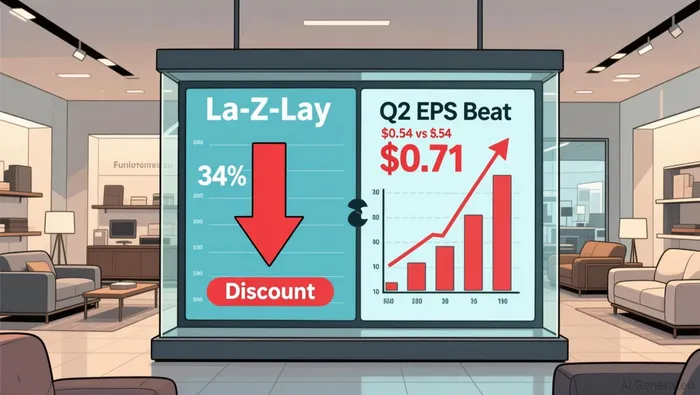
La-Z-Boy delivered a solid Q2 2026 earnings beat on November 18, 2025, posting EPS of $0.71 versus a consensus estimate of $0.54-a $0.17 margin of error that translates to a 31% beat. Revenue came in at $522.48 million, edging past the $517.63 million estimate by less than 1%. On the surface, this looks like a clear victory. But the real question for investors is whether the market had already baked this outcome into the stock price.
The magnitude of the EPS beat suggests otherwise. A $0.17 beat is not a whisper-number nudge-it's a meaningful outperformance that typically moves shares. Yet the stock's reaction tells a different story. When a company beats by this margin and the share price doesn't respond proportionally, it usually means one of two things: either the beat was already priced in, or the market is focusing on something else entirely.
Looking at the guidance update provides a clue. La-Z-Boy's Q3 revenue guidance of $525 million to $545 million centered roughly around the consensus of $535.3 million. That's not a raise. That's not even a beat-it's essentially in-line. When a company delivers a 31% EPS beat but guides in-line for the next quarter, the market interprets this as "the beat was a one-time thing, not a trend."
The whisper number likely sat closer to the actual $0.71 than the published $0.54 consensus. Analysts often sandbag estimates, and the gap between consensus and whisper can be substantial in stocks that have been under pressure. If traders expected La-Z-BoyLZB+1.72% to clear $0.65 or higher, then $0.71, while technically a beat, doesn't represent a fundamental surprise-it represents meeting elevated expectations.
This is the expectation arbitrage in action: the published consensus was $0.54, but the real question is what traders were actually pricing. The modest revenue beat (under 1%) combined with in-line guidance suggests the market had already adjusted for a decent, if not exceptional, quarter. The $0.17 EPS beat was the headline, but the guidance reset kept the valuation in check.
The bottom line: La-Z-Boy beat, but the beat was likely partially priced in. The stock's muted reaction reflects a market that saw the numbers, recognized the guidance as unexceptional, and concluded that the easy money had already been made.
Tariff Tailwind: Buy the Rumor or Sell the News?
The tariff landscape for La-Z-Boy just shifted-and the market's reaction suggests this may be one of those "buy the rumor, sell the news" moments that has already played out.
At the end of December, the White House invoked Section 232 to delay the scheduled tariff increase on upholstered furniture, kitchen cabinets, and vanities from 50% back to 25%-but only until 2027. the plan was pushed back to 2027. That's a one-year reprieve, not a resolution. The current 25% tariff remains firmly in place, and the underlying Section 232 investigation into wood products continues. duties specific to furniture importers, of around 25%, are not under Supreme Court review-the furniture-specific duties are safe from that particular legal challenge.
So what's the trade setup here? The delay provided a near-term relief rally, but the fundamental tariff burden hasn't disappeared. What investors should be watching is the mid-May Trump-Xi meeting. the Trump-Xi meeting rescheduled for mid-May could lead to a more enduring trade deal that would resolve these issues before any salvos are fired. If that meeting produces meaningful progress on US-China trade relations, the tariff tailwind could extend well beyond 2027. If it stalls-or if China's retaliatory investigations (launched in March) produce new duties-La-Z-Boy faces renewed headwinds.
The market's current pricing suggests limited upside from here. La-Z-Boy shares down about 11% over the past year but trading at roughly a 34% discount to analyst targets. That gap implies the market expects something to go right-but is it the tariff relief, or something else? The transformation story (distribution consolidation, margin expansion) is already baked into that fair value estimate. Tariff relief would be a bonus, not a foundation.
Here's the expectation arbitrage: the Section 232 delay was priced in as soon as it was announced in late December. The stock moved, but not dramatically-exactly what you'd expect when good news arrives but was already anticipated. The real question is whether the May meeting delivers a deal that extends beyond the 2027 deadline. That's the binary event. If it does, La-Z-Boy gets a multi-year tariff runway. If it doesn't, the 25% tariff becomes a permanent cost structure that compresses margins.
For now, the tariff tailwind is more headline than substance. The market is waiting on Beijing.
Guidance and Execution Risk: The Century Vision Test
La-Z-Boy's forward guidance just delivered a reality check that the market is absorbing with sober caution. The company set Q4 sales guidance at $560 million to $580 million, sitting well below the analyst consensus of $590.2 million. That's a guidance cut of roughly 2-5% versus what the street was expecting-a clear signal that management sees headwinds ahead, not tailwinds.
The official explanation points to adverse weather as the primary culprit. But here's the expectation arbitrage question: how much of this is transitory weather noise versus structural demand softness? When a company cites weather as a key headwind, investors should ask whether this is a one-time drag or a symptom of broader weakness. The fact that management felt the need to frame guidance around weather suggests they're aware the numbers are vulnerable-and that the market may not be buying the explanation at face value.
Profit pressure compounds the concern. Net income fell to $21.65 million from $28.43 million a year earlier, with EPS down across both the quarter and nine-month period. Lower net income and EPS as La-Z-Boy leans into retail expansion and company-owned stores under the Century Vision plan. This is the classic investment-phase dynamic: profits get compressed while the company builds out infrastructure, with the promise that margins will improve once new stores reach maturity. The question is whether the market has patience for that narrative.
The Century Vision strategy itself is now under the microscope. La-Z-Boy is pushing harder on retail expansion and company-owned stores-a bet that direct-to-consumer and omnichannel presence will capture more homeowner demand over time. Revenue of US$541.59m for the quarter came in ahead of expectations and above the US$521.78m reported a year earlier, which suggests the top line is still holding up even as furniture peers face their own demand questions. But revenue growth alone doesn't pay the bills-margins do. And with profit down year-over-year, the market is watching to see whether new and acquired stores will eventually support better margins or continue weighing on them.
The dividend affirmation at $0.242 per quarter adds another layer to the calculation. It signals management's willingness to keep returning cash to shareholders even as earnings soften-which income-focused investors may appreciate-but it also means less capital available for reinvestment or buybacks at a time when the company is investing heavily in retail expansion.
So what's priced in? The stock trades at roughly a 34% discount to analyst fair value estimates, the company is trading at 34.1% below one estimate of its fair value-but that discount already factors in the transformation story and the expectation that retail expansion will eventually deliver margin improvement. The guidance cut and profit pressure are new variables that the market must now reprice. If the weather-related headwinds prove truly transitory and Q4 sales land within the $560m-$580m range, the stock could stabilize. If demand proves softer than expected-or if new stores continue to drag on margins-the discount could widen further.
The execution test is straightforward: Can La-Z-Boy deliver on the Century Vision promise while navigating near-term profit compression? The market is giving management the benefit of the doubt, but only just. The next few quarters will determine whether this is a temporary investment phase or a structural challenge that outweighs the long-term upside.
Valuation Gap: Mispriced Opportunity or Value Trap?
La-Z-Boy trades at a 34% discount to analyst fair value estimates and a 33% intrinsic discount, with shares down about 11% over the past year. The stock trades at roughly a 34% discount to analyst targets. That's a meaningful gap-but is it a margin of safety or a reflection of legitimate execution concerns?
The market has already priced in the transformation story. The distribution consolidation from 15 centers to 3 hubs, expected to deliver 50-75 basis points of wholesale margin improvement by Year 4, is baked into that $44.50 fair value. The multiyear transformation is expected to yield 50-75 basis points of wholesale margin improvement. The tariff relief sentiment, the earnings beat, the retail expansion-all of it is reflected in the current price. What's not priced in is any upside beyond what management has guided.
Here's the expectation arbitrage: the whisper number for fair value isn't $44.50-it's lower. When a stock trades at a 34% discount and the market is still hesitant, it usually means investors are demanding a premium for execution risk. The guidance cut to $560-$580 million versus $590.2 million consensus, the profit compression, the weather headwind explanation-these are all red flags that the market is weighing heavily.
The margin of safety exists, but it's narrow. La-Z-Boy's dividend at $0.242 per quarter provides some support, and the distribution transformation offers a tangible path to margin improvement. But the timeline matters: Year 4 is three years away. Enhancing long-term operating efficiency and net margins as supply chain costs decline is a multi-year thesis, and the market has little patience for that when near-term profits are declining.
The value trap risk is real. Softer store traffic and ongoing retail margin pressure could challenge the fair value assumptions. Risks such as softer store traffic and ongoing retail margin pressure could challenge those fair value and earnings assumptions. If the Century Vision stores continue to drag on margins longer than expected, or if the tariff reprieve expires without a deal, the discount could widen further.
The binary catalyst remains the May Trump-Xi meeting. A meaningful trade deal would unlock multi-year tariff relief that's not currently priced in. Without it, the 25% tariff becomes a permanent cost structure that compresses margins indefinitely.
The bottom line: This is a "priced for failure" setup, not a clear mispricing. The 34% discount reflects the market's assessment that execution risk is high and near-term headwinds are real. For the gap to close, La-Z-Boy needs to deliver on the transformation sooner than Year 4, or the tariff situation needs to resolve favorably. Absent those catalysts, the stock may trade sideways for the foreseeable future. The margin of safety is there-but it's being tested.
Disclaimer: The content of this article solely reflects the author's opinion and does not represent the platform in any capacity. This article is not intended to serve as a reference for making investment decisions.
You may also like
Market Makers: The Unseen Force Driving Crypto Liquidity

Plug Power Jumps 25%: Analyzing the Drivers Behind the Earnings Upswing

Bitwise updates Hyperliquid ETF with Wintermute and Flowdesk; launch is approaching.
Dividend Kings or High-Yield Pitfalls: Uncovering the Market’s Overlooked Discrepancy for $31K Earnings
Trending news
MoreCrypto prices
More





