
Brazil's Terrabras Initiative: A State-Owned Rare Earths Strategy Amid China's Increasing Restrictions

China’s Rare Earths Dominance and the Global Supply Challenge
The rare earths industry is heavily concentrated in China, which is responsible for 95% of global output and possesses 36% of the world’s known reserves. This overwhelming control gives China significant leverage on the world stage. Recent developments have highlighted this vulnerability: in April 2026, China introduced strict new export controls on essential medium and heavy rare earths and their derivatives, citing national security. This action put pressure on supply chains critical to electric vehicles, defense, and renewable energy, underscoring the strategic risks for other nations.
Brazil’s Untapped Potential: A Strategic Opportunity
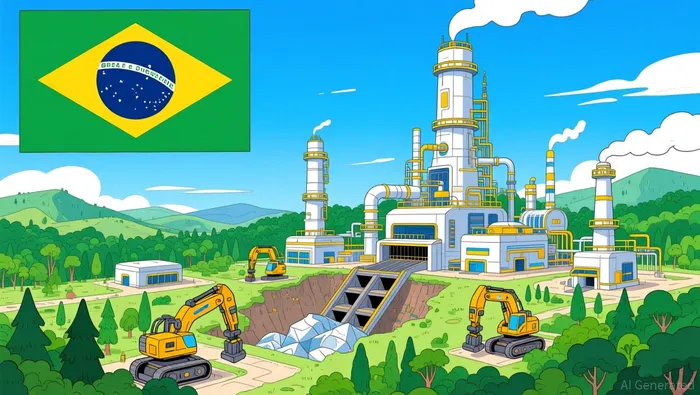
Brazil finds itself in a unique position. Despite holding 23% of global rare earth reserves—second only to China—its contribution to global production is minimal, at just 1%. This disparity between resource abundance and actual output presents a significant opportunity. With geopolitical tensions rising and the need for diversified supply chains growing, Brazil’s largely undeveloped reserves have become a focal point for potential state-led development. The current climate has made resource security as crucial as economic gain, positioning Brazil to play a pivotal role in the evolving market.
Blueprint for a State-Backed Rare Earths Leader
To capitalize on this opportunity, a proposal has been put forward to establish a government-controlled entity, Terras Raras Brasileiras SA (Terrabras), modeled after the state oil company Petrobras. The initiative, spearheaded by Congressman Rodrigo Rollemberg, would allow for investment from private companies, development banks, and sovereign funds, but the federal government would maintain a controlling stake to ensure strategic oversight.
Terrabras would oversee the entire rare earths value chain—from exploration and research to processing and commercialization. The aim is to develop a fully integrated domestic industry, reducing reliance on imports and positioning Brazil as a formidable competitor to China in the global market.
This strategy is also a response to international dynamics. As the United States intensifies efforts to secure alternative sources of rare earths, Brazil’s reserves have attracted interest for partnership. Notably, the US International Development Finance Corporation recently extended a $565 million loan to Brazil’s only current rare earths producer, Serra Verde, as part of a broader push to diversify supply chains away from China.
Domestically, the proposal aligns with President Luiz Inácio Lula da Silva’s push for industrialization and economic independence. The bill’s sponsor, a former cabinet member under Lula, frames Terrabras as a tool to safeguard national interests and maximize the value of Brazil’s resources. However, the legislative process is complex, and with elections approaching, time is of the essence for the proposal to advance.
Challenges: Investment, Environment, and Political Timelines
While the vision is ambitious, bringing it to fruition will not be easy. Developing a rare earths sector from the ground up requires massive investment—one major project alone is projected to need 3.5 billion reais (about $650 million) in upfront capital. Securing such funding is a lengthy process, even in politically stable environments. For a new state-owned company like Terrabras, the hurdles include not only financing but also navigating the complexities of exploration, permitting, and construction.
Environmental and social concerns further complicate the picture. The rush to exploit Brazil’s reserves has already led to friction, with 187 mining applications currently under review—many of which overlap with rural settlements and protected areas. This raises the risk of land conflicts and environmental degradation, threatening both local communities and biodiversity. Environmental advocates warn that unchecked mining could repeat the mistakes of the past, undermining the sustainability goals central to the global energy transition.
The political calendar adds further uncertainty. With elections looming, the bill faces a tight window to pass through a complex legislative process. Political shifts and debates could delay or derail the project, and the typical decade-long timeline for commodity projects is at odds with the short-term pressures of electoral politics.
Ultimately, this is a high-risk, high-reward gamble. The proposal seeks to leverage global demand for diversified rare earths supply, but its success depends on overcoming significant financial, social, and political obstacles. While the broader environment favors diversification, the practical realities of building a new industry in Brazil remain daunting. Achieving the necessary alignment of political will, investment, and social acceptance will be a formidable challenge.
Key Factors to Watch
- Political Dynamics: The fate of the proposal hinges on its progress through Brazil’s legislative system, especially in an election year. While the bill’s sponsor is closely aligned with President Lula, internal disagreements and external pressures—such as the $565 million US loan to Serra Verde—have already sparked tensions between Brazil and the United States. Political ambitions of other leaders, like former Governor Ronaldo Caiado, add further complexity.
- Securing Investment: The viability of Terrabras depends on attracting significant private and foreign capital. The United States is a key potential partner, actively seeking to ensure access to rare earths. The level of commitment from both international and domestic investors will signal confidence in the project’s prospects.
- Market and Geopolitical Trends: The rare earths market is now closely tied to policy decisions. China’s recent export restrictions have tightened supply and increased strategic urgency. The resolution of these controls, and any retaliatory actions, will directly affect Brazil’s economic calculations. Sustained high prices could accelerate investment, while a return to normal trade could lessen the urgency for diversification.
In summary, Brazil’s attempt to establish a state-led rare earths industry is shaped by global power shifts, domestic politics, and the realities of resource development. The outcome will depend on navigating a complex web of challenges—financial, environmental, and political—at a time when the stakes for supply chain security have never been higher.
Disclaimer: The content of this article solely reflects the author's opinion and does not represent the platform in any capacity. This article is not intended to serve as a reference for making investment decisions.
You may also like
Gold price to accelerate and hit new record highs after this event – technical analyst
SCHD’s Reputation for Quality Slips: Negative Information Ratio Puts “Safe” Dividend Strategy to the Test

Hungary's Tisza Party Faces Structural Hurdles as Market Optimism Risks a Sudden Repricing
BNB Price Near $600 Signals Breakout as Trend Strength Builds

Trending news
MoreCrypto prices
More





