
SpaceX IPO: Why Your 401(k) Is the Exit Liquidity Insiders Are Counting On

SpaceX isn't just going public. It's rewriting the rulebook to guarantee passive funds become its exit liquidity on day one.
The company confidentially filed its S-1 with the SEC on April 1, 2026, targeting a June NasdaqNDAQ-1.25% listing at a valuation between $1.75 trillion and $2 trillion, with a planned raise of up to $75 billion a planned raise of up to $75 billion. That alone would make it the largest IPO in history. But the real story isn't the size-it's the regulatory gymnastics happening in the background to ensure the stock gets bought by forces that can't say no.
Here's what's unprecedented: Nasdaq is considering a rule change that would let SpaceX skip the standard 12-month seasoning period and enter the Nasdaq 100 after just 15 trading days after just 15 trading days. Michael Burry called it "the most SHAMELESS structural manipulation of a major index I've ever seen" the most SHAMELESS structural manipulation. The Fast Entry proposal targets companies with market caps in the top 40 of Nasdaq-100 members-SpaceX's exact target top 40 of Nasdaq-100 members.
Then there's the 5x float multiplier. Any stock with under 20% free float would be weighted at five times its actual float in the index, capped at 100% weighted at five times its actual float. This is the mechanism that turns a $1.75 trillion company into a $1.4 trillion passive fund buying obligation. When the index weights a stock at 5x its available shares, passive funds tracking that index must buy five times more stock than actually exists in the public float.
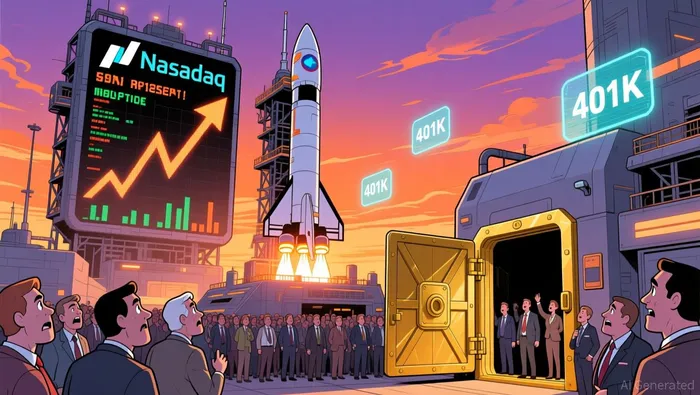
The math is brutal. If SpaceX lists at $1.75 trillion with a typical 20% free float, that's $350 billion in actual public shares. But with 5x weighting, the index exposure becomes $1.75 trillion. Passive funds tracking the Nasdaq 100-ETFs, 401(k) plans, pension funds-will be mechanically forced to buy that stock regardless of valuation, price discovery, or liquidity concerns protects passive investors from being forced into untested, illiquid stocks.
This is why the timeline matters. The standard 12-month waiting period exists so the market can establish real price discovery before passive money gets locked in That waiting period exists for a reason. Compressing it to 15 days removes that protection entirely. Insiders get their exit. Passive investors get the stock, warts and all, at whatever price the IPO sets.
| Total Trade | 12 |
| Winning Trades | 7 |
| Losing Trades | 5 |
| Win Rate | 58.33% |
| Average Hold Days | 16.92 |
| Max Consecutive Losses | 3 |
| Profit Loss Ratio | 0.92 |
| Avg Win Return | 2.59% |
| Avg Loss Return | 2.68% |
| Max Single Return | 3.91% |
| Max Single Loss Return | 4.46% |
The Department of Labor's proposed rule changes to allow 401(k) holders access to alternative assets like private companies DOL is attempting to change this through a new proposed rule. Now those same retirement accounts will be the ones buying SpaceX on day one-not because they chose to, but because the index rules were rewritten to make them mandatory buyers.
The setup is complete. The valuation is set. The regulatory path is being cleared. What's left is for insiders to decide when they're done riding.
The Trap: Why This Is a Classic Exit Liquidity Setup
Here's how the trap springs. SpaceX is structuring the IPO with 95% insider ownership and just 5% free float 95% insider ownership and just 5% free float. At a $1.75 trillion valuation, that's roughly $87.5 billion in actual public shares. But the 5x float multiplier changes the math entirely-passive funds will be forced to buy as if SpaceX were worth $437.5 billion as if SpaceX were worth $437.5 billion.
The $1.4 trillion figure isn't theoretical. That's the total exposure across the Nasdaq-100 ecosystem-ETFs, mutual funds, structured notes, derivatives. QQQ alone manages nearly $400 billion. When the index weights a stock at 5x its float, passive money has no choice but to absorb it passive money has no choice but to absorb it.
Now add timing. The Fast Entry rule lets SpaceX into the Nasdaq 100 after just 15 trading days after just 15 trading days. That's the same timeline insiders need before their lock-up expirations kick in. The sequence is brutal:


- IPO hits at $1.75 trillion
- Passive funds mechanically buy $437.5 billion worth in the first two weeks
- Price inflates on forced demand, not value
- Lock-ups expire
- Insiders sell into the liquidity they created
Michael Burry put it plainly: "Your 401(k) is the exit liquidity" "Your 401(k) is the exit liquidity".
This isn't speculation. The tiny-float playbook is already in motion. A fund holding stakes in SpaceX and Anthropic saw its price bid up 1,500% above real value in four days-investors paying sixteen dollars for every one dollar of actual value paying sixteen dollars for every one dollar of actual value. That's the pattern. Scarcity drives the price, not fundamentals. Then the insiders walk.
The 97% that wasn't offered in the IPO? That's the real story. When that block hits the market while your fund is already maxed out on position size, you're holding the bag at the top. The system doesn't ask your retirement account for permission. It just buys. And when insiders start selling, there's no one left to buy from them but the passive funds that just got locked in.
That's the trap. That's always been the trap. The only thing new is the scale.
The Employee Angle: Tax Traps and Timing Risks
For SpaceX employees, the IPO isn't a celebration-it's a tax event waiting to happen.
The company is targeting a June listing at a valuation between $1.75 trillion and $2 trillion targeting a June listing. But here's the brutal reality: employees will owe taxes on equity long before they can sell a single share.
The numbers are staggering. A typical employee with 10,000 ISOs at a $10 strike faces a $700,000 spread at today's valuations. Exercising now triggers approximately $230,000 to $265,000 in combined federal and California AMT-before paying a cent for the shares themselves combined AMT exposure. Wait until IPO, and that bill could exceed $1.6 million in a single year Federal AMT alone could exceed $1.3 million.
This is the core mismatch: paper wealth that's taxable but illiquid.
The dilemma is compounded by timing. Employees are facing a January 2026 tender at $421 per share, while IPO rumors suggest prices above $800 tender at $421/share. That's a 90%+ gap creating impossible decisions. Sell now and lock in gains, or hold for a potentially higher IPO price-but risk lockup restrictions and massive tax bills on shares you can't yet sell.
The Q2 2025 cutoff for long-term capital gains treatment adds another layer. Employees who exercise ISOs and hold for more than one year after exercise AND more than two years after grant get favorable tax treatment. Miss that window, and every dollar of gain becomes ordinary income at rates approaching 50% when you factor in California taxes and AMT.
The employees who will pay the least tax at IPO are the ones who started exercising years ago, spreading the AMT exposure across multiple tax years The employees who will pay the least tax. Everyone else is looking at a seven-figure bill on shares they cannot sell during the lockup period.
This is the insider trap in microcosm. The same structural advantages that let insiders exit at peak valuations create a nightmare for employees: they're taxed on paper gains while being legally barred from selling. Your 401(k) may be the exit liquidity for public investors. For employees, their own equity is the trap.
What to Watch: Catalysts and Red Flags
The next 60 days will determine whether the SpaceX IPO proceeds as planned or faces significant headwinds. Here's what to watch-and more importantly, what to watch for.
The S-1 public filing drops in April or early May. SpaceX confidentially filed its draft registration on April 1, 2026, and has approximately 15 days of mandatory waiting before the investor roadshow begins the public prospectus could land in April or early May. That document will confirm the exact valuation target, share count, and lock-up terms. Any deviation from the $1.75-$2 trillion range discussed publicly will signal internal recalibration. Watch the filing date-if it slips past mid-May, the timeline is in trouble.
The capital supply/demand mismatch is staggering. SpaceX, OpenAI, and Anthropic collectively want to raise $170-$195 billion from investors collectively valued at over $3 trillion-against a market that handled just $47 billion in IPOs all of last year against a market that handled $47 billion in IPOs. That's a 4:1 oversubscription risk built into the setup. If primary market demand softens, the pricing model breaks. The question isn't whether the IPO happens-it's whether it happens at the stated valuation.
Nasdaq's Fast Entry decision is the regulatory wildcard. The proposal to let SpaceX enter the Nasdaq 100 after just 15 trading days-instead of the standard 12-month seasoning period-remains pending enter the index after just 15 trading days. Michael Burry has labeled it "the most SHAMELESS structural manipulation of a major index I've ever seen" the most SHAMELESS structural manipulation. If Nasdaq scales back the proposal under investor pressure, the passive fund buying obligation collapses. Without Fast Entry, the 401(k) exit liquidity mechanism fails.
Insider selling activity before the IPO is the true signal. The 95% insider ownership structure means Elon Musk and early employees hold roughly $1.66 trillion in paper wealth at the target valuation 95% insider ownership and just 5% free float. Any pre-IPO tender activity, secondary sales, or pledge behavior will tell you whether insiders believe in the pricing or are positioning to exit. The January 2026 tender at $421 per share tender at $421/share already established a floor-anything below that signals insider skepticism.
The red flags are already visible. If the S-1 filing reveals a valuation below $1.5 trillion, if Nasdaq denies Fast Entry, if the roadshow shows weak institutional demand, or if insiders begin pledging shares before listing-these are the break points. The setup is aggressive. The execution risk is real. The only question is whether the market has already priced in the possibility of failure.
Watch the filings. Watch the index rules. Watch what the insiders do with their own money. That's where the real signal lives.
Disclaimer: The content of this article solely reflects the author's opinion and does not represent the platform in any capacity. This article is not intended to serve as a reference for making investment decisions.
You may also like
Burry's JD.com and Alibaba Longs Protected by Puts as He Bets on Policy-Driven Stabilization
Salesforce's Strategic AI Move: Exploring the $800M ARR Growth Driver Fueling the Upcoming S-Curve

LABNEW (LAB) fluctuates 40.8% in 24 hours: Driven by whale accumulation and high trading volume
Trending news
MoreCrypto prices
More





