
USPS Suspends $200M Pension Payments to Buy Time—Is This the Last Gasp for Regulated Legacy Assets?

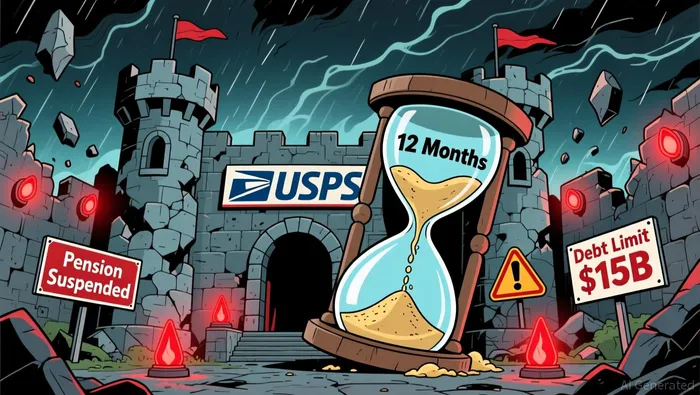
The U.S. Postal Service is facing a severe liquidity crisis that has triggered an immediate, non-operational capital reallocation. Postmaster General David Steiner has warned that, at current spending levels, the agency will run out of cash in less than 12 months if it continued to pay its bills on time. The critical deadline is now crystallizing, with the agency itself warning it could exhaust its cash reserves as soon as February 2027 could run out of cash as soon as February. This is not a distant forecast but a structural stress test for a legacy regulated asset whose financial model is under acute pressure.
In response, USPS has initiated a drastic capital shift. It announced it will temporarily suspend employer payments for a federal pension program, specifically halting $200 million in employer contributions every other week for the defined benefit portion of the Federal Employees Retirement System. This move is explicitly framed as a cash conservation measure to ensure the agency can continue making payroll, paying suppliers, and delivering mail to be able to continue making payroll, paying suppliers and delivering the mail. The suspension is a clear signal that operational continuity is being prioritized over long-term employee benefit obligations.
Viewed through an institutional lens, this action constitutes a severe liquidity stress test. The $200 million reallocation is a direct, immediate capital shift from a long-term liability to immediate cash flow needs. For a regulated asset like USPS, which operates under a universal service obligation but lacks a direct taxpayer subsidy, this highlights a critical vulnerability: its ability to generate cash from operations is insufficient to cover both its current obligations and its legacy commitments. The move underscores that the financial crisis is no longer theoretical; it is forcing a painful triage of capital allocation, where the survival of core service delivery takes precedence over pension funding.
The Financial Engineering Imperative and Sector Rotation Catalyst
The proposed financial adjustments represent a classic, albeit desperate, attempt at short-term liquidity engineering. The agency is seeking an 8% temporary price increase on key package services and a permanent 4.8% increase on First-Class stamps to 82 cents. These moves are a direct response to the severe financial crisis and rising costs, aiming to bridge the gap between outlays and revenue. Yet, viewed structurally, these are tactical price hikes, not a strategic solution. The 8% package surcharge is explicitly time-limited, running only until January 2027, and is framed as a "necessary bridge" to a permanent mechanism. This underscores the agency's admission that its current pricing model is fundamentally misaligned with its cost structure.
The core demand, however, points to a more profound failure of the existing financial architecture. The agency is urging Congress to lift its statutory debt limit of $15 billion to allow operational borrowing. This is not a request for a bailout, but a plea to access the capital markets to manage a severe cash flow crunch. The need for such a move highlights a critical vulnerability: USPS lacks the financial flexibility to smooth out its operational cycles. Its reliance on a rigid, non-borrowing model has turned a cyclical liquidity issue into a structural solvency threat.
This crisis exposes the complete failure of the prior decade's financial plan. The 10-year plan put in place in 2021 has not reversed the losses, with the agency posting net losses of $9 billion last fiscal year and $9.5 billion in 2024. The current crisis is the inevitable outcome of a strategy that underestimated the secular decline in mail volume and overestimated the agency's ability to self-fund its universal service obligation. The proposed price hikes and borrowing request are symptoms of a broken model, not a cure.
From an institutional perspective, this sets the stage for a significant sector rotation catalyst. The USPS case forces a hard look at the valuation of regulated assets with fixed pricing power and legacy cost structures. The agency's plea for a strategic direction-whether to cut services, raise prices, or seek subsidies-creates a policy uncertainty that is a classic driver for portfolio repositioning. Investors must now weigh the risk of a forced, politically-driven restructuring against the potential for a more sustainable, albeit less universal, service model. The financial engineering on display is a stopgap; the real investment story is the pending debate over the future of universal service funding.
Institutional Risk Assessment and Portfolio Construction Implications
The USPS crisis is a classic case study in a legacy, regulated asset facing a structural tailwind shift. The agency is a modern-day utility in a digital world, its financial model built for a paper-based economy that has been in secular decline for nearly two decades since peak 2006 mail volume. This mirrors the challenges faced by other "cash cow" utilities that once provided stable, low-growth returns but now struggle with obsolescence and regulatory inflexibility. The primary risk for institutional investors is not an immediate operational failure, but a protracted period of financial strain, potential for further asset sales, and deep regulatory uncertainty.
The stress test is now a policy debate. Postmaster General Steiner has framed the situation as a choice between maintaining the status quo or selecting a strategic direction: drastically cut operations, raise prices, or provide subsidies drastically cut postal operations, including post offices and delivery days per week; raise delivery prices or provide subsidies. This forces a hard look at the valuation of all regulated assets with fixed pricing power and legacy cost structures. The crisis highlights a critical vulnerability: the inability to adjust to a changing environment without political intervention. For a portfolio, this creates a clear catalyst for sector rotation away from low-growth, capital-intensive models toward more dynamic, capital-light alternatives that can adapt to structural shifts.
From a risk-adjusted returns perspective, the path forward for USPS is fraught with downside. The proposed $15 billion debt limit increase is a stopgap, buying time for a debate that will inevitably involve trade-offs between service levels and cost. Any permanent solution will likely involve either higher user fees, which could further accelerate mail volume decline, or a shift toward taxpayer support, which introduces a new, unpredictable cost center. This regulatory uncertainty is a classic driver for portfolio repositioning. The institutional flow is likely to favor assets with clearer, more flexible cash flow generation and less exposure to political re-pricing.
The bottom line is that the USPS case underscores a quality factor shift. In a world of accelerating change, the "quality" of a regulated asset is no longer just about stable earnings, but about its strategic flexibility and ability to innovate within its constraints. The financial engineering on display is a symptom of a broken model; the real investment story is the pending debate over the future of universal service funding. For now, the risk premium demanded by the market for such legacy assets is widening.
Catalysts, Liquidity Metrics, and Watchpoints
The immediate path for the USPS crisis hinges on a narrow window of political and regulatory action. The key near-term catalyst is Congressional approval of the agency's request to lift its statutory debt limit of $15 billion. This is the primary mechanism for accessing the capital markets to manage the severe cash flow crunch. Without this authorization, the agency's ability to borrow for operations is legally blocked, turning its liquidity crisis into an immediate solvency threat.
Parallel to this, the agency must secure regulatory approval for its proposed price hikes by the July 12 deadline. The 4.8% increase on First-Class stamps to 82 cents and the temporary 8% surcharge on key packages are critical revenue bridges. The PRC's review is a formal hurdle; a favorable decision would provide the necessary pricing flexibility to cover rising costs and buy time for a permanent solution. The July 12 effective date for the stamp hike is a hard deadline that will determine if the agency can implement its financial engineering plan in time.
Institutional investors must monitor quarterly cash balances as the leading indicator of liquidity stress. The agency's own warning that it could run out of cash in less than 12 months sets a clear timeline. Any deviation from the projected burn rate-whether faster depletion or unexpected inflows from price adjustments-will signal whether the current measures are sufficient. Further operational disruptions, such as delayed payments to vendors or the suspension of more services, would be a material escalation of the crisis.
Finally, watch for any shift in political rhetoric toward a more aggressive restructuring or privatization debate. The Postmaster General has framed the situation as a choice between drastically cut operations, raise delivery prices or provide subsidies. While the immediate focus is on the debt limit and price hikes, the underlying debate over the future of universal service funding is escalating. A move toward more radical restructuring would signal a higher risk of systemic change, potentially altering the asset's fundamental cash flow profile and regulatory status. For now, the watchpoint is whether Congress acts to contain the crisis or allows it to force a more profound, and likely more costly, reorganization.
Disclaimer: The content of this article solely reflects the author's opinion and does not represent the platform in any capacity. This article is not intended to serve as a reference for making investment decisions.
You may also like
XRP Is Back in Top 4 of Cryptocurrency Market With $81 Billion Market Cap Surge


Bittensor (TAO) Eyes 19% Recovery as Technical Indicator Flashes Rare Buy Signal

Trending news
MoreCrypto prices
More





