
Fastly Falls Despite $80 Billion Sovereign Cloud Tailwind

Market Snapshot: A Stock at a Crossroads
Fastly (FSLY.O) is currently navigating a volatile environment with shares down 15.90% over the recent period, reflecting a market that remains skeptical despite emerging opportunities in the sovereign cloud sector.
News Highlights: The Sovereign Cloud Surge
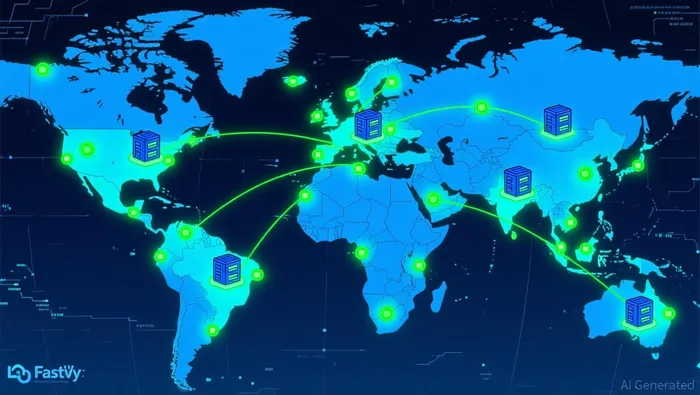
The most significant recent development for the cloud infrastructure space involves a major shift in global data strategy. Gartner recently predicted that 20% of current cloud workloads will migrate from global providers to local providers due to "geopatriation," driving sovereign cloud infrastructure spending to an estimated $80 billion in 2026, a 35.6% increase from 2025. This macro trend creates a potential tailwind for edge computing companies like FastlyFSLY--, which specialize in low-latency content delivery that local providers need. While other news items focused on unrelated sectors like Gartner's legal s or Versa Networks' awards, the $80 billion sovereign cloud forecast is the primary catalyst to watch for the sector.
Analyst Views: A Skeptical Consensus
The street remains cautious on Fastly, with a simple average rating score of 3.00 based on the activity of just one analyst, James Fish from Piper Sandler. The consensus rating is currently "Neutral," which aligns with the recent price decline. The performance-weighted rating is even lower at 0.00, reflecting Piper Sandler's poor historical track record with this name, where they have made 3 predictions with a 0.0% win rate and an average loss of -3.57%. There is no strong buy or sell consensus, leaving the stock in a holding pattern until fundamentals show clearer signs of life.
Fundamentals: A Struggling Balance Sheet
While the market looks for growth, Fastly's internal metrics paint a picture of a company still in the investment phase with significant headwinds. The company is reporting a negative Net profit margin of -23.52%, indicating that for every dollar of revenue, the company is losing roughly 24 cents. Return on Equity (ROE) is deeply negative at -11.16%, suggesting the company is not currently generating returns on shareholder capital. However, there are glimmers of operational efficiency: the Cost of sales ratio sits at 44.56%, which is relatively controlled, and Total profit showed a Year-over-Year growth rate of 15.64%, a positive sign that losses are narrowing even if profits remain elusive. Net cash flow from operating activities saw a massive 543.75% YoY growth, though this likely stems from a low base rather than massive cash generation.
Money-Flow Trends: Retail and Institutions Agree on Selling
The flow of capital into and out of Fastly is uniformly negative across all size categories, signaling a lack of institutional support. The Large inflow ratio is 0.48, the Medium inflow ratio is 0.48, and even the Extra-large inflow ratio is 0.49. When these ratios dip below 0.50, it indicates that selling pressure outweighs buying pressure. Specifically, the Small inflow ratio is 0.48, meaning retail investors are also net sellers. The block inflow ratio stands at 0.48, confirming that large block trades are not supporting the stock. This broad-based outflow suggests that no segment of the market is currently willing to accumulate shares at current levels.
Key Technical Signals: Bearish Patterns Dominate
The chart tells a clear story of weakness. The most prominent signal is the "MACD Death Cross," which occurred recently and is historically a biased bearish indicator with a 37.5% win rate and an average return of 3.79% when it appears. This is compounded by a "Dark Cloud Cover" pattern noted on April 6th, a classic reversal signal that often precedes further declines. While there was a "Long Lower Shadow" pattern appearing on April 1st and April 9th, suggesting some buyers are stepping in at lower levels, the overall trend is weak. The technical analysis shows 1 bearish indicator versus 0 bullish indicators, with the market direction remaining unclear but leaning heavily downward.
Trend-Based Trade Idea: Wait for the Sovereign Cloud Confirmation
What just happened? Gartner has forecasted a massive 35.6% jump in sovereign cloud infrastructure spending to $80 billion in 2026, driven by a predicted 20% shift of workloads to local providers. This news highlights the critical need for edge computing and low-latency delivery, which is Fastly's core business model.
Why it matters for this stock Fastly is uniquely positioned to benefit from the "geopatriation" trend if they can secure contracts with local cloud providers. However, the company's fundamentals (negative ROE and -23.52% net margin) and the current negative money flows (Large inflow ratio 0.48) suggest the market is not yet pricing in this opportunity. The recent MACD Death Cross confirms that technical momentum is currently working against the stock, creating a conflict between the long-term news narrative and short-term price action.
Our trade response Given the conflict between the positive long-term news and the negative short-term technicals, we advise a patient approach. Do not chase the stock on the news headline. Instead, wait for a confirmed technical reversal. Look for the price to stabilize and close above the recent resistance levels with a volume spike that pushes the Large inflow ratio above 0.55. If the stock breaks out with this volume, it would indicate that the "smart money" is finally ignoring the Death Cross to play the sovereign cloud narrative. Set a stop-loss below the recent low formed during the Dark Cloud Cover pattern.


What could go wrong? If the broader tech sector enters a risk-off mode, the sovereign cloud narrative may be ignored, and the negative fund flows could drive the stock to test lower support levels before any recovery.
Wrapping up
Fastly is currently a story of two opposing forces: a compelling long-term opportunity in the $80 billion sovereign cloud market versus a difficult reality of negative fundamentals and bearish technicals. Until the money flows turn positive and the technical indicators show a clear reversal, the prudent move is to hold cash and wait for the market to prove it believes in the new growth story.
Disclaimer: The content of this article solely reflects the author's opinion and does not represent the platform in any capacity. This article is not intended to serve as a reference for making investment decisions.
You may also like
Indonesia Retail Sales Surge Despite Global Energy Woes

TOWNSTRY Tests 0.135 Support After Midnight Volume Shock

Sydney Airport Chaos Hits Qantas, Virgin, Jetstar Revenue

Ryder Capital’s Edge: Buying Fear, Selling Greed in Australia’s Mispriced Small Caps

Trending news
MoreCrypto prices
More





